Mr Mamman’s case has brought renewed attention to how public officers’ conduct in office has deepened Nigeria’s long-running power crisis.
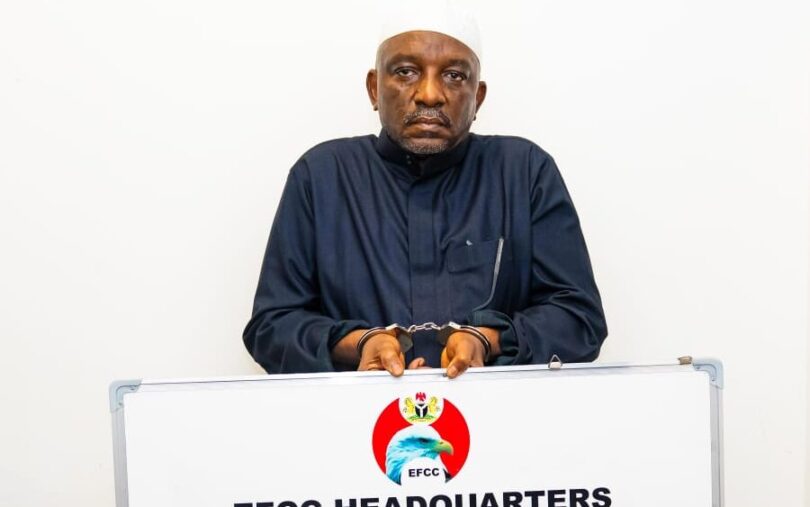
When the Economic and Financial Crimes Commission (EFCC) announced the re-arrest of the fleeing former Minister of Power Saleh Mamman in May, the news of capturing him after days of searching became less interesting than his picture accompanying the update.
On 7 May, the Federal High Court in Abuja convicted former Minister of Power, Saleh Mamman, of money laundering involving a whopping N33.8 billion meant for Nigeria’s electricity projects.
LETwelve days later, on 19 May, the court sentenced him to prison on each of the 12 charges brought against him by the EFCC.
He received seven years’ imprisonment for each of 10 counts, two years for one count and three years for another count. The sentences for all 12 counts, which the court ordered to run consecutively, summed up to 75 years in jail for the 68-year-old man.
His case has brought renewed attention to how corruption has derailed electricity reform promises under successive administrations, deepening Nigeria’s long-running power crisis. Nigerians continue to suffer acute power shortages despite huge public spending on the power sector over the years.
At the heart of Mr Mamman’s trial was the theft of funds meant for Mambilla and Zungeru hydropower schemes, conceived to contribute altogether nearly 4,000 megawatts to Nigeria’s electricity grid.
The construction of the Zungeru Hydroelectric Power Station, a 700 megawatt plant in Niger State, began in 2013 and is near completion. The $5.8 billion, 3,050 MW Mambilla Hydropower Project in Taraba State has remained stalled since it was conceived in the 1970s.
The EFCC preferred 12 money laundering charges against Mr Mamman under the Money Laundering (Prohibition) Act, 2011, accusing him of diverting billions of naira released for the Mambilla and Zungeru Hydroelectric Power Plant projects.
It charged him with diverting the funds in breach of public trust and splurging them on personal luxurious expenses, property acquisition in choice areas of Abuja.
The first count alleged that Mr Mamman conspired with some officials of the ministry of power and private companies to convert over N33.8 billion from the funds released for the power projects in 2019.
 Counts 2 to 8 revolve around the trail of the stolen money and how Mr Mamman lavished part of the stolen wealth on luxury and property acquisition in choice areas of Abuja.
In the third category of offences spread across Counts 9 to 12, the prosecution accused him of diverting millions of naira from the power project funds in criminal breach of trust at various times between January 2020 and December 2022.
The EFCC arraigned him in July 2024 on the 12 counts of money laundering. He denied the allegations.
On 12 July 2024, the court granted him N10 billion bail with two sureties.
During the trial, the EFCC called 17 witnesses and tendered about 43 exhibits through the lead prosecution lawyer, Rotimi Oyedepo, a Senior Advocate of Nigeria (SAN) who is the Director of Public Prosecutions for the Federation (DPPF). But Mr Mamman presented no defence witness to rebut the prosecution’s case.
PREMIUM TIMES has reviewed newly obtained filings, which the court examined to come to its judgement.
Together with previous reporting, the filings offer clearer understanding of the scope of Mr Mamman’s lavish spending on luxury and real estate at the expense of Nigeria’s critical power projects. This review highlights EFCC’s key revelations about the corrupt use of public funds and how Mr Mamman’s conviction struck a historic note.
The prosecution presented in several charges a trail of money stolen from the power projects funds and how it ended up as payment for a N200 million property for Mr Mamman.
The prosecution accused Mr Mamman of conspiring with one Samson Bitrus, procuring him, and aiding him to make the payment in cash without passing through a financial institution.
Then, another count alleged that Mr Bitrus paid for the property with $655,700 in cash to Mohiba Investment Limited to acquire the N200 million worth of property of Mr Mamman.
 As of when the parties closed the real estate deal in 2019, the prosecution said, the $655,700 paid was equivalent to N200 million, the agreed price of the property at No. 12 A & B, Lungi Street, Off Cairo Street, Wuse II, Abuja.
Mohammed Asheik Jidda, who represented the seller, Mohiba Investment Limited, in the transactions, appeared during Mr Mamman’s trial as the 14th prosecution witness.
Mr Jidda confirmed the cash transaction, which the EFCC alleged violated the provisions of the Money Laundering (Prohibition) Act, 2011, and the Foreign Exchange (Monitoring and Miscellaneous Provisions) Act prohibiting individuals from making cash payments above N5 million outside a financial institution.
The testimony of the 12th prosecution witness, Samson Bitrus, who is a real estate agent, shed light on the transactions.
Narrating his role in the deal, Mr Bitrus told the court that Mr Mamman, whom he said he knew through a business associate, Mustapha Dandaura, instructed him to search for a property. He said he found the property on Lungi Street and linked the former minister to the owner.
According to his account, after negotiations were concluded, he accompanied Mr Mamman to the office of the seller, where the dollar equivalent of the N200 million was physically counted. Mr Mamman and others involved witnessed the counting and that the title documents were subsequently handed to “Saleh Mamman and his friend Mohammed Hussein.”.
Mr Bitrus also said he later managed the property and that rent was paid into an account provided by the ex-minister belonging to Nasiru Mamman,.Prosecutors presented the receipt as evidence of continued financial benefit after the transaction.
The 13th prosecution witness, a Zenith Bank compliance officer, tendered account records of accounts that received rent proceeds from the property. According to the prosecution, the records showed inflows connected to the Lungi Street property and subsequent transfers to accounts associated with Mr Mamman and his relatives.
The property owner, Mohammed Asheik Jidda, also testified as the 14th prosecution witness, confirming that Mr Mammant visited his office and negotiated price. He said the then-minister paid for the property in dollar cash without routing the funds through a financial institution despite having bank accounts.