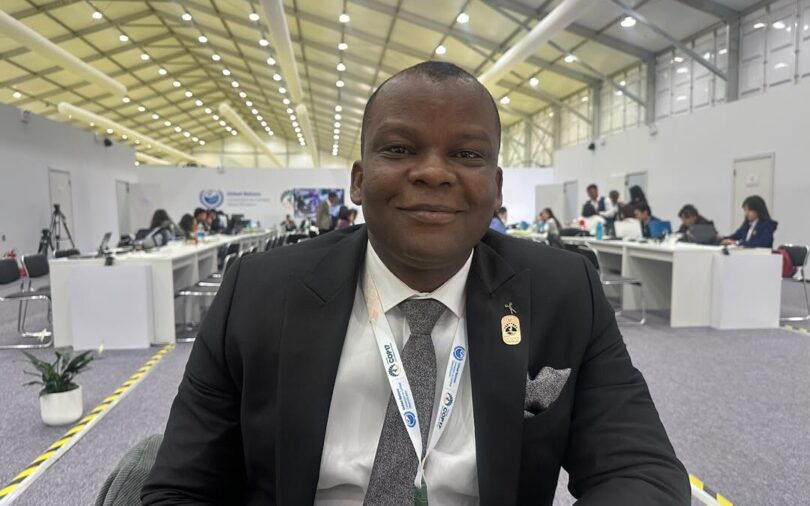
A member of the Cross River State House of Assembly, Martins Archadu, says his participation at the ongoing 17th session of the UNCCD COP17 in Mongolia has exposed gaps in Nigeria’s environmental policies and shown how stronger legislation could improve land restoration, biodiversity conservation and environmental management.
In this interview with PREMIUM TIMES on the sidelines of the ongoing 17th session of the United Nations Convention to Combat Desertification (UNCCD COP17) in Mongolia, Martins Archadu, a lawmaker at the Cross River State House of Assembly, who is the Chairman House Committee on Education; and Vice Chairman Committee on Environmental Matters, argued that COP17 has exposed major gaps in Nigeria’s environmental policies.
Excerpt:
Achadu: Yes, this is my first COP, and I am very impressed by the expositions here. I have done my best to participate in all the relevant sessions, particularly those concerning issues in my state.
I am from a rainforest zone in Nigeria, where we have massive rainfall. Because of that, we also experience a lot of flooding, erosion and landslides. So, I have consciously followed the sessions addressing those issues so that I can gain better insights into how to tackle them.
I have also followed sessions dealing with financing. I took time to have meetings and photo sessions with some very relevant personalities.
On the whole, Mongolia has been an experience for me. The people themselves are warm and welcoming, and the city is very neat.
Achadu: We have a lot of loopholes and setbacks in our legislation. I have learnt a lot from the experiences shared during the sessions because many of them are case studies from different countries. I paid particular attention to the policy aspect and found out that most of their successes are rooted in their policies. Let me give you an example. Under our mining system, the federal government has the authority to issue licences to mining companies to operate in communities. In that process, communities are given some level of authority through community agreements.
But I found the Indian case study particularly interesting, and I made sure I asked relevant questions during the session. In India, as in Nigeria, land is largely under government control. However, I found that the states participate in virtually every aspect of awarding or sending a company to undertake mining or agricultural activities.
When the central government decides to send an investor into a state for mining, agriculture or any other activity involving land, the state profiles that company. It looks at what kind of mining or agricultural activity the company wants to undertake and assesses it against the environmental policies of the state. If the project does not fit into the state’s environmental policies, the state has the liberty to say no. So, I asked them what happens when the central government has already approved a company and the state, after profiling it, says the project does not comply with its environmental policies. They told me that the state can say no and the project ends there.
It is not so in Nigeria.
Secondly, from their explanation, we understood that they participate not only in sending a company there but also in the ongoing monitoring. They carry out consistent evaluations to determine whether companies are complying with environmental requirements. I requested copies of their laws, which I have obtained and will go back to study. I have also made proposals for my own system. You cannot wish to have the result someone else is getting when you are not using the policies that produced that result. It is when you apply those policies that you can begin to hope for similar results. I see a big breakthrough for Cross River State and, of course, Nigeria in the days to come from our experiences here.
Achadu: Let me make it clear that the motivation comes from the kind of governor we have. If you see your boss thinking outside the box and doing extraordinary things, it motivates you to also do extraordinary things.
When we had the flooding situation and landslide in Calabar, I said this was the best time to attend COP. Coincidentally, the focus this year is on restoring life, restoring land and restoring hope. That speaks directly to the expectations of Cross River because the issues on the ground are about land loss from landslides, people being displaced, and the loss of investments. So, COP17 became the destination. I discussed it with His Excellency, and he said it was a good idea. So, I represented the legislature, while the Clerk of the House came as a technocrat of the Assembly.
It is a balanced team. On arrival here, we knew we were on assignment. For every session, we took notes because we have a boss we are going to report to and give details of how far we have gone. So, to answer the question directly, we were motivated to be here because we have seen how our governor is working. We decided to take the bull by the horns.
Achadu: Let me also address an issue. I think it depends on when you are talking about. Since the coming of this administration, we have been conscious of aligning with every environmental policy. I cannot speak for previous administrations or say whether there was extensive logging and other activities at that time. But under this government, His Excellency, Governor Bassey Otu, has been very conscious of ensuring that the state aligns with environmental policies that will protect the environment for posterity.
Achadu: The state is trying to revive the system and correct the wrongs of the past. I want to commend the governor for what he has done so far. Recently, he employed forest rangers massively to ensure that illegal activities in the forest are curtailed.
Achadu: Let me describe COP as a university. You cannot sit at home and wish to have an experience that you have not opened yourself to. Being here for the first time, I want to say we are late. If there had been consistent participation by a team from Cross River, and to the magnitude we have done this time, some of the losses we are suffering might have been avoided.
COP exposes you to what others are doing. Your attendance gives you corrective measures for the wrongs you are doing. It gives you hope and makes you see the potential of what you have been undermining. Coming to COP is an exposition. For me, there should be no COP, particularly one that contains biodiversity, land restoration and other critical matters affecting our region, that we should stay away from.
Achadu: There is no direct wrong I can point to, but I have seen what we can do better.
Achadu: One, we have to clearly review our environmental policies. If any of them is obsolete, we have to update it. Two, we have to examine our policies on biodiversity management and the administration of our biodiversity processes. We have to look at the relevant laws currently on the ground and see what we can do, policy-wise, to update them. But it is not just about having policies; it is about enforcing them. For instance, Cross River State has gorillas, and this is not being sufficiently highlighted.
I have to go back and look for a policy avenue that will compel the state to be more conscious of the fact that we have what people see as a heritage. It should become a major leverage for us to attract financial assistance and preserve those heritage sites and species in Cross River State so that they do not go extinct. As a state and as legislators, our job is policymaking. My experience at COP17 has sent me back to school. It means I have to go back and study so that I can be relevant to the House.
Achadu: Of course. Biodiversity loss is a global issue, so you have to examine the extent to which your own region is contributing to the losses. Cross River State owns a large share of the remaining rainforest in Africa, and we are very conscious of that. The elephants you mentioned are abundant in the Cross River forests. In fact, recently, they have even been moving into areas where humans live.
Achadu: That is where we need not only legislation but also effective management. People need to understand that if these elephants are preserved, they can be protected through alternative livelihoods. Instead of people going into hunting, you divert their attention to other livelihoods.Secondly, we need to make the policy. Killing an animal is as serious as killing a human being when you consider the fact that these are endangered species. If they are not valued and protected, an ordinary hunter can kill them. But if people understand that it is a serious crime to kill these animals, nobody will want to do it. Even if elephants are eating people’s crops, we should create avenues for affected communities to make claims and receive appropriate support rather than resorting to killing them.
Achadu: Before I answer that directly, let me tell you what I will do when I leave here. On getting back home, I will hold seminars with relevant stakeholders, including the commissioners for environment, water resources and agriculture. I need to transfer my experience to them and point them in the direction the world is moving.
To respond directly to your question on wooing investors, we met with a lot of investors and partners. Most of what they told us is that, after evaluating your issues, whatever investment they make has to be aligned with national interests. Investors or partners coming in can hardly just enter a sub-region and begin to invest without acknowledging or passing through the national priorities.
We met here with the Minister of Environment. He was very warm and welcoming. We presented our paper to him, took pictures, and he assured us that he would follow it up. He mentioned the NEWMAP project, which is also covering parts of our state. I told him that although NEWMAP has been there, the issue that brought us here is not just the old erosion sites.
The current erosion situation has expanded, and the fingers of erosion have opened up to such an extent that the existing funding may no longer cover the current level of damage. We need additional intervention. He accepted that, and we assured him that even if our governor had to personally engage him, he would visit Calabar. We also met with the World Bank Country Director and many other stakeholders, and all of them were very positive.
No one hears the story of Cross River without expressing sympathy. But it all boils down to national interest. If the nation makes it a priority, it will be picked up. While here, we did not only emphasise land loss and erosion. We also took advantage of the opportunity to meet investors in the agricultural and water sectors. It is all very promising. We have their contacts, and when we return home, we will sit down and initiate formal discussions with them. The engagement will build from there.
Achadu: I may not be in the perfect position to respond to how funding has been so far, but I would rather encourage every system to make the environment a priority. For my state, I can only speak for my state. The governor, so far, is getting it right, and that is a big motivation for us. As for Nigeria as a country, you can see that the minister came here. That tells you that the environment sector is also in focus. By God’s grace, with the right funding, appropriate budgetary provisions and releases, we will not be in a state where environmental challenges overwhelm us.