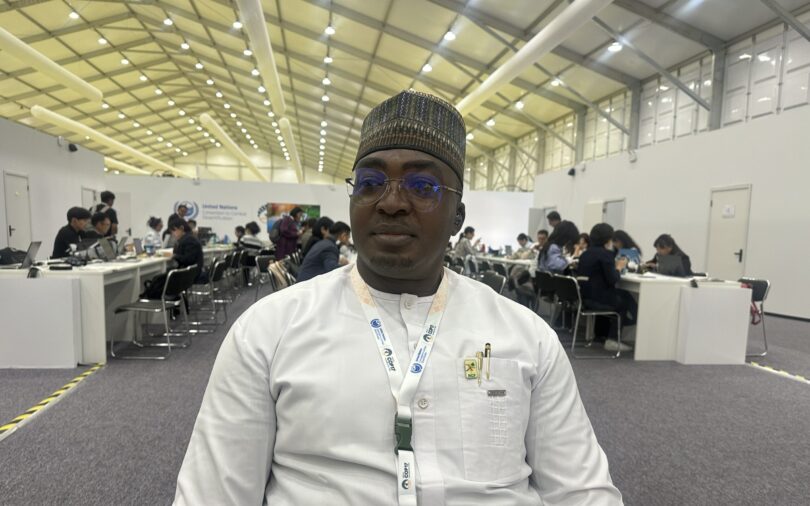
In this interview, the NCF Director General discussed NCF’s Green Recovery Nigeria initiative and Nigeria’s prospects of accessing the $1.3 billion financing announced at COP17 in Ulaanbaatar, Mongolia.
Joseph Onoja, Director-General of the Nigerian Conservation Foundation (NCF), speaks on Nigeria’s worsening land degradation, the financing gap in environmental protection and the need for greater synergy among the three major UN environmental conventions.
Excerpt:
Onoja: One of the things we are interested in at NCF, and one of the reasons we are here at COP17, is to further our objectives while working very closely with the Nigerian government, especially the Federal Ministry of Environment. One of our flagship projects is Green Recovery Nigeria. It is an ambitious project through which we hope to galvanise efforts towards restoring Nigeria’s degraded landscapes, particularly the forest landscape. What we are seeing is that our landscape is being degraded. Sometimes, people erroneously think that when you talk about the UN Convention to Combat Desertification, you are only talking about deserts. It goes beyond deserts.
It also concerns forests and other landscapes because we are talking about land degradation. Nigeria has also committed to Land Degradation Neutrality (LDN). When you make that commitment, you have to ensure that your lands maintain the quality that supports livelihoods, agriculture, biodiversity and climate action. So, whether you are talking about the desert, savannah or forest, you need quality land across the landscape. That is why, as NCF, one of the things we have pledged to do is to galvanise efforts towards restoring Nigeria’s landscapes, particularly through Green Recovery Nigeria.
Onoja: Most of these finances are normally pledged to governments. So, as NCF, being a technical partner of the government, what we can do is help the government prepare bankable projects that can access these funds. There are different mechanisms and avenues through which the government can make that happen. That is domiciled with the Federal Government, through the Federal Ministry of Environment and the relevant department responsible for land management. Whatever funding we want to access through the UNCCD has to go through that process, although there are some other funding opportunities that organisations and NGOs can access directly. Platforms such as this conference provide an avenue for like-minded people to come together and interact.
When you talk about finance, pledges will be made, but most of those pledges go to governments. However, these platforms also provide opportunities to create bilateral engagements with funding organisations willing to fund NGOs, local communities and indigenous peoples who are doing the actual work on the ground. That is where we come in as NCF. But it is not just about finance. It is about the project. What are you going to use the finance for? I think that is the first step. You have to prepare yourself to be able to access these funds because the finance is available. The question is: what are you going to use it for?
That is why, as NCF, we developed Green Recovery Nigeria. It is all-encompassing. By restoring our landscape, you promote biodiversity, climate action and other environmental objectives. It also serves as a nature-based solution to issues such as biodiversity loss and the effects of climate change.
Onoja: I think that is a question for the government to answer. All we can do is pledge our support to the government. As a technical partner, we can provide technical expertise in preparing bankable projects, identifying needs and identifying areas where interventions can take place. We can work together with the government to prepare these documents and make sure that the government positions itself to access these funds.
Onoja: Nigeria has different ecotones and habitats. We have everything from the mangrove ecosystem all the way to the desert. We now have desertification advancing in parts of Nigeria. Areas that used to be Sahel savannah are increasingly experiencing desertification. We also have significant forest degradation. Nigeria is one of the countries with a very high rate of deforestation, and when that happens, it definitely contributes to land degradation. When you expose the land by removing the vegetation that provides land cover, you expose it to erosion.
Once erosion removes the productive topsoil, the land can no longer perform the ecosystem services it is supposed to provide. Nigeria is also a mining country, and there is a lot of illegal mining. When mining takes place without proper environmental management, it contributes to land degradation. Even grazing, under certain circumstances, can contribute to land degradation.
All of these factors need to be put into context. When we look at the problem from the perspective of land degradation, we can better manage our land. That is why I like the fact that the relevant government department is focused on land management. It is very important for us to manage our land properly. I usually say that nature has been put in place to support us, but we have to support nature for nature to continue playing its role in supporting us. If we do not support nature, nature will lose its ability to support us, even though nature itself will continue to exist.
Onoja: No, we are not doing enough. As a country, we need to do more. There is much more to be done. Nigeria is a very big and diverse country, so regardless of what we do, there is always room to do more. If you look at different landscapes, particularly some of the frontline states in the north, you will understand why initiatives such as the Great Green Wall are important. Fortunately, we have the Great Green Wall Agency in Nigeria, and the agency is playing a role in creating that green belt to stop the southward advancement of the desert. That shows political will to address the problem.
Onoja: I must state that the Federal Ministry of Environment is one of the poorest-funded ministries. It is not funded as it should be. If you look at it properly, the Federal Ministry of Environment should be one of the most funded ministries because its mandate provides the foundation upon which many other sectors depend. If you don’t have a healthy environment, you don’t have a healthy country.
No matter what you do, you cannot perform well without a healthy environment. Some of the conflicts we are experiencing in Nigeria are environmentally driven. Take farmer-herder clashes, for instance. Forget the conspiracy theories and look at the root cause. One of the drivers is migration, and land degradation contributes to that migration. When land becomes degraded in one area, people and livestock may have to move to another area. But the destination is not a vacuum. People already live there.
Usually, the movement is not systematic. There may not be enough time for dialogue, resource-sharing arrangements or other discussions before the movement occurs. That can lead to conflict because the available resources have to be shared. That is why I am saying that the Federal Ministry of Environment needs to be funded much more than it currently is. If you fund the Ministry of Environment properly, it provides the platform for good agriculture, food security and economic development. It can also help ensure that mining activities are properly managed and that we know where to mine and how to do so sustainably. The environment is the bedrock on which all these other things thrive.
Onoja: For us at NCF, one of the things we are trying to achieve is greater synergy among the three major environmental conventions: the UN Framework Convention on Climate Change (UNFCCC), the Convention on Biological Diversity (CBD), and the UN Convention to Combat Desertification (UNCCD). The objectives of these conventions should not negatively affect one another because they are all interconnected. When you talk about land degradation, you find it within the UNCCD agenda.
You also find its implications in biodiversity and climate change. As an organisation, we want to see greater cohesion among these three conventions. We have discussed this at the climate change COP, and we will continue the conversation at the biodiversity COP before returning to the climate and land-related negotiations. It is a continuous conversation that we need to have at the country level as well, to ensure that whatever we are doing does not undermine the objectives of another convention.
We also hope to create partnerships with like-minded organisations and identify opportunities where funding can come from. There are funding organisations whose objectives align with the work we want to do in Nigeria and which could provide the necessary support. So, whatever we are able to achieve here can also, by extension, support the Nigerian government, even though I am not its spokesperson.
Onoja: Thank you.