The Osun State Government allocated billions of naira to the health sector, awarded contracts for primary healthcare revitalisation and reported progress in improving rural health services. But a PREMIUM TIMES investigation across three primary healthcare centres found that challenges remain
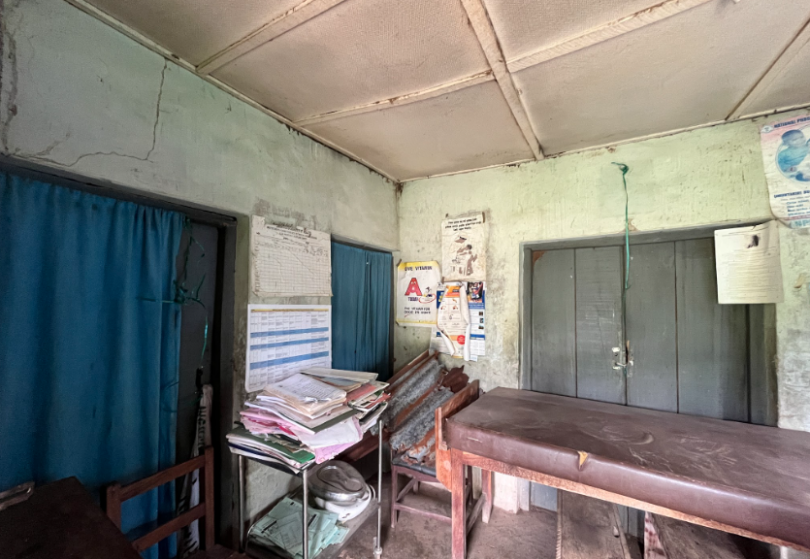
The overgrown grasses are the first sign of neglect at Agbinpa Primary Healthcare Centre in Ede South Local Government Area of Osun State. They cover parts of the compound, brushing against walls with peeling paint and deep cracks. Sections of the facility have become unusable, while others have fallen into disrepair after years without major rehabilitation.
Getting to the facility was difficult. It took this reporter about an hour on a commercial motorcycle from Osogbo to Agbinpa, travelling along long stretches of uneven rural roads.
It was in late May, and Rashidat Lamidi was attending to patients. For years, she has run the health centre as its sole caregiver and administrator. Mrs Lamidi attends to pregnant women, children, and other patients, responds to emergency calls even after leaving work, clears the surroundings and, at times, buys basic consumables when they are out of stock.
“Even if I’m at home and somebody comes to call me because a child is sick or a woman wants to give birth, I will come,” she said.
Mrs Lamidi said the state government pays her salary regularly. But it does not extend the same attention to the facility, despite many politicians and government officials visiting over the years, particularly during election periods.
“They come here, but they don’t do anything.”
The impact of the deteriorating infrastructure extends beyond the building itself.
Because the facility has no functional laboratory, patients who need basic blood tests have to travel about 26 kilometres to Ede. Although a few delivery instruments were available during PREMIUM TIMES’ visit, they were inadequate for the number of patients the facility serves. Women in labour buy gloves for the nurse and buy methylated spirit and other consumables before receiving care.
As the only official, Mrs Lamidi is concerned about the health centre’s future after her retirement.
“I don’t know what will happen to this place,” she said.
The poor condition of the PHC has not diminished its importance for the residents of Agbinpa. It has only made healthcare harder to access and more expensive.
Iya Beji, a woman who gave birth to each of her five children at the facility, praised the commitment of the lone nurse.
“The nurse is good. It is only because of the condition of the hospital that people do not come here,” she said.
According to the woman, patients who need scans are referred to Ede, where transport alone costs about N6,000.
“If someone is sick, what can we do? We have to go.”
Abdulrahaman Babatunde, another resident, said commercial motorcycles rarely use the route because of its condition.
“If you hire a bike, it can cost N6,000,” he said. “If the rider waits for you, they charge as much as N10,000.”
Mr Babatunde said farmers also suffer when taking produce to nearby markets, limiting economic activity in the community.
Electricity is another challenge for the locals. Private operators of solar charging points charge between N400 and N700 to charge their phones or power banks.
“There has been no light here for a long time,” Mr Babatunde said. “The poles and wires are still there, but there is no electricity.”
About an hour’s ride from Osogbo, Abudo PHC in Egbedore LGA presents a different, but equally troubling picture.
Here, the biggest obstacle to healthcare begins long before patients reach the facility.
The road to the community is so bad that commercial motorcyclists avoid it. When this reporter arrived around 1 p.m., the facility was locked.
Through dusty louvre windows, patient registers and other documents could be seen scattered across the rooms. Cobwebs hung from parts of the building, suggesting some sections had remained unused for some time.
No health worker was on the premises. Instead, telephone numbers had been written on a wall for anyone who needed them to call.
This reporter dialled the numbers repeatedly, but the calls either failed to connect or the phones were switched off.
Chief Alao, a community leader, said Abudo’s PHC serves the community as well as several neighbouring settlements.
He said years of poor road infrastructure have isolated the area, affecting access to healthcare and residents’ livelihoods.
“This road was not constructed by the government,” he said. “The community did it ourselves, although there are still many potholes.”