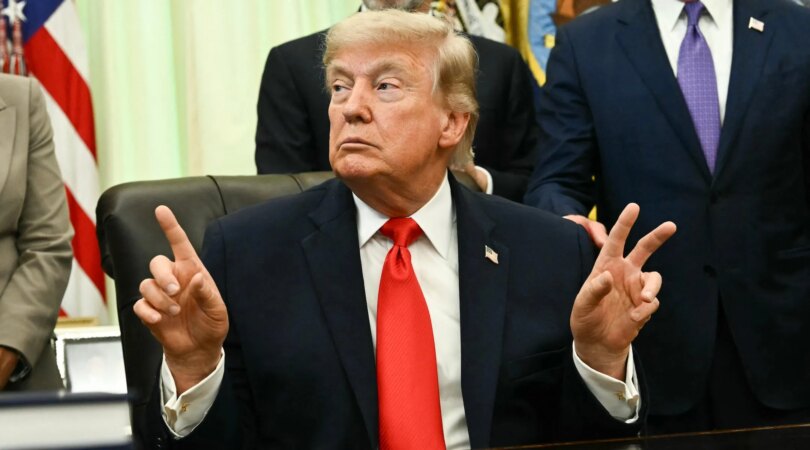
Iran has secured sweeping sanctions relief while retaining its ballistic missile programme and stockpile of enriched uranium under a new ceasefire agreement signed by U.S. President Donald Trump and Iranian President Masoud Pezeshkian, bringing an end to months of conflict between the two countries.
The interim agreement, released on Wednesday by both governments, extends an existing ceasefire by 60 days and paves the way for negotiations on a permanent truce after a war that killed more than 7,000 people, disrupted global energy markets and heightened fears of a wider regional conflict.
The deal marks a significant shift from several of Trump’s stated war objectives. Despite earlier vows to dismantle Iran’s missile programme and remove its stockpile of enriched uranium, Tehran emerged from the negotiations with both largely intact.
Under the agreement, the United States will lift sanctions on Iran, unfreeze billions of dollars in Iranian assets and support a $300 billion reconstruction fund aimed at rebuilding infrastructure damaged during the conflict.
Iran, in turn, reaffirmed its longstanding pledge not to pursue nuclear weapons and agreed to the supervised down-blending of its enriched uranium stockpile under the oversight of the International Atomic Energy Agency (IAEA). However, Tehran rejected U.S. demands that the uranium be transferred out of the country.
The agreement also provides for the full reopening of maritime traffic through the Strait of Hormuz, a critical global oil transit route, and the lifting of restrictions on Iranian ports.
Despite signing the ceasefire, Trump issued stern warnings that military action could resume if Iran violates any part of the deal.
“We’re going to bomb the hell out of them if they violate the agreement,” Trump told reporters during the G7 summit in France.
The U.S. president nevertheless expressed optimism that the accord could usher in a broader peace across the Middle East and help stabilise global energy markets.
In another notable departure from his previous position, Trump appeared to soften his stance on Iran’s ballistic missile programme.
Earlier in the conflict, he had vowed to destroy Iran’s missile capabilities. But speaking after the signing of the agreement, Trump suggested it would be unfair to deny Iran missiles if other countries possess similar weapons.
“I’m saying that if other countries have them, it’s a little bit unfair for them not to have some,” he said.
Iranian officials celebrated the agreement as a diplomatic victory, arguing that negotiations had delivered more benefits than military confrontation.
“Everything we sought to achieve through military action, we obtained several times over through negotiation,” Iran’s lead negotiator, Mohammad Qalibaf, said in remarks broadcast on state television.
The war began on February 28 when the United States and Israel launched coordinated attacks on Iran, targeting senior military figures and key installations. The conflict quickly expanded across the region, drawing in allied groups and intensifying hostilities in Lebanon.
Although the ceasefire agreement includes provisions aimed at ending violence in Lebanon, clashes between Israeli forces and Hezbollah fighters continued to be reported on Wednesday.
Global markets reacted positively to the deal, with oil prices initially falling on expectations that the Strait of Hormuz would remain open and regional tensions would ease. Prices later recovered some losses after Trump’s warnings of renewed military action.
World leaders attending the G7 summit welcomed the agreement, describing it as a major step toward restoring stability in the Middle East. However, questions remain over whether the temporary truce can evolve into a lasting settlement, particularly as disagreements persist over Iran’s nuclear activities, missile programme and regional influence.
For now, the agreement appears to have delivered substantial economic relief to Tehran while leaving key elements of its strategic capabilities untouched — an outcome likely to fuel debate in Washington and among U.S. allies over whether the war achieved its original objectives.