The 86-year-old said political actors continued to exploit ethnic divisions in the oil-rich region for control of resources.
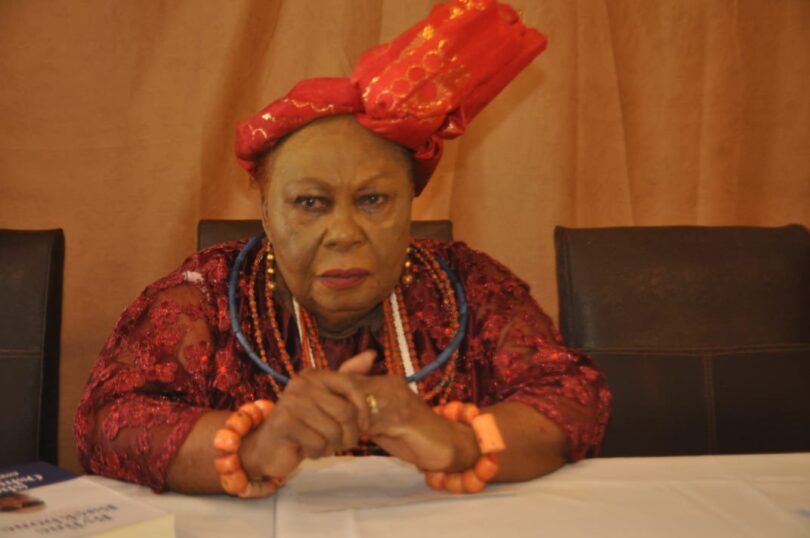
Prominent Itsekiri leader, businesswoman and philanthropist, Rita Ogbebor, has called for the federal government’s intervention over rising tensions in the Warri axis of Delta State, warning of the possibility of renewed violence in the area if the situation was not urgently addressed.
“You may say the word genocide is harsh, but it is true. It is a fact,” she stated. “There is a looming genocide against the Itsekiri, and Nigerians must know that the Itsekiri are being battered.”
Mrs Ogbebor noted that her concerns followed recent public activities by Ijaw and Urhobo groups, which she said amounted to mobilisation against the Itsekiri.
She referenced separate press conferences reportedly held by the groups, where they called on their members across the world to unite over the Warri issue.
“What is this fight? It is only when you understand the history that you can solve the problem,” she said.
Mrs Ogbebor warned that failure to resolve the issues could lead to renewed conflict in the Niger Delta.
“Nigeria will wake up one morning and the whole area will be in flames,” she said. “And then it will not be the Itsekiri alone; it will be a war.”
She called on the federal government to intervene and ensure protection for the Itsekiri people amid rising tensions in the region.
At the time of filing this report, INEC and the Urhobo ethnic group had not commented on the allegations. .
She said the Itsekiri had historically welcomed other ethnic groups into Warri, describing the area as a melting point for migration and settlement.
The Itsekiri leader linked the current situation to the violent ethnic crisis that affected Warri between 1997 and 2003, which she said was driven by political decisions over local government structures and resource control.
“For eight years they fought us. What is at stake is the oil money,” she said. “Every politician wants to control that area because of the oil wells in our land.”
Mrs Ogbebor maintained that the Itsekiri are the original owners of Warri and insisted that several court judgements had settled parts of the dispute in their favour.
“There is a judgement that says everybody in Warri except the Itsekiri is a settler,” she said.
She also faulted past decisions on local government administration in the area, including the relocation of the Warri South-West Local Government headquarters, which she said had never been properly resolved at the federal level.
The Itsekiri leader renewed her call for the creation of Warri State, arguing that it would provide political protection and stability for her people.
“We want Warri State. We were a nation on our own,” she noted. “Warri is viable and meets the conditions for state creation.”
Her comments come amid continued tension over the Independent National Electoral Commission (INEC) ward and polling unit delineation exercise in Warri Federal Constituency.
The exercise follows a 2022 Supreme Court judgement ordering INEC to redraw electoral wards and polling units in Warri South, Warri South-West and Warri North.
Since then, the process has triggered competing claims among Itsekiri, Ijaw and Urhobo groups over representation and electoral boundaries.
In September 2025, Ijaw and Urhobo groups protested at INEC headquarters in Abuja, demanding the immediate implementation of the court order and warning that delays could affect voter participation ahead of the 2027 elections.
In February 2026, Urhobo representatives again protested, urging INEC to release its final report and alleging that earlier proposals did not fairly reflect their population.
Responding at the time, INEC National Commissioner Abdullahi Zuru said the matter remained under consideration and disclosed that the commission was consulting the Office of the National Security Adviser over the dispute.
More recently, Itsekiri groups also protested at the commission’s headquarters, rejecting aspects of the delineation exercise and alleging marginalisation in the allocation of wards and polling units.
The protest was the third by Itsekiri groups at INEC this year.
INEC has yet to conclude the implementation of the delineation exercise as continuous voter registration continues nationwide.
The dispute has deepened tensions among the three ethnic groups, with stakeholders divided over the commission’s handling of the Supreme Court directive.
While Ijaw and Urhobo groups have pushed for immediate implementation of the report, Itsekiri groups continue to reject parts of the exercise.