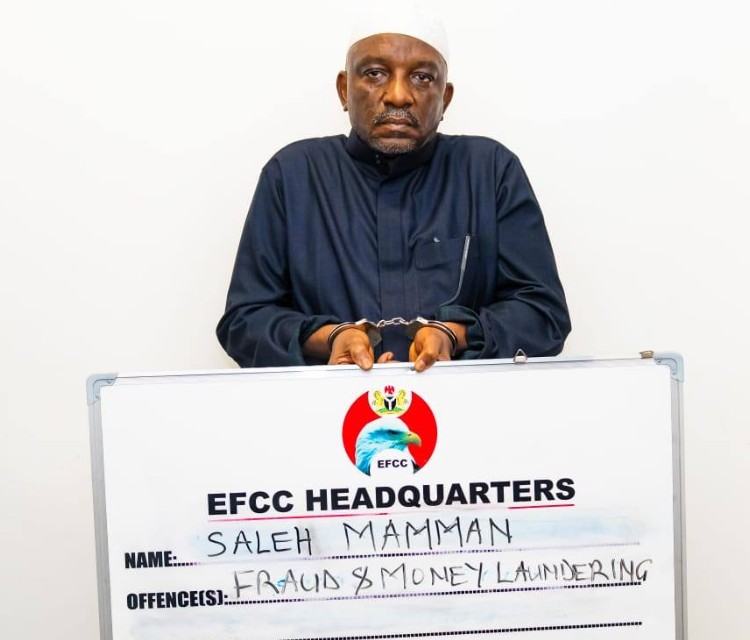
The Economic and Financial Crimes Commission (EFCC) says it has arrested former minister of power, Saleh Mamman, who recently went missing after being convicted.
Ola Olukoyede, chairman of the commission, said Mamman was arrested in Rigasa, Kaduna State, at about 3:30 a.m. on Tuesday.
On May 7, Mamman was convicted on all 12 counts filed against him by the EFCC and sentenced in absentia to 75 years in prison.
He received seven-year jail terms on 10 counts, while counts four and five attracted prison terms of three years and two years respectively.
James Omotosho, the presiding judge, ruled that the sentences should run consecutively and without the option of a fine, except for count four, which carries an option of a N10 million fine.
The court also ordered the forfeiture of foreign currencies recovered from the former minister, as well as four high-value properties in Abuja traced to him.
Omotosho further directed all security agencies to work with Interpol to ensure Mamman’s arrest, adding that his prison term would begin from the date of his arrest.
“I’m happy to announce to Nigerians that at about 3:30 a.m. this morning, we arrested Mr Saleh Mamman somewhere in Rigasa, Kaduna State,” Olukoyede told journalists at the EFCC headquarters.
“This is a test of the commitment of the federal government of Nigeria to the fight against corruption and to assure Nigerians that anyone who has pilfered national resources will not go unpunished.
“The eagle eye of the Economic and Financial Crimes Commission will always catch up with you wherever you are hiding.”
Olukoyede confirmed that Mamman is currently in EFCC custody and said two other persons found with him were also arrested.
“We discovered that he was actually being protected all this while,” he said.
“At the location where we effected the arrest, we apprehended two other Nigerians who were with him inside the property. The owners of the property are also under investigation because it is a crime to harbour or protect a convict.”