The latest intervention builds on previous programmes by the administration in 2025.
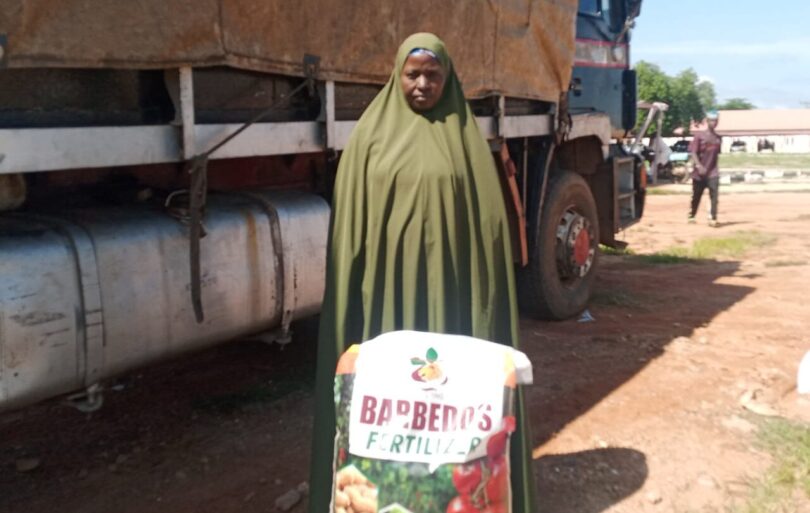
Women farmers in Kaduna State are among the key beneficiaries of the state government’s latest free fertiliser distribution, as the Governor Uba Sani administration seeks to reduce production costs and strengthen the capacity of smallholder farmers.
Speaking to PREMIUM TIMES Hausa at the Babban Dodo fertiliser redemption centre in Zaria Local Government Area, the Supervisory Councillor for Agriculture and Forestry, Nuhu Dogara-Malami, said the programme marked the third consecutive year of the administration’s fertiliser intervention.
He said the government was placing particular emphasis on women and young farmers, noting that rising farm input costs had made it increasingly difficult for smallholder farmers to maintain or expand production.
According to him, the intervention is intended to protect farmers against rising costs, prevent a reduction in cultivated farmland and ultimately contribute to food security.
Dogara-Malami said the fertiliser would be distributed across all 23 local government areas through a system designed to reach farmers in both urban and rural communities.
He said 10 farmers would be selected from each polling unit, with each beneficiary receiving two bags of fertiliser.
He added that the government had adopted a new distribution formula to ensure that women and young farmers were adequately represented among the beneficiaries.
“In Zaria Local Government, we created three distribution centres — Babban Dodo, Galma, and Tukur-Tukur — to ensure that farmers in both villages and urban areas benefit from the intervention,” he said.
The latest intervention builds on previous programmes by the administration.
In 2025, the government distributed 400 truckloads of free fertiliser to 100,000 smallholder farmers, with each beneficiary receiving two bags.
In 2024, the government distributed more than 500 truckloads of fertiliser alongside other agricultural inputs.
The focus on women is significant in a state where agriculture is a major source of livelihood.
Kaduna’s Agricultural Development Agency estimates that the state has about 1.3 million farming households, while agriculture accounts for about 38 per cent of the state’s GDP.
Women are deeply involved in crop production, livestock, processing and marketing, but they often face greater difficulty accessing land, credit, extension services, and farm inputs.
Kaduna State’s Women’s Economic Empowerment Policy notes that only 4.7 per cent of women in the state independently own agricultural land, while 92.7 per cent do not own land at all.
The policy also identifies limited access to productive resources as a major constraint to women’s participation in agriculture.
Studies of women farmers in Kaduna have similarly identified high input costs, inadequate capital, limited extension services and gender-related barriers as challenges affecting their productivity.
For women who operate small farms or cultivate food crops around their homes, access to fertiliser can make a direct difference to output levels and the income they can generate for their households.
At the Babban Dodo centre, some beneficiaries said the intervention came at a time when affording the cost of inputs had become increasingly difficult for smallholder farmers.
Amina Suleiman, who farms maize, rice, and beans, thanked the state government for including women in the programme.
She said it was the first time she had benefited from a government agricultural intervention.
Masa’uda Aliyu said that receiving the support made her feel that her efforts as a farmer were being recognised.
She expressed hope that similar interventions would continue, saying they could help lift smallholder farmers out of poverty.
Hadiza Ibrahim, who grows tomatoes in her backyard while her husband, Ibrahim Sani, cultivates maize, said the fertiliser would benefit both of them.
“I use the fertiliser for my tomatoes, while my husband will also use it on his maize farm,” she said.
Bashir Baban-Kwanbo, who cultivates maize on a small plot of land near his home, also thanked the government and appealed for the programme’s continuation.
In Sabon Gari Local Government Area, the vice chairman, Abdulkareem Kamilu, thanked the state government for supporting smallholder farmers.
He urged beneficiaries who received text messages notifying them of the intervention to visit the designated centres and collect their fertiliser, stressing that the inputs were free and no payment was required.
Husaina Musa, a beneficiary from Dogarawa, expressed appreciation for the support and prayed that the government would continue assisting poor farmers.