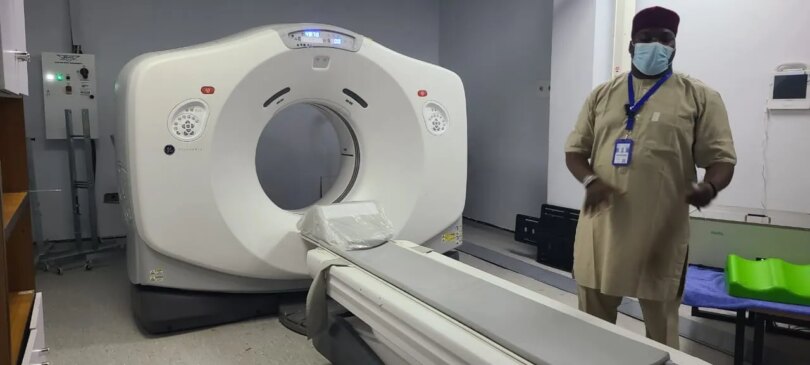
The Kano Cancer Treatment Centre has commenced advanced cancer care with the introduction of 3D high-dose-rate, HDR brachytherapy services, marking a major milestone in oncology treatment in Northern Nigeria.
DAILY NIGERIAN reports that the new therapy system represents a significant step toward improving access to modern cancer care in the region.
The facility, unveiled on Friday in Kano, is expected to enhance treatment outcomes and ease the burden on patients who previously had to travel long distances to complete their therapy.
Speaking at the launch, the Chief Executive Officer and Administrator of the centre, Dr. Nafisa Abdu, described brachytherapy as a specialised form of radiation therapy that delivers targeted doses directly to cancerous tissues.
“We invited you today to witness the commencement of brachytherapy services at the Kano Cancer Treatment Centre,” she said.
“We are very proud of this milestone because this is the first 3D HDR brachytherapy system in Northern Nigeria.
“In simple terms, brachytherapy is a focused radiation treatment that complements external radiotherapy,” she added.
Ms Abdu noted that the service would play a crucial role in treating cervical cancer, one of the most common cancers affecting women in the region.
Addressing concerns about affordability, Mrs Abdu said, “Cancer treatment is generally expensive due to the cost of equipment, manpower and safety requirements involved, but we are committed to making it as accessible as possible.”
She stressed that having such a centre in Kano would significantly reduce indirect costs for patients.
“Patients can now access treatment close to home without worrying about travel, accommodation and other expenses associated with seeking care elsewhere,” she said.
On safety and precision, medical physicist, Abbas Umar Farouk, explained that the centre uses advanced 3D planning systems to ensure accurate treatment delivery.
“Our role is to ensure quality assurance throughout the treatment process—from patient care to equipment performance and staff safety,” he said.
“We use CT simulation and 3D planning to precisely target tumours while protecting healthy organs.”
Also speaking, a radiation oncologist at the centre, Dr. Aminu Ladan, emphasised the importance of completing the full radiation dose required to effectively control cancer.
“Before now, patients had to travel far after completing external beam radiation to access brachytherapy. Now, once we finish the external treatment, patients can immediately proceed with brachytherapy here,” he said.
“This ensures they receive the full dose needed for effective treatment.”
He added that cervical cancer patients typically undergo three to four sessions over a period of about two weeks.
Mr Farouk added that the facility is equipped with reinforced radiation shielding to ensure the safety of both patients and staff.
In his remarks, lead radiation therapist, Peter Emana, highlighted the centre’s advanced technology, including multiple functional linear accelerators and modern techniques such as image-guided radiotherapy.
“This allows us to see precisely where we are treating, reducing side effects and improving recovery,” he said.
He explained that brachytherapy is particularly effective for cancers located near sensitive organs.
“For example, in cervical cancer, the bladder and rectum are very close to the tumour. Brachytherapy allows us to deliver radiation directly into the tumour while minimising damage to surrounding tissues,” he said.