…Gives Broadcaster 48 Hours To Apologise, Retract False Corruption Claims
…Petitions IGP, DSS Over Alleged Plot To Endanger His Life
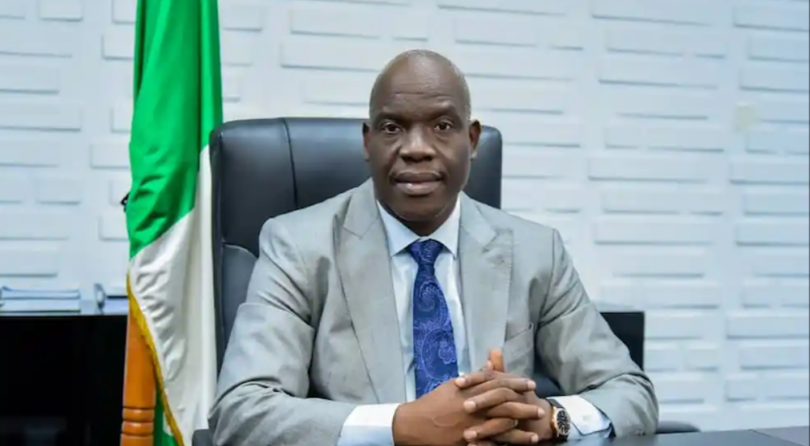
Former Commission Chief Executive of the Nigerian Upstream Petroleum Regulatory Commission (NUPRC), Mr. Gbenga Komolafe, has threatened to institute a N10bn libel suit against Voice of the People Television (VOP TV) over what he described as a false, malicious and defamatory broadcast alleging that N5tn and $1.4bn went missing under his watch.
VOP TV is a Nigerian media platform co-founded by prominent broadcaster Rufai Oseni, managed by General Manager Precious Enyi, and headquartered in Lagos.
Komolafe, through his solicitors, Ojukwu Chikaosolu & Co., issued a pre-action notice demanding an immediate public retraction of the allegations, an unreserved written apology and the removal of the offending broadcast from all digital and social media platforms.
The legal team also gave the broadcaster 48 hours to retract the statements and 72 hours to tender a written apology, warning that failure to comply would leave their client with no option but to commence legal proceedings seeking ₦10bn in damages and other reliefs.
The demands were contained in a letter titled “Demand for Immediate Retraction, Written Apology and Cease-and-Desist in Respect of False, Scandalous and Defamatory Publications Made Against Our Client, Mr. Gbenga Komolafe, FNSE.”
According to the solicitors, the defamatory remarks were made during a programme aired by the television station in which one Barrister Darlington Agomou, described as the station’s in-house legal analyst, allegedly made several damaging statements concerning Komolafe.
The lawyers alleged that during the programme, Agomou claimed that after a forensic examination of Komolafe’s department, ₦5tn and $1.4bn were discovered to be missing and suggested that despite the alleged findings, the former NUPRC chief was allowed to leave office without being held accountable.
Specifically, Agomou alleged, “Gbenga Komolafe of the oil sector, After forensic examination of his department, N5tn and $1.4bn dollars was discovered to be missing. What are you supposed to do if you are actually looking for money? But he was asked to go away with that money.
“Meanwhile, you now turn around oh, to go and borrow $568m to go and do Badagry-Sokoto highway. Meanwhile, somebody went away with $1.4bn dollars. Please, where is the sense in all these things? Where is the wisdom in all these things? Tell me.”
The legal team argued that, in their natural and ordinary meaning, the statements portrayed Komolafe as a corrupt public official who diverted public funds running into trillions of naira and billions of dollars.
According to the solicitors, the broadcast left the impression that their client “corruptly diverted, stole, looted and personally absconded” with the funds allegedly mentioned during the programme.
However, they insisted that the allegations were entirely false, reckless and unsupported by any credible evidence.
“Our client has never been indicted by any investigative agency, never been charged before any court of law, and has never been convicted of any offence involving corruption, fraud, theft, embezzlement, financial misconduct or abuse of office,” the lawyers stated.
The solicitors described Komolafe as a respected legal practitioner, petroleum engineer and career public servant who served Nigeria meritoriously in different capacities, including at the Nigerian National Petroleum Corporation (NNPC) before becoming the pioneer Commission Chief Executive of the NUPRC.
They further highlighted his professional achievements, noting that he had earned several local and international honours during his career, including a Professional Doctorate in Leadership (Energy Law) and the Global Sustainable Leadership Award conferred at the Global Sustainable Education and Leadership Conference held at the House of Lords, Palace of Westminster, United Kingdom.
According to the lawyers, throughout his years in public service, Komolafe discharged his responsibilities with integrity, professionalism and dedication and had never been associated with corruption or financial impropriety.
They stated that after completing his tenure in public office, he returned to private life and had continued to enjoy an impeccable reputation built over decades of distinguished service.
The legal practitioners accused the television station of failing to exercise basic journalistic responsibility before airing the allegations.
They argued that the broadcaster neither verified the claims nor sought documentary evidence to support such serious accusations before transmitting them to viewers across the country and beyond.
The lawyers also faulted the station for failing to contact Komolafe to obtain his reaction before airing the programme.
According to them, the failure to provide their client an opportunity to respond before broadcasting the allegations amounted to a breach of established principles of responsible journalism and media ethics.
The letter further accused the broadcaster of violating provisions of the Nigeria Broadcasting Code.
Specifically, the solicitors cited Paragraph 3.3.1(a), which requires broadcast content to be accurate and credible.
They argued that the programme presented the allegations as statements of fact despite the absence of any forensic report, investigative findings, judicial pronouncement or official indictment linking Komolafe to the alleged missing funds.
They also referenced Paragraph 3.3.1(b), which requires fairness by ensuring that all sides to an issue are presented, preferably within the same programme.
According to the lawyers, the broadcaster failed to contact Komolafe before the programme was aired and denied him the opportunity to present his own side of the story.
The solicitors equally cited Paragraph 3.3.1(c), which guarantees a right of reply to any individual with a genuine claim of misrepresentation.
They argued that rather than providing such an opportunity, the broadcaster continued to make the programme available on various online platforms, thereby worsening the damage allegedly caused to their client’s reputation.
The legal team further cited Paragraph 3.3.1(e), which requires broadcasters to ensure compliance with extant laws relating to libel.
According to them, the publication was prima facie defamatory because it exposed Komolafe to public hatred, ridicule, contempt and lowered him in the estimation of right-thinking members of society.
The lawyers maintained that the allegations had caused significant reputational damage.
They stated that since the programme was aired, Komolafe had received numerous telephone calls, text messages and enquiries from professional colleagues, associates, family members, friends and members of the international community seeking clarification regarding the allegations.
According to them, the broadcast had undermined a reputation painstakingly built over several decades of distinguished public service.