Lagos State continues to grapple with widespread flooding despite spending more than N106.6bn on drainage construction, dredging and rehabilitation projects between 2025 and the first quarter of 2026, an analysis of official budget implementation reports by NEWSNGR has shown.
The findings come as heavy rainfall that swept across the state on Sunday submerged major roads, stranded commuters, disrupted businesses and reignited public criticism over the government’s flood control efforts despite sustained investments in drainage infrastructure.
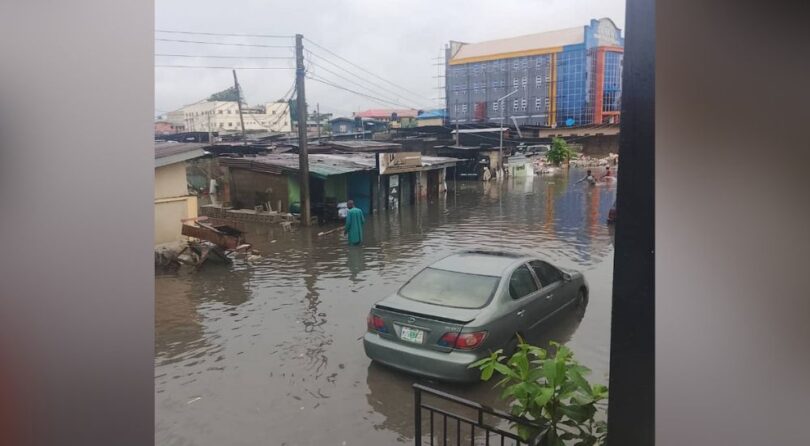
The downpour, which lasted several hours, left large sections of Gbagada, Iyana Ipaja, Ikorodu Road, Ikeja, Maryland, Mushin, Ogudu, Lekki, Oshodi, Agege, Alimosho and Obalende underwater, forcing many residents to abandon their journeys as commercial transport operators suspended services due to rising floodwaters.
Several motorists were also forced to abandon their vehicles after they developed faults while attempting to navigate flooded roads.
The flooding also affected sections of the Lagos-Ibadan Expressway, Lagos-Abeokuta Expressway, Apapa-Oshodi Expressway and Lekki-Epe Expressway, worsening traffic congestion across the state.
In Gbagada, traffic was brought to a standstill as floodwaters inundated major roads, leaving several vehicles damaged.
A resident, Oge Obi, said the flooding prevented her from attending church.
“The rain started in the morning. Our street is currently flooded, and we are all indoors. Only those with bigger vehicles can pass through the flood for now,” she said.
Another resident, identified simply as James, said his vehicle developed mechanical problems after he drove through flooded roads from Ikeja to Ajah.
The latest incident comes nearly a year after severe flooding caused by heavy rainfall in July 2025 forced the Lagos State Government to apologise to residents and commuters.
That flooding affected several communities, including Eredo, Bojije, Epe, Sangotedo, Ibeju-Lekki, Awoyaya, Labora, Abijo, Iyana-Oworo, Agege, Ijegun-Isheri Osun and Gbagada. It also disrupted traffic and contributed to the collapse of a two-storey building in Mushin.
At the time, residents accused the government of failing to adequately prepare for perennial flooding despite Lagos’ status as a coastal city.
However, the Commissioner for Environment and Water Resources, Tokunbo Wahab, attributed the flooding to natural factors rather than deficiencies in government planning.
An analysis of the Lagos State Budget Implementation Reports for the fourth quarter of 2025 and the first quarter of 2026 shows that the state committed about N106.59bn to flood control and drainage infrastructure under multiple capital projects aimed at improving stormwater management.
The largest expenditure was recorded under the Drainage Construction and Dredging Statewide project, where N48.63bn was spent out of a revised budget of N59.26bn, representing an implementation rate of 82.1 per cent.
The state also spent N13.90bn on rehabilitating drainage infrastructure across local government areas, achieving 55.1 per cent of the revised allocation of N25.22bn.
Another N13.38bn was expended on the Dredging and Construction of Drainages Across the State project, representing 73.9 per cent of its revised budget of N18.10bn.
In addition, Lagos paid N24.69bn towards outstanding liabilities for drainage construction projects, accounting for 74.1 per cent of the revised allocation of N33.32bn.
Combined, the four drainage-related projects accounted for approximately N100.59bn in spending during 2025.
The investment continued in 2026, with the first-quarter budget implementation report showing an additional N6bn spent on drainage construction and dredging projects.
The report indicated that N27.15bn was budgeted for the projects in 2026, with the first-quarter expenditure representing 22.1 per cent of the allocation, leaving N21.15bn available for the remainder of the fiscal year.
While the latest budget reports show that the Lagos State Government has maintained significant investments in drainage construction, rehabilitation and dredging to improve flood resilience and protect critical infrastructure, the recurring flooding across the state continues to raise questions about the effectiveness of the interventions as residents count the cost of each heavy rainfall.
The Nigerian Meteorological Agency (NiMet) had earlier forecast that 2026 would witness above-normal rainfall, with Lagos expected to be among the hardest-hit states due to its coastal geography and low-lying terrain.
Responding to an X user who suggested banning roadside trading, Wahab said the flooding being experienced was not peculiar to Lagos State, noting that similar incidents had been recorded in other states across the federation.
He appealed to Lagos residents to play their part by refraining from indiscriminate waste disposal, illegal dumping and other activities that obstruct the free flow of stormwater.
“As a government, we have continued to intensify efforts to mitigate the impact of flooding through the clearing of drainage channels, enforcement against illegal developments obstructing waterways, and other proactive interventions. At the same time, we appeal to all Lagosians to play their part by refraining from indiscriminate waste disposal, illegal dumping, and other activities that obstruct the free flow of stormwater,” Wahab said on Sunday.