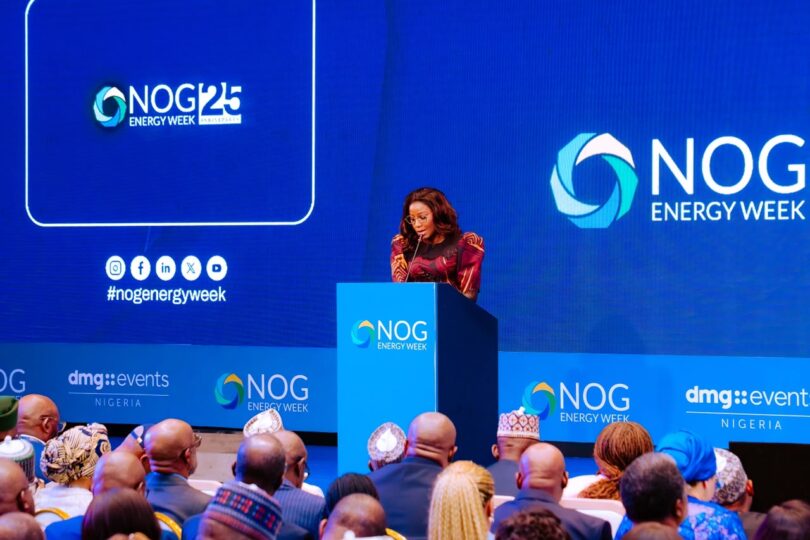
For twenty-five years, NOG Energy Week has been one of the rooms where Nigeria tells the truth about energy: what we have promised, what we have postponed, what we have delivered, and what we must now become.
This year’s theme speaks of ambition, competitiveness and resilience. I want to add a fourth word: proof.
Because in this season — when records are being tested, reforms are being debated, and the future of our economy is being contested — Nigeria does not need louder promises. Nigeria needs proof that courage works. Proof that discipline works. Proof that when government does what it says, capital responds, production rises, and national confidence returns.
Let us begin with the world as it is, not as we wish it to be.
The global energy map has changed. Capital is no longer sentimental. It is not moved by speeches, slogans or sympathy. Capital has no passport. It is rational. It prices risk. It follows credibility. It asks one question: can this country turn resources into bankable projects, and bankable projects into reliable returns?
For Africa, that question is urgent. And for Nigeria, the scale of the task is equally clear: to sustain the current base and grow toward our 2030 production target, analysis shows a financing gap of about US$38.3 billion. That gap cannot be closed by rhetoric, and it cannot be closed by Nigeria alone. And that capital — from Lagos, Johannesburg, London, Houston, Abu Dhabi or Beijing — is asking for the same thing: credible rules, bankable projects, competitive costs, predictable regulation and disciplined execution. That is a warning — and an opportunity.
So, the competition is no longer only geology against geology. It is government against government. It is rules against rules. It is delivery against delay.
And Nigeria has made a choice.
We have chosen not to be a warehouse of raw potential. We have chosen to become an engine of African industrialisation. We have chosen not merely to produce molecules, but to convert molecules into megawatts, fertiliser, petrochemicals, mobility, manufacturing, jobs and exports.
That is the real energy transition for Africa. Not transition as surrender. Transition as transformation.
Under the leadership of President Bola Ahmed Tinubu, this administration has done what many said was too difficult, too risky, too controversial, or too politically expensive. We began to remove the distortions that punished production and rewarded leakage. We took on reforms that had been discussed for years and delayed for decades.
We recalibrated fiscal terms, clarified regulation and streamlined oversight. We introduced targeted incentives and cut contracting timelines by more than half. And we made a clear statement to the world: Nigeria is no longer asking to be trusted; Nigeria is working to be bankable.
The results are not abstract.
We are targeting three million barrels per day and ten billion standard cubic feet of gas per day by the end of the decade. We now have more than 50 billion dollars of upstream projects in the visible pipeline. In the last three years, more than 10 billion dollars of long-awaited final investment decisions have come through.
Crude oil and condensate production has risen by about 400,000 barrels per day since 2023. Onshore production is at its strongest level in twenty years. Nigeria’s share of Africa’s upstream FIDs has risen dramatically — from the margins to leadership. External reserves have crossed 50 billion dollars. These are not talking points. They are signals. When the rules improve, capital moves.
And we are not only fixing oil and gas. We are resetting power.
For too long, the electricity market carried the weight of unpaid obligations, broken incentives and weak confidence. That is why the Presidential Power Sector Financial Reforms Programme is not merely a bond issue; it is a ₦4 trillion credibility programme. It is a negotiated reset of legacy obligations, payment discipline and market confidence across the generation, gas and financing chain.
It says to GenCos: produce with confidence. It says to gas suppliers: supply with confidence. It says to lenders and investors: Nigeria is rebuilding the bankability of the power value chain. And it says to Nigerians: the objective is not accounting elegance in Abuja; it is more reliable power for factories, SMEs, agro-processing, mining and homes.