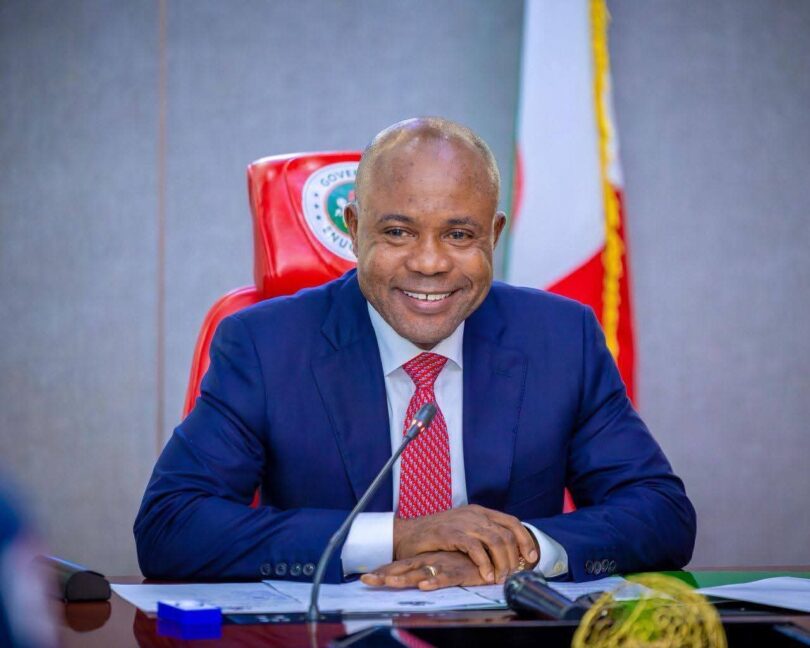
In less than three years in office, Peter Ndubuisi Mbah has fundamentally altered the trajectory of governance in Enugu in a manner that has not only surpassed the accomplishments of previous governments but has also redefined what leadership should look like in modern Nigeria.
Since the creation of Enugu State in 1991, successive administrations have contributed in varying degrees to the growth of the state. Some laid institutional foundations, others executed important projects, while a few attempted reforms within the limitations of their era. Yet, in less than three years in office, Peter Ndubuisi Mbah has fundamentally altered the trajectory of governance in Enugu in a manner that has not only surpassed the accomplishments of previous governments but has also redefined what leadership should look like in modern Nigeria.
At the centre of this revolution is Governor Mbah’s audacious commitment to grow Enugu’s economy from approximately $4.4 billion to $30 billion within eight years. In a country where political manifestos are often abandoned immediately after elections, Mbah has treated his manifesto as a binding governance document.
Every ministry, every policy, and every project under his administration reflects a disciplined alignment with that vision. Unlike previous administrations that focused primarily on routine governance and urban cosmetic projects, the current government has embraced disruptive innovation as the engine of development.
The result is that Enugu is no longer merely functioning as a state capital struggling with basic infrastructure deficits; it is rapidly emerging as a regional economic powerhouse with global ambitions.
Perhaps nowhere is this transformation more evident than in infrastructure development. Previous governors built roads, but Peter Mbah has industrialized road construction. In less than two years, over 1,000 kilometers of roads have either been completed, rehabilitated, or initiated across urban and rural communities. Entire neglected rural belts that were once economically isolated are now being linked to commercial centers through modern road networks.
Critical corridors such as the Owo–Ubahu–Amankanu–Umuakor–Ikem road are not just transportation projects; they are economic arteries connecting Enugu to regional trade routes across the North and beyond. While past administrations often concentrated development within the capital city, Mbah’s infrastructure strategy penetrates deeply into rural communities, thereby democratizing development in a manner never before witnessed in the state.
The comparison becomes even more striking in the education sector. No administration in the history of Enugu State has invested in education with the intensity and futuristic imagination of Peter Mbah. While previous governments largely focused on conventional classroom construction and teacher recruitment, Mbah has completely redesigned the philosophy of public education.
The construction of 260 Smart Green Schools across all political wards is arguably one of the most ambitious educational projects in Africa today. These are not ordinary schools; they are technology-driven learning ecosystems equipped with robotics laboratories, AI hubs, digital classrooms, mechatronics facilities, and renewable energy systems.
By exposing children as young as three years old to robotics and augmented reality, the administration is preparing a generation that can compete globally in the digital economy. The allocation of over 30 percent of the state budget to education consecutively in 2024 and 2025 not only surpasses UNESCO benchmarks but also represents the highest educational investment ratio in Nigeria today. No previous governor in Enugu has ever pursued education as an economic weapon for global competitiveness on this scale.
Healthcare under Mbah has equally experienced a revolutionary transformation. Before his administration, access to quality healthcare in rural communities remained largely inadequate, forcing citizens to rely on overcrowded urban facilities or poorly equipped local centers. Today, the construction and commissioning of 260 Type-2 Primary Healthcare Centres across all political wards has fundamentally decentralized healthcare delivery. Beyond the grassroots, the ongoing construction of the 300-bed Enugu International Hospital represents a direct challenge to the culture of medical tourism that has drained billions from Nigeria’s economy annually.
The recruitment of 2,500 health workers, implementation of 100 percent CONHESS for medical personnel, digitization of patient records, and establishment of a 24-hour ambulance system reveal a government that understands healthcare as both a social necessity and an economic asset. Unlike earlier administrations that merely managed the health sector, Mbah is rebuilding it from its foundations.
Water supply, one of the most persistent failures of successive governments in Enugu State, has perhaps become the clearest evidence of Mbah’s “talk and do” leadership style. For over two decades, residents of Enugu endured dry taps and failed promises from multiple administrations. Yet within 180 days of assuming office, Peter Mbah restored pipe-borne water to Enugu metropolis exactly as promised.
By rehabilitating the Ajali and Oji River water schemes and commissioning the Ninth Mile 24/7 Water Scheme, water production surged from a negligible 2 million liters per day to about 120 million liters daily. This was not just a technical achievement; it was a political statement that governance could once again become credible. Previous administrations attempted temporary fixes, but Mbah delivered a structural solution to a problem many had come to accept as permanent.
The economic management of the state under Mbah has been equally extraordinary. Historically, Enugu relied heavily on federal allocations with limited internally generated revenue. However, through aggressive reforms, automation of tax systems, and institutional transparency, the state’s IGR skyrocketed from N37.4 billion to N144.7 billion within a remarkably short period. Such growth is unprecedented in the state’s history and has provided the fiscal backbone for massive capital projects.
Unlike previous administrations where budgets were often constrained by weak revenue generation, Mbah has created a financially assertive state capable of funding ambitious development without crippling dependence on Abuja. The implementation of Treasury Single Account systems, Enterprise Resource Planning technology, and citizens’ engagement frameworks has institutionalized transparency in ways never previously achieved.
Perhaps the most visionary element of Mbah’s governance philosophy is the New Enugu City project. While previous governments focused largely on expanding the existing city structure, Mbah is building an entirely new economic ecosystem.
Spread across 10,000 hectares, the New Enugu City is envisioned as a smart urban hub with modern infrastructure, industrial parks, digital connectivity, and integrated residential systems. It is a deliberate attempt to position Enugu as a global investment destination rather than merely a regional administrative center. This bold urban vision distinguishes Mbah from his predecessors, many of whom governed within the limitations of existing structures rather than imagining entirely new possibilities for the future.
The transport revolution under his administration further reflects this futuristic thinking. The launch of Enugu Air immediately elevated the state into an elite category of subnational governments with strategic aviation ambitions. Combined with the development of ultramodern transport terminals at Holy Ghost, Abakpa, Garriki, and Nsukka, alongside the deployment of CNG-powered buses, the state is gradually evolving into a modern mobility ecosystem. Previous governments struggled mainly with traffic management and basic road maintenance, but Mbah is reimagining transportation as an integrated economic driver capable of stimulating trade, tourism, and investment.
Agriculture under previous administrations often remained trapped within subsistence frameworks. Peter Mbah has shifted the paradigm entirely toward industrial-scale agribusiness. Through the establishment of Smart Farm Estates, mechanization partnerships, revitalization of dormant agro-industrial assets, and partnerships worth over N140 billion, agriculture is being repositioned as a core pillar of economic diversification. The state’s strategy now integrates technology, processing, exports, and youth empowerment in ways that move agriculture beyond survival into wealth creation.
The tourism sector, once largely dormant despite Enugu’s rich heritage, is also witnessing a historic revival. The restoration of Hotel Presidential and Nike Lake Resort, completion of the massive Enugu International Conference Centre, and development of a Nollywood hub collectively signal the emergence of a new creative economy. Previous governments acknowledged tourism potential rhetorically, but Mbah is converting those potentials into tangible economic infrastructure capable of attracting international conferences, filmmakers, investors, and tourists.
What ultimately separates Peter Mbah from every previous governor of Enugu State is the scale of intentionality behind his governance. Past administrations often governed within the limitations of monthly allocations and political cycles. Mbah governs with the mindset of a global economic strategist. Every sector under his administration is interconnected within a larger framework aimed at industrialization, private sector expansion, technological advancement, and human capital development.
Roads are linked to agriculture. Education is connected to digital innovation. Healthcare is tied to economic productivity. Tourism is positioned as revenue generation. Energy reforms are designed to unlock industrialization. Governance itself has become data-driven, measurable, and aggressively performance-oriented.
Critics may debate politics, but the physical evidence across Enugu State is becoming impossible to ignore. From urban centers to remote communities, there is a palpable sense that the state is undergoing its most comprehensive transformation since its creation.
The conversation in Enugu today is no longer about managing decline or enduring stagnation; it is about expansion, growth, innovation, and global competitiveness. This psychological transformation alone may be one of the administration’s greatest achievements.
The 2027 election, therefore, will not merely be another political contest. It will represent a referendum on whether Enugu should continue on its current trajectory of disruptive development or return to the slower, incremental patterns of the past. History shows that transformational societies are not built through abandoned visions or interrupted reforms.
They are built through continuity, consolidation, and sustained leadership. The foundations currently being laid across infrastructure, education, healthcare, energy, technology, industry, and human capital require continuity to fully mature into the economic renaissance already taking shape.
For many observers, Peter Mbah is no longer simply governing Enugu State; he is redesigning its future. And if the pace, scale, and strategic depth of his achievements within less than two years are anything to judge by, then 2027 may present the people of Enugu with a clear and historic choice: to consolidate a revolution already in motion or risk slowing down what is rapidly becoming one of the most ambitious subnational transformations in contemporary Nigeria.
* Dr Collins Ogbu is the Senior Special Assistant to the Governor of Enugu State on Strategic Communications