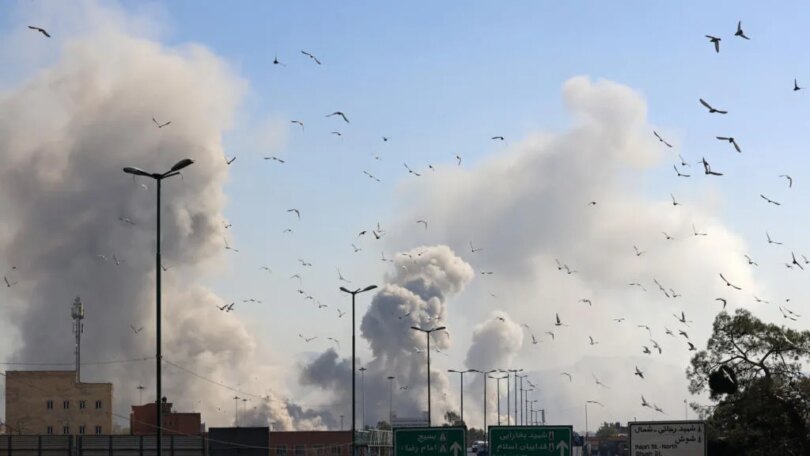
The ongoing crisis in the Middle East could reduce economic growth across African countries by up to 0.2 per cent, a new joint policy report has revealed.
The African Development Bank Group (AfDB) said this in a statement released on its website on Friday.
The report, presented in Washington, D.C., was jointly produced by the African Union Commission(AUC), AfDB, United Nations Economic Commission for Africa(ECA) and United Nations Development Programme(UNDP).
Titled “Impacts of the Conflict in the Middle East on African Economies,” the report warned that Africa’s fragile recovery from global shocks could be undermined by the conflict.
It noted that African economies were still recovering from the effects of the COVID-19 pandemic, the Russia–Ukraine war and rising global trade tensions.
The report was presented by Mr Kevin Urama, Chief Economist and Vice President for Economic Governance at the AfDB, on the sidelines of the IMF and World Bank Spring Meetings.
Urama highlighted the strategic importance of the Strait of Hormuz, noting that its closure had significant implications for global transport and trade.
According to him, the crisis has triggered rising prices of hydrocarbons, food and fertilisers, while disrupting global supply chains and increasing volatility in capital and foreign exchange markets.
Mr Claver Gatete, Executive Secretary of the ECA, said Africa remained highly exposed to developments in the region.
“Eighty per cent of the oil imported into Africa comes from this region, as well as 50 per cent of refined petroleum,” he said.
Gatete added that about 31 African countries were already experiencing currency depreciation as a result of the shocks.
Ms Francisca Belobe of the African Union Commission said the report underscored Africa’s resilience in the face of global crises.
To mitigate the impact, the report urged African governments to adopt prudent fiscal and monetary policies, including strategic inflation management and strengthened debt monitoring.
It cautioned against broad-based subsidies that could worsen fiscal deficits, while recommending targeted social protection measures to support vulnerable populations.
The report also called for diversification of energy sources, food systems and industrial inputs to reduce dependence on external markets.
It further urged African countries to strengthen intra-African trade, particularly in oil and fertiliser markets, to enhance economic resilience.
Development partners and multilateral institutions were also urged to provide emergency support through crisis response financing and technical assistance.
The report emphasised the need to fast-track implementation of the African Continental Free Trade Area(AfCFTA) to boost regional trade and economic integration.
It also highlighted the importance of accelerating reforms under the New African Financial Architecture for Development initiative.
The United Nations Deputy Secretary-General, Amina Mohammed, called for collective action to safeguard development gains across the continent.
“We must work to ensure that the Sustainable Development Goals and Agenda 2063 are achieved,” she said.
Also speaking, Marie-Laure Akin-Olugbagde of the AfDB stressed the need for coordinated global responses to the crisis.
“There is a need for global coordination, as no country or institution can face these shocks alone,” she said.
Similarly, Ms Ahunna Eziakonwa of UNDP, urged African countries to pursue energy independence and invest in innovation and digital technologies.
“The shocks affect us deeply, and we have no choice but to be resilient,” she said.
The report presentation was followed by a panel discussion where stakeholders examined its findings and proposed additional policy responses.
NAN