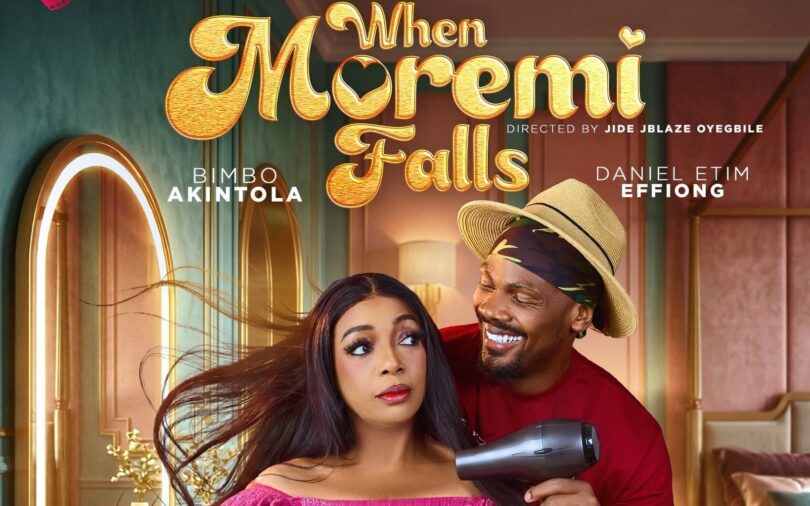
The film reflects Nollywood’s growing shift toward intimate, character-driven storytelling for digital audiences.
What happens when a woman who has built her life on control meets a man she cannot control, and, more unsettlingly, cannot ignore? That is the gripping question at the centre of ‘When Moremi Falls’ (2026), a romantic drama directed by Jide Oyegbile and produced by Stan Nze.
Anchored by commanding performances from Bimbo Akintola and Daniel Etim Effiong, When Moremi Falls delivers a thoughtful, character-driven take on love, power, and emotional surrender in modern Nigeria.
Moremi Bello (Bimbo Akintola) is a formidable businesswoman whose wealth, influence, and emotional detachment make her nearly untouchable. Scarred by a past betrayal, she has long reduced relationships to transactions, carefully curated, financially compensated, and easily discarded. Love, to her, is a liability she cannot afford.
Then she meets Osas (Daniel Etim Effiong). A skilled hairstylist with quiet confidence and unshakable principles, Osas disrupts Moremi’s carefully ordered life most unexpectedly: he refuses her. He cannot be bought, impressed, or controlled. What begins as a curious encounter gradually deepens into a connection neither of them fully understands, one that unsettles Moremi and forces her to confront the emotional walls she has spent years perfecting.
 As their relationship unfolds, Moremi’s control begins to slip, replaced by doubt, desire, and a vulnerability she neither trusts nor recognises. But just as she edges toward something real, the past she thought she had mastered resurfaces, threatening to undo everything. Can love survive in a space built on power, or must one give way for the other to exist?
Akintola’s performance as Moremi is the film’s backbone. With a career spanning decades, she brings a level of gravitas that elevates the material. Her Moremi is not softened for audience sympathy; she is allowed to be difficult, guarded, even unlikable at times.
Yet beneath the surface, Akintola reveals flickers of vulnerability through moments of hesitation, silence, and internal conflict, making the character’s evolution feel earned. The audience can resonate while staying dazzled. The audience can see the soft lady behind the hard skin.
 Effiong, on the other hand, delivers one of his more restrained performances. Known for his polished on-screen presence, he embodies a man whose strength lies in quiet conviction, despite portrayals of similar roles. His Osas is neither saviour nor subordinate, a balance that prevents the narrative from slipping into cliché.
The chemistry between the two actors is subtle but effective, relying more on dialogue and emotional tension than on overt romance. Supporting performances, including Fadekemi Olorunlolaye, provide levity and context, though some characters feel underwritten, a likely consequence of the film’s modest runtime.
At first glance, When Moremi Falls looks like another Nollywood love story. But as the narrative progresses, it becomes more daring, raising the bar for subsequent flicks of similar genres.
The film challenges how power works in relationships. By placing a dominant, emotionally guarded woman at the centre, it flips familiar gender expectations. Moremi, played by Bimbo Akintola, is in control, financially, emotionally, and socially, while Osas, portrayed by Daniel Etim Effiong, refuses to play along. That tension gives the story its edge. This is not the typical Nollywood romance where love “happens”; here, it must confront pride, fear, and deeply rooted habits.
In many ways, the film is less about romance and more about the vulnerability ‘what it costs to open up when you’ve spent years protecting yourself?’ Some viewers may see this as a refreshing take on female autonomy, while others may question how believable it feels. Either way, it sparks conversation, which is part of its strength.
Visually, the film keeps things simple. Set mostly in sleek offices, salons, and upscale homes, it reflects the class divide between its characters without trying too hard to impress. There are no grand multiple subplots. It is just clean, straightforward storytelling. While this works for the film’s intimate tone, it can occasionally feel too safe.
Where ‘When Moremi Falls’ truly stands out is in its dialogue and performances. Conversations feel natural, almost lived-in, and the emotional shifts happen gradually rather than through forced drama. The film trusts its actors to carry the story, and they do. Still, the pacing dips slightly in the second half, where some subplots, especially around family, feel underdeveloped. This is both a strength and a weakness. It keeps the film grounded, but also leaves parts of the story feeling a bit too contained. And while it avoids the usual romantic clichés, its overall direction remains somewhat predictable.
Even so, when Moremi Falls succeeds where it matters most, it is sincere, well-acted, and emotionally aware without being overwhelming.
‘When Moremi Falls’ may not redefine Nollywood romance, but it raises the bar and gives a fresh perspective to Nollywood love stories.
For viewers who prefer character-driven stories over spectacle, this is a film worth sitting with. Because sometimes, the most powerful love stories are not the loudest but the ones that unfold gently, and stay with you long after the credits roll.
‘When Moremi Falls’ is showing on Love Story Media’s YouTube channel