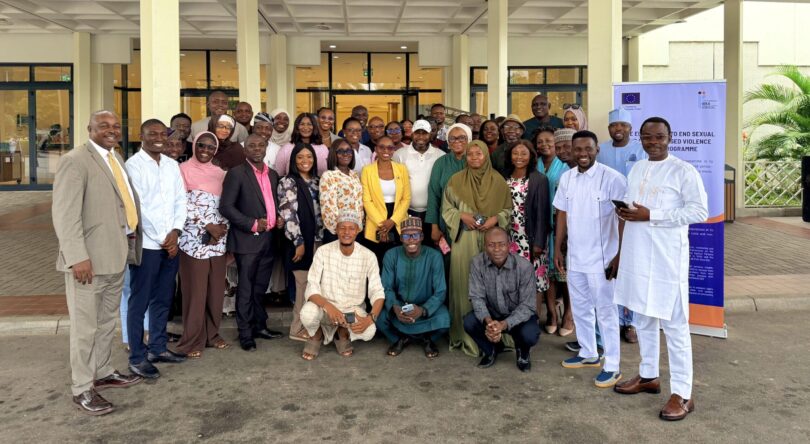
NAPTIP disclosed that 21 per cent of Nigerian women aged 15 to 49 have experienced physical or sexual violence.
The National Agency for the Prohibition of Trafficking in Persons (NAPTIP) has raised concern over the high rate of unreported sexual and gender-based violence (SGBV) in Nigeria, saying 58 per cent of survivors do not seek help or report their experiences.
The figures were presented during a two-day SGBV Media Corps Workshop organised by NAPTIP with support from the European Union Support to End Sexual and Gender-Based Violence (ESGBV) Programme, implemented by the International Institute for Democracy and Electoral Assistance (International IDEA).
The workshop also marked the launch of the SGBV Media Corps, an initiative designed to strengthen the capacity of journalists to report cases of sexual and gender-based violence more ethically, accurately and responsibly.
The programme targets the Federal Capital Territory (FCT) and Benue, Kaduna and Oyo states, with a focus on improving public engagement, strengthening community-based communication and promoting access to reliable information on SGBV prevention and response.
The initiative seeks to move media coverage of SGBV away from sensationalism and fragmented reporting towards survivor-centred, evidence-based and action-oriented journalism.
It also seeks to strengthen referral pathways for survivors and support efforts to challenge social norms and behaviours that contribute to violence against women and girls.
Speaking during the workshop, Toyin Adewale-Gabriel, one of the facilitators, said the 21 per cent prevalence rate demonstrated the scale of violence against women in Nigeria.
She said the fact that more than half of survivors do not report or seek assistance made it even more important for the media to provide accurate information and create an environment in which survivors feel safe seeking help.
Ms Adewale-Gabriel said responsible reporting could help build public confidence in institutions and encourage survivors to access available support services.
Vincent Adekoye, head of Press and Public Relations/Population Unit at NAPTIP, urged journalists to go beyond reporting individual incidents and investigate the factors responsible for the persistence of SGBV.
He said the media should question the roles of institutions, cultural practices, social norms and behaviours that may contribute to violence.
“We want the media to go out of the normal routine of writing reports to be able to question some things that are coming up,” Mr Adekoye said.
He said the newly established media corps was intended to bring more critical stakeholders into efforts to prevent and respond to SGBV.
According to him, journalists have a responsibility not only to inform the public about cases but also to examine the systems and circumstances that allow such violence to persist.
Mr Adekoye also stressed the importance of protecting survivors from further harm through irresponsible reporting.
“We want the media to know that the victims are very critical to us. We must protect them. We must ensure their dignity is protected, their privacy,” he said.
He said reporting should not expose survivors to additional stigma but should instead help restore their confidence and trust in society and relevant institutions.
Mr Adekoye said NAPTIP had rescued more than 3,000 people from critical situations since January 2026.
He also said the agency had secured more than 20 convictions in SGBV-related cases, including three life imprisonment sentences.
He said NAPTIP had expanded its response by collaborating with frontline institutions, including the police and the Nigeria Security and Civil Defence Corps, as well as through community-level engagement.
The agency, he said, was also working to strengthen coordination among institutions involved in preventing and responding to SGBV.
Mr Adekoye said technology-facilitated gender-based violence was emerging as an additional challenge, requiring greater public awareness and stronger collaboration among government agencies, civil society organisations, communities and the media.
The NAPTIP official also spoke on the implementation of the Violence Against Persons (Prohibition) Act, 2015, saying 34 states had so far domesticated the legislation.
He said Kogi and Delta states remained the only states yet to domesticate the Act.
The VAPP Act provides a legal framework for preventing and responding to various forms of violence and protecting victims and survivors.
Mr Adekoye said effective implementation of the law remained important to efforts to address SGBV and ensure accountability for perpetrators.
Also speaking at the workshop, Armsfree Ajanaku discussed international and regional frameworks for preventing and responding to SGBV.
He identified the Convention on the Elimination of All Forms of Discrimination Against Women (CEDAW), the Maputo Protocol, and the Sustainable Development Goals as important instruments that complement Nigeria’s domestic legal framework.
He said the fight against SGBV required sustained commitment from government institutions, civil society organisations, development partners, the media and citizens.