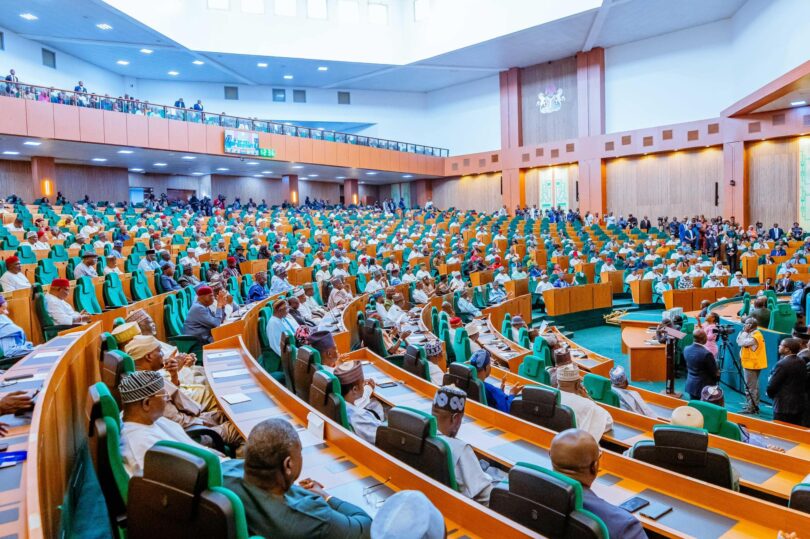
It was a busy week for the members of the House of Representatives, who considered and passed some bills and motions and conducted investigative hearings before proceeding on a long recess.
It was a busy week for the members of the House of Representatives, who considered and passed some bills and motions and conducted investigative hearings before proceeding on a long recess. The week, however, also witnessed a dramatic event: the Minority Caucus’s protest walkout during the passage of the state police bill. Here are some of the major activities of the lawmakers.
The passage followed the consideration and adoption of the report of the House Committee on Constitution Review, chaired by the Deputy Speaker, Benjamin Kalu.
The bill is designed to provide the constitutional foundation for the establishment of state police, with further legislation expected to provide detailed operational guidelines for the proposed security architecture.
While presenting a synopsis of the proposed constitutional amendment, Mr Kalu said the bill would not, on its own, resolve all the concerns surrounding the establishment of state police.
He said the amendment would instead provide the necessary legal framework for the development of detailed implementation legislation.
The House subsequently dissolved into the Committee of the Whole to consider the bill.
Speaker Abbas Tajudeen, who presided over the Committee, provided details of the lawmakers who participated in the voting process.
He said 211 members physically present in the chamber were from the All Progressives Congress, while 65 were from other political parties.
According to him, 35 members participated virtually through the National Assembly’s electronic platform and declared their support for the bill.
Mr Tajudeen said a total of 311 members had either signed the attendance register or participated virtually in the proceedings.
He explained that the constitutional requirement for the passage of the bill was two-thirds of the 360-member House, representing 240 members.
The bill contained 26 clauses, an explanatory memorandum and the long title.
The House thereafter passed the bill. But the passage did not go without controversy.
The minority caucus staged a walkout of the chamber in protest against the procedure adopted in passing the state police bill.
The walkout occurred shortly after the House passed the constitutional amendment bill.
Addressing journalists after the protest, Minority Leader Fred Agbedi (PDP, Bayelsa) said the caucus was not opposed to the establishment of state police.
Rather, he said, the lawmakers rejected what they described as a disregard for the Constitution and the Standing Orders of the House.
Mr Agbedi said a constitutional alteration bill must be considered clause by clause, with lawmakers voting on each clause as prescribed by the rules.
He cited Order 13.15(a) of the House Standing Orders, which provides that during clause-by-clause consideration in the Committee of the Whole, a clause or question shall be deemed passed if supported by a positive vote of two-thirds of the members of the House.
According to him, the procedure adopted by the House denied lawmakers the opportunity to vote individually on the provisions of the bill or propose amendments.
The minority leader said the caucus had earlier informed the speaker of areas where it wanted amendments, adding that Mr Tajudeen had acknowledged some of the concerns raised.
The House also stepped down a bill seeking to prohibit the production, importation, distribution, sale and consumption of unbranded and unfortified edible oil in Nigeria.
The bill, sponsored by Chike Okafor (APC, Imo), was brought before the House for second reading but faced strong opposition from lawmakers who argued that its provisions could harm rural producers and overlap with the functions of existing regulatory agencies.
Presenting the bill, Mr Okafor raised concerns about the health implications of the widespread consumption of unbranded and unfortified edible oil.
He cited the increasing incidence of heart-related diseases and other health challenges linked to poor-quality edible oil.
The lawmaker claimed that 67 per cent of Nigerians consume unbranded edible oil, while only 31 per cent of edible oil in circulation in the country is fortified.
However, lawmakers opposed the proposed prohibition, arguing that a blanket ban could have serious consequences for millions of Nigerians involved in small-scale and rural oil production.
Responding to the concerns, Mr Okafor said the bill’s intention was not to undermine NAFDAC or criminalise legitimate local production.
He said the proposed legislation was intended to reinforce the existing regulatory framework and improve enforcement.