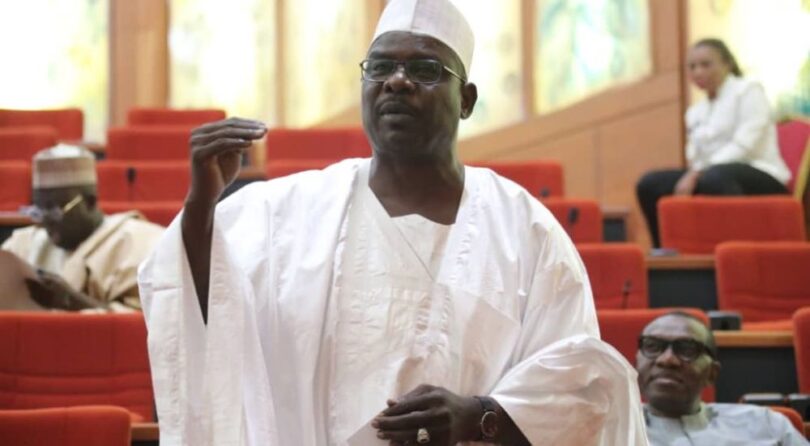
Senator Ali Ndume, representing Borno South Senatorial District, has denied allegations that he acted as an intermediary in the payment of a N5bn ransom to Boko Haram/ISWAP for the release of abducted residents of Ngoshe in Gwoza Local Government Area of Borno State.
Speaking on Channel TV on Friday, Ndume insisted that his only involvement in the matter was to alert relevant security agencies.
Ndume’s denial comes after reports on social media said the DSS has since arrested Kaigama after he alleged, during a separate televised interview, that N5bn was paid to secure the release of 360 hostages and that Ndume had facilitated or paid about N1.9bn of that sum.
The Borno State Government has denied that any ransom was paid, maintaining that the hostages were freed through a military operation.
Speaking during a live television interview, Ndume responded directly to allegations made by Samaila Ibrahim Kaigama, President of the Borno South Youth Alliance (BOSYA), who has accused the senator of facilitating or personally benefiting from the alleged ransom payment.
Narrating how the matter began, Ndume said Boko Haram insurgents invaded Ngoshe during the Eid-el-Kabir celebration and abducted 416 residents, after which Kaigama reached out to him claiming to be in contact with the terrorist group.
“He became aware of the Borno South Youth Alliance after the abduction of 416 people from my local government, particularly in Ngoshe, and after he claimed to be in contact with Boko Haram, Boko Haram demanded a ransom of 5 billion, and that if they are not released within 72 hours, the people are going to be killed, some will be married out,” Ndume said.
He said he immediately escalated the matter through official channels rather than engaging in any negotiation himself.
“I reported the matter to the NSA, the police, and the military intelligence,” he said, adding that he also spoke directly with the Director-General of the DSS about Kaigama’s claims.
Ndume said he had never met Kaigama in person, describing their entire relationship as conducted over the phone and through voice messages, some of which he says he has preserved as evidence.
He said his suspicion of Kaigama grew after the youth leader began pressuring him to personally contribute money toward the ransom.
“I told him that I do not support negotiation with Boko Haram, not to talk of paying ransom, and I think that is where the problem started,” Ndume said.
“In my life I have never seen 1 billion at once, cash – not to talk of 5 billion.”
The senator maintained that he has, throughout his political career, opposed any negotiation with Boko Haram or payment of ransom to the group, a position he said predates the current controversy.
He questioned how the alleged ransom could have been transferred if it was paid, and challenged Kaigama to substantiate the claims before the appropriate authorities.
“If it is not paid by cash, which account was that money paid to? Who was responsible for the payment?” Ndume asked.
“He should go and prove to the responsible authorities that this is what happened,” Ndume said.
Ndume disclosed that he has reported Kaigama to the police over comments he described as defamatory, and said he intends to pursue a lawsuit against him.
“I’m also going to take him to court on this matter because it’s serious defamation of character,” he said.
He further alleged that some of his constituents had approached him claiming that Kaigama solicited money from them for the release of relatives held captive, without any of them being freed.
According to Ndume, Kaigama is now facing a case with the Economic and Financial Crimes Commission (EFCC) bordering on extortion.
Drawing a parallel to his own past, Ndume recalled that he was charged in 2011 over alleged contact with a man claiming links to Boko Haram, a case that kept him in detention for about six weeks and in court for six years before it was eventually dismissed for lack of evidence.
He said he had served around that period on a federal government committee, set up under the Goodluck Jonathan administration, to explore possible dialogue with the insurgency, but that the committee’s efforts did not succeed.
“There was no evidence, and then they threw out the case,” he said of the 2011 prosecution.
Asked whether he was aware of past instances in which ransom had reportedly been paid to secure the release of captives in Nigeria, Ndume said he could not speak on behalf of the government.
“I’m not the state governor,” he said, adding that his position on the matter has remained the same regardless of what others may have done.
“I have never, and I will not be involved,” he added.
Ndume suggested that the allegations against him could be politically motivated, noting that Kaigama is contesting the Borno South senatorial seat under a different political party.
“I wouldn’t have mentioned that if it is not because… you have pushed me to the level,” he said, adding that he remained open to a direct, supervised confrontation with his accuser.
“I insisted that the security agency should investigate this matter – invite me and him… and question us, both of us, so that they can build evidence.”
He said 56 of his constituents from Gosia, along with dozens of others from neighbouring communities, remain in Boko Haram captivity, stressing that his continued engagement with security agencies has been focused on securing their release rather than negotiating directly with the insurgents.