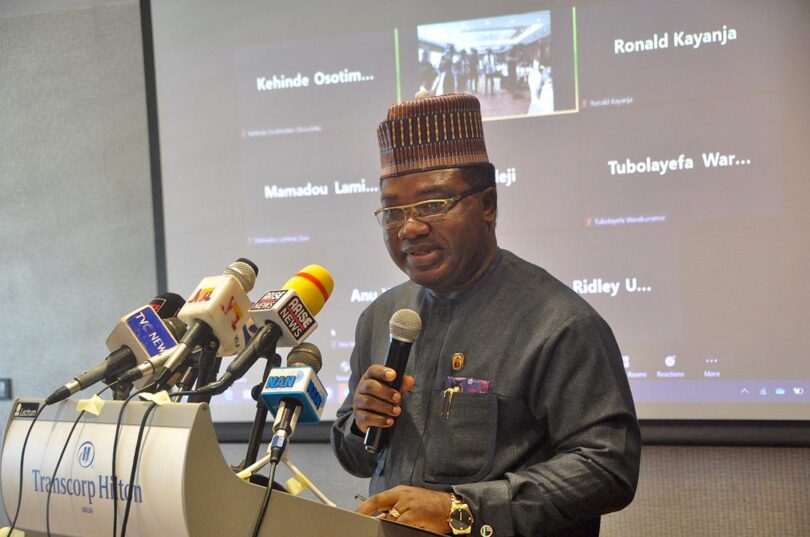
The NHRC said the agreement signed on Tuesday emphasised prevention of human rights violations over reactions.
The National Human Rights Commission (NHRC) and Hope Behind Bars Africa (HBBA) on Tuesday entered into a two-year Memorandum of Understanding (MoU) to strengthen human rights protection, access to justice, digital rights, and accountability in Nigeria.
“Let me be clear about why this matters. A human rights commission that only counts violations after they occur is doing half of its job. Our mandate, as I have said on many occasions, is as much about prevention as it is about redress,” Mr Ojukwu, a Senior Advocate of Nigeria (SAN), said.
The MoU aims to address and respond to emerging and persistent human rights challenges, strengthen access to justice, protect civic participation, and support individuals and communities impacted by violations.
To achieve this, the NHRC and HBBA would take on the following initiatives: the Justice-Tech Node, Defend the Defenders: Enhancing Action Against Strategic Litigation Against Public Participation (SLAPPs), and the Civic Accord Project.
The organisations said they would planned achieve the goals through public education, capacity building, and advocacy.
They also planned to explore integrated legal responses, case management and referral mechanisms, routine custodial centre visits, jail delivery initiatives, and the production of annual reports examining the state of human rights in corrections and detention facilities.
Mr Ojukwu and Funke Adeoye, the founder of HBBA, noted that the MoU is an opportunity to deepen the organisation’s work in the justice system.
The organisations also introduced the Justice-Tech Node initiative, a platform for justice institutions and civil society organisations to mitigate technology-enabled harms.
“Technology is rapidly changing the way Nigerians interact with the justice system. It is creating new opportunities for access to information, legal assistance and accountability, but it is also creating new forms of harm,” Ms Adeoye said.
Digital surveillance, online harassment, technology-facilitated abuse, unlawful restrictions on digital expression, the misuse of emerging technologies and other technology-driven harms increasingly have consequences for fundamental rights.”
She noted that the platform would bridge the gap between lawyers who may not understand technology and technologists who are not conversant with the legal terrain and the implications of “systems they build.”
The Justice Tech-Node is intended to bring together stakeholders “to identify technology- enabled harms, exchange knowledge, develop practical responses and contribute to a stronger technology and justice ecosystem.”
“We want the Node to support research, knowledge exchange, capacity building, referrals, innovation and practical interventions around emerging digital rights and technology-related justice issues. We also want it to help ensure that the development and deployment of technology in Nigeria is grounded in human rights, accountability and access to justice.”
Mr Ojukwu described Justice Tech-Node as “prevention-minded by design”, adding that “it seeks to get ahead of technology-enabled harm before it multiplies.”
Technology and Artificial Intelligence in particular have driven significant societal progress; however, they have also created avenues for technology-facilitated human rights violations.
In February, PREMIUM TIMES reported Gatefield’s warning that up to 70 million women and girls in Nigeria could be exposed annually to artificial intelligence–facilitated online abuse by 2030, if urgent legal and regulatory safeguards are not introduced.
Gatefield found that Nigeria lacks a coordinated legal and institutional framework to address AI-facilitated abuse.
Similarly, content monetisation has opened massive economic opportunities for social media creators. However, the system is being exploited, leading to Technology-Facilitated Abuse (TFA).