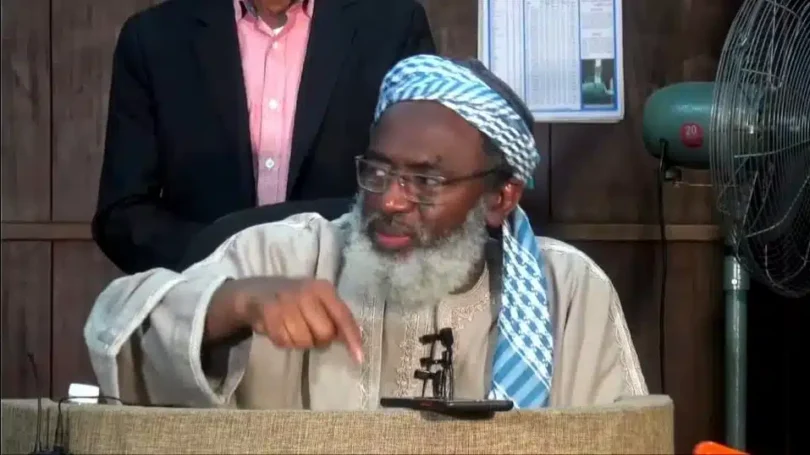
Controversial Islamic cleric, Sheikh Ahmad Gumi, has rejected growing calls for possible military support from the United States in Nigeria’s counter-terrorism operations, warning that foreign involvement could worsen the country’s already fragile security situation.
In a post shared on Facebook on Monday, Gumi argued that Nigeria must be cautious in dealing with external military partnerships, insisting that the nation’s sovereignty should not be compromised under any security arrangement.
He maintained that the ongoing fight against insurgency and banditry can still be won internally if properly managed.
He stressed that Nigeria’s armed forces have the capacity to handle terrorism, but only if their operations are guided by fairness, discipline, transparency, and strict adherence to rules of engagement.
According to him, inviting foreign military intervention, particularly from the United States, could create unintended consequences, including the escalation of violence and the possible attraction of international terror networks into the country.
Gumi warned that such a development could turn Nigeria into what he described as a “new arena” for global extremist activities, further complicating the security landscape and exposing civilians to greater danger.
He wrote, “The military can handle the situation if the rules of engagement are free from prejudices and deception, both in the application of force and finances.
“The involvement of the USA will only attract international terror groups to the ‘new arena,’ exposing Nigeria to an unnecessary increase in violence.”
The cleric also dismissed allegations that ongoing amnesty initiatives and dialogue efforts have weakened the military’s capacity to confront insurgents such as Boko Haram. He described such claims as misleading and capable of distorting public understanding of the security crisis.
Gumi has consistently supported non-kinetic approaches to tackling insecurity, including negotiation with armed groups, a position that has continued to generate controversy across Nigeria. Critics argue that such advocacy undermines military pressure on insurgents, while supporters believe dialogue remains necessary to reduce violence.
He further insisted that reliance on force alone has not delivered lasting peace, noting that Boko Haram has continued its operations nearly 17 years after the killing of its founder, Mohammed Yusuf, in 2009.
According to him, the persistence of insecurity is partly linked to alleged excesses by security forces during operations, including accusations of harm against innocent civilians in affected regions.
He maintained that any lasting solution must address justice, fairness, and accountability within security operations, warning that failure to do so would continue to fuel resentment and prolong the conflict.