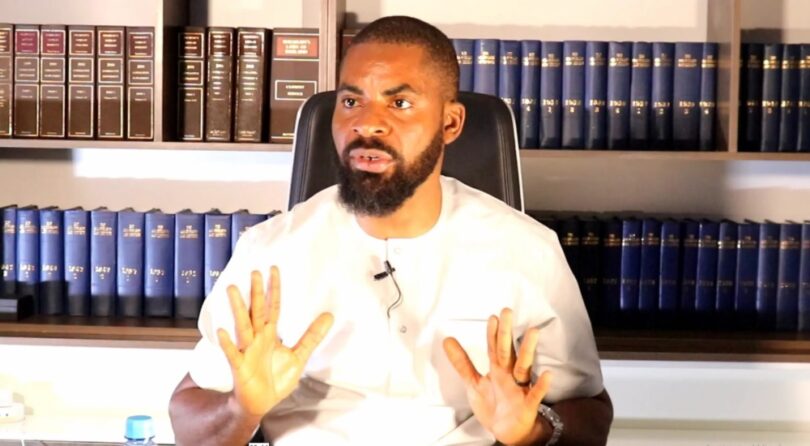
Human rights lawyer and activist, Deji Adeyanju, has condemned the heavy deployment of operatives of the Department of State Services (DSS), police officers, and other security personnel at the Federal High Court in Abuja, describing it as an unacceptable militarisation of the judiciary and a dangerous signal in a democratic society.
Adeyanju, in a statement reacting to the security build-up around the court during proceedings involving activist and former presidential candidate Omoyele Sowore, said the intimidating presence of armed operatives had no place in a democracy and must not be normalised.
According to him, the atmosphere created by the security deployment was inconsistent with democratic norms and threatened the sanctity, independence and dignity of the judiciary.
“The heavy deployment of DSS operatives, police officers, and other security personnel at the Federal High Court, Abuja, is a spectacle that has no place in a democratic society,” Adeyanju said.
He stressed that Nigeria is not under military rule and that the nation’s courts must not be turned into security zones where citizens are intimidated or denied free access.
“Nigeria is not under a military regime, and our courts must never be transformed into intimidating security zones where lawyers, litigants, journalists, and citizens are subjected to fear, harassment, or restricted access,” he stated.
The lawyer further warned that any action capable of creating the impression of executive intimidation of the courts undermines constitutional democracy and erodes public confidence in the justice system.
He noted that the judiciary remains a co-equal arm of government and must be treated with the highest regard, free from conduct that could compromise its independence or portray it as being under siege.
“The judiciary is a co-equal arm of government whose independence and dignity must be jealously protected,” Adeyanju said.
“Any conduct that undermines the sanctity of the courts or creates the perception of intimidation and executive overreach strikes at the very foundation of constitutional democracy and must be unequivocally condemned.”
Adeyanju’s reaction comes amid growing concerns from civil society groups, lawyers and political observers over the increasing use of heavy security presence around court proceedings involving high-profile activists, opposition figures and politically sensitive cases.