The minister explained that the upgraded system now includes audience measurement technology that provides data on viewers’ preferences and channel popularity.
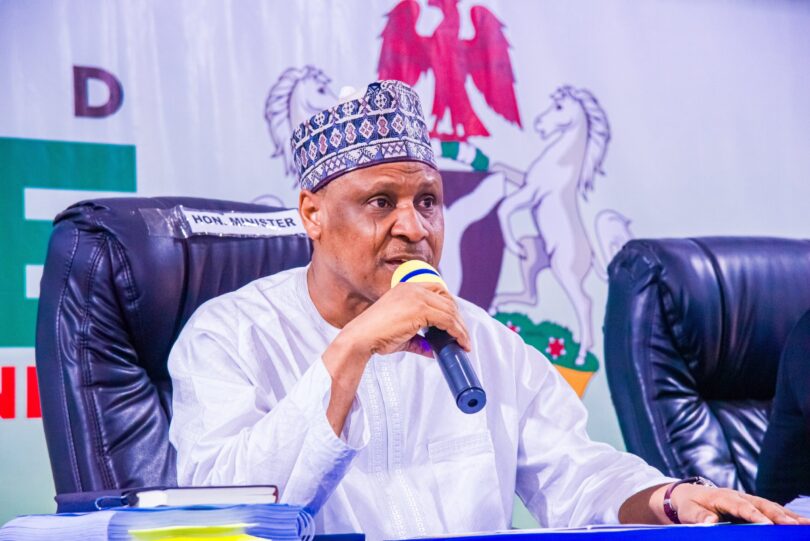
The Minister of Information and National Orientation, Mohammed Idris, has announced that the federal government will officially relaunch its free satellite television service on 17 June in Abuja.
The free satellite television project was first launched in January 2019 during the administration of former President Muhammadu Buhari. At the time, the project was celebrated with a colourful ceremony led by the then Minister of Information and Culture, Lai Mohammed, in Kpaduma III, a community in the Federal Capital Territory.
The project was then funded by the Chinese government and was expected to reach 1,000 villages across Nigeria. However, shortly after its launch, the initiative faded without the government providing an adequate explanation.
Mr Idris said the new satellite television project is a collaboration involving the Nigerian Communications Satellite (NIGCOMSAT), the National Broadcasting Commission (NBC), the National Orientation Agency (NOA), and the Ministry of Communications.
He said that the upgraded platform has been designed to serve not only Nigerians but also audiences across Sub-Saharan Africa.
Mr Idris said one of the major shortcomings of the previous project was the high cost and encrypted nature of the set-top boxes used at the time.
“In the past, the boxes that were provided by those who had that experiment were encrypted, meaning that it is difficult for you to go now and decide which one to do and then it costs a lot higher,” he said.
The minister added that while the earlier Digital Switch Over (DSO) project was limited to about eight cities in Nigeria, the new platform would have a much wider reach through NIGCOMSAT coverage.
“Now this is free. The government has already taken off some of these costs on behalf of Nigerians. And in the past, you remember that the DSO had already been tested in about eight cities across this country. Now, everywhere you are, not only in Nigeria, but in sub-Saharan Africa, wherever NIGCOMSAT is, you are also there,” he said.
The minister described the failure of the previous project as unfortunate despite the huge investments and partnership with the Chinese government.
He further explained that the upgraded system now includes audience measurement technology that provides data on viewers’ preferences and channel popularity.
“I mean, it’s been, such a shame in the past that Nigeria has not been able to achieve this. But now, the digital switchover is here. Everybody now can watch whatever he wants to watch in real time and painless. Free TV everywhere for everybody. This will enable viewers, advertisers, and others to make informed decisions about what they see on any given channel. I think this is a great thing that is happening.
“This is going to bring a lot of advantages to all the broadcasters, the viewers, and everybody who advertises.. Now, science is at play. I mean, if you are now viewing any particular station, you know who is viewing what, how many people are viewing,” he added.
The minister noted that the audience measurement feature, which was absent in the earlier project, will enable advertisers to determine where to place adverts based on viewership patterns and target audiences.
He maintained that the relaunch marks a major step in Nigeria’s digital broadcasting transition and would improve access to free television services for citizens.
“The standard measurement that was absent in the previous experiment is now being made available here. So, this will help advertisers to take informed decisions about what programming is it that people are watching, what is it that Nigerians want to watch across all the demographics. So, it’s easy for you to now say, I want to put an advert on this channel, or I want to put it on this channel. Who are you targeting. The information is there and provided for you.”
If successfully implemented, the federal government’s free satellite television initiative could significantly reshape Nigeria’s broadcasting industry, particularly at a time when millions of Nigerians are struggling with rising subscription costs on pay-TV platforms.
For many households, the increasing cost of cable television subscriptions from providers such as MultiChoice’s DStv and GOtv has become a major concern amid worsening economic conditions and inflation. A government-backed free satellite television platform could therefore provide an alternative source of entertainment, news and educational content for low-income families who can no longer afford monthly subscriptions.
Beyond affordability, the initiative may also deepen access to digital broadcasting in rural and underserved communities where television penetration remains limited. If the government fulfils its promise of nationwide and sub-Saharan coverage through Nigerian Communications Satellite (NIGCOMSAT), millions of Nigerians in remote areas could gain easier access to information, public enlightenment campaigns, educational programmes and emergency communication.
The project could equally increase competition within Nigeria’s pay-TV industry. Another potential impact is on local broadcasting and advertising. If effectively deployed, this could help advertisers make data-driven decisions and potentially increase advertising revenue for local television stations.