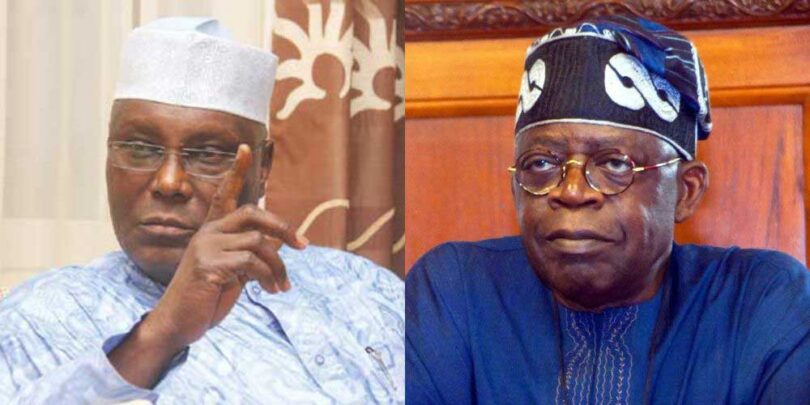
Presidential candidate of the African Democratic Congress (ADC) Atiku Abubakar has criticized President Bola Tinubu’s administration, declaring that his era is about to come to an end.
He noted that Nigerians are growing weary of what he described as “governance by propaganda” by the current administration as it marks three years in office.
In a statement issued on Friday by his Senior Special Assistant on Public Communication, Phrank Shaibu, Atiku said the Tinubu administration had failed to deliver on its promise of renewed hope, insisting that the country was instead battling worsening hardship, insecurity and economic decline.
According to the former vice president, the true assessment of the administration lies not in official celebrations or media campaigns, but in the daily struggles faced by ordinary Nigerians.
“The era of excuses is ending. The era of accountability is approaching. The era of propaganda is fading. And with the support of Nigerians, a new chapter of competence, prosperity, security, and genuine hope shall begin.
“Let no one be deceived. The era of complacency is over. The era of propaganda is ending. The era of taking Nigerians for granted is coming to a close. The people are awake. The people are watching. And when the time comes, they will deliver their verdict through the ballot,” he said.
The 2027 African Democratic Congress (ADC) presidential candidate accused the Federal Government of masking the realities confronting citizens.
According to him, the reality of the past three years could be seen in “the tears of hungry families, the despair of unemployed youths, the collapse of businesses, and the haunting images of schoolchildren being abducted by criminals while a complacent government looks the other way.”
“Three years ago, President Tinubu promised renewed hope. What Nigerians have received instead is renewed hardship, renewed insecurity, renewed poverty, and renewed hopelessness,” he stated.
He added that many small and medium-scale businesses were shutting down due to harsh economic conditions, while the naira had continued to weaken and citizens’ purchasing power had collapsed.
He noted that although every government was entitled to its own opinions, no government is entitled to its own facts.
Atiku further criticised the administration’s borrowing profile, citing reports that the Federal Government borrowed about N11.9tn within nine months while allegedly spending only N3.1tn on capital projects.
“Nigerians are therefore entitled to ask a simple question: where did the rest of the money go?” he queried.
The former vice president also questioned the concentration of major infrastructure projects around the Lagos-Calabar Coastal Highway and the Badagry-Sokoto Highway, alleging that government spending appeared to favour politically connected interests.
According to him, the development had created the impression that ordinary Nigerians were being forced to make sacrifices while a privileged few benefitted from state resources.
On security, Atiku described the resurgence of mass kidnappings and school abductions as one of the strongest indictments against the Tinubu administration.
He referenced the recent abduction of schoolchildren in Borno State and the kidnapping of pupils and teachers in Oyo State’s Oriire Local Government Area, saying the incidents reflected a government disconnected from the realities facing citizens.
“The tragedy of Borno and Oyo is not merely a security failure. It is the inevitable consequence of a government that has become detached from reality and addicted to propaganda,” he said.
Atiku also dismissed claims by the Federal Government that the economy and security situation were improving, describing such narratives as attempts to create a false impression of progress.
Warning against taking Nigerians’ patience for granted, the former vice president said endurance should not be mistaken for approval.
He added that the ADC would soon unveil a policy blueprint focused on economic recovery, job creation, security reforms, fiscal discipline, healthcare and rebuilding public confidence in government institutions.