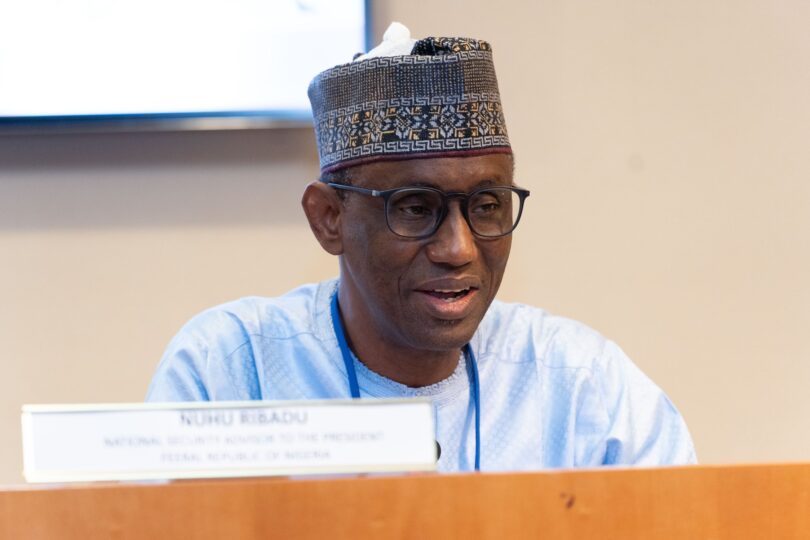
The ONSA says the successful operations in July and August highlight an increasingly coordinated, intelligence-driven approach to tackling terrorism, banditry, kidnapping, arms trafficking and other emerging security threats.
The Office of the National Security Adviser (ONSA) says successful operations by Nigeria’s security agencies in July and August highlight an increasingly coordinated, intelligence-driven approach to tackling terrorism, banditry, kidnapping, arms trafficking and other emerging security threats.
Mr Onumah said the security agencies conducted 7,062 operations, neutralising 1,487 terrorists and insurgents and rescuing 777 kidnapped victims in July and August nationwide.
According to him, the operations also led to the arrest of 354 suspects and the recovery of firearms, ammunition and Improvised Explosive Devices.
He said the results demonstrated the growing importance of intelligence sharing and operational coordination among security and law enforcement agencies.
Mr Onumah said that no single institution could secure Nigeria on its own, stressing the need for intelligence, border management, financial intelligence, emergency preparedness and community engagement.
He said the Nigeria Police Force (NPF) also recorded significant gains through intelligence-led operations, arresting 1,334 suspects and rescuing 383 kidnapped victims.
The police, he said, recovered 175 firearms and more than 3,790 rounds of ammunition while disrupting kidnapping, armed robbery, cultism and gunrunning networks.
Mr Onumah said the State Security Services complemented the efforts through intelligence-driven operations against arms trafficking, terrorism, kidnapping and other threats.
He said the agency’s interventions disrupted illicit supply chains, facilitated hostage rescues and contributed to convictions for serious security offences.
The security adviser also highlighted the growing focus on dismantling the networks that finance and sustain criminal activities.
He said the National Centre for the Control of Small Arms and Light Weapons destroyed 1,419 illicit weapons on 30 July, bringing weapons destroyed since 2022 to more than 19,000.
Mr Onumah said the Nigeria Customs Service (NCS) further strengthened the effort in August by handing over 399 intercepted firearms and hundreds of firearm components to the Centre.
He said the development demonstrated how border enforcement, intelligence and arms-control institutions could operate as interconnected components of the national security architecture.
According to him, the National Drug Law Enforcement Agency (NDLEA) conducted 2,298 targeted operations between July and August, arresting 3,705 suspects and securing 471 convictions.
“It also seized almost 54,000kg of illicit drugs and obtained court orders freezing accounts containing more than ₦9.8 billion linked to cartel operations.
Mr Onumah said the figures underscored the importance of following the money because organised crime depended on networks of financiers, facilitators, transporters and criminal entrepreneurs.
He said the Nigerian Financial Intelligence Unit (NFIU) was deepening cooperation with security and law-enforcement agencies to identify financial structures supporting organised crime and terrorism.
Beyond conventional security operations, he said agencies were also addressing human trafficking, irregular migration, cyber-enabled crime and climate-related emergencies.
According to him, the Nigeria Immigration Service (NIS) rescued trafficking victims, identified persons of interest and dismantled elements of a fraudulent transnational organised crime syndicate during the period.
“Similarly, the National Agency for the Prohibition of Trafficking in Persons intensified operations against human trafficking and online exploitation, securing convictions and rescuing suspected victims,” he said.
Mr Onumah said flood preparedness and emergency response were also critical components of national security and resilience.
He said the National Emergency Management Agency (NEMA) provided relief assistance to 24,625 households, representing about 147,750 people, during the period.
According to him, the agency also activated its National Emergency Operations Centre to strengthen information management, coordination and decision-making during the flood season.
“This, too, is national security. Disasters could destroy livelihoods, displace communities and intensify competition over scarce resources,” he added
Mr Onumah said credible information was becoming a critical national security asset amid increasing misinformation, fabricated videos, manipulated images and rumours.
According to him, the Defence Headquarters (DHQ) issued 137 press releases and identified and countered 13 instances of misinformation during July and August.
He said NDLEA also issued 27 official statements, participated in 36 broadcast engagements and countered dozens of misinformation items.
Mr Onumah stressed that strategic communication should be regarded as an integral component of security operations rather than an afterthought.
“Public trust is fundamental. Where credible official information is absent or unnecessarily delayed, speculation and misinformation quickly occupy the vacuum,” he said.