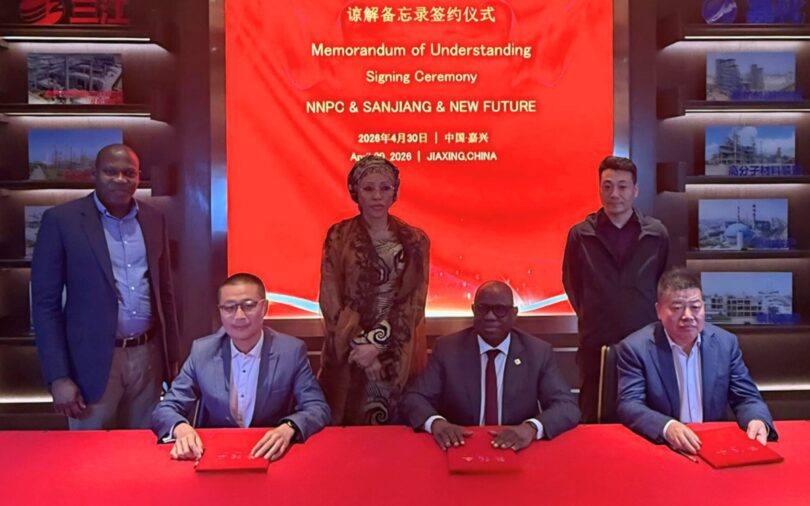
The Nigerian National Petroleum Company (NNPC) Limited has signed a Memorandum of Understanding (MoU) with two Chinese firms as part of efforts to restart and expand the Port Harcourt and Warri refineries through a potential technical equity partnership.
The Nigerian National Petroleum Company Limited (NNPCL) has announced that it signed a Memorandum of Understanding (MoU) with two Chinese companies to support the completion, operation, and possible expansion of the Port Harcourt and Warri refineries.
“The NNPC Ltd has signed a Memorandum of Understanding (MoU) with two Chinese companies, Sanjiang Chemical Company Limited and Xinganchen (Fuzhou) Industrial Park Operation and Management Co. Ltd, for collaboration through a potential Technical Equity Partnership in support of the completion and operation of the Port Harcourt and Warri Refineries,” the statement said.
According to the statement signed by NNPC’s Chief Corporate Communications Officer, Andy Odeh, the collaboration is expected to be driven through a potential Technical Equity Partnership arrangement.
It said the MoU was signed by NNPC Group Chief Executive Officer, Bashir Ojulari, Chairman of Sanjiang Chemical Company, Guan Jianzhong, and Chairman of Xinganchen Industrial Park Operation and Management Co., Ltd, Bill Bi.
According to the statement, the proposed framework will focus on completing outstanding work at both refineries and ensuring efficient operation and maintenance to achieve “best-in-class, sustainable performance.”
Nigeria has four state-run refineries, including two in Port Harcourt, which together form the Port Harcourt Refining Company, with a combined installed capacity of 210,000 barrels per day (bpd).
The Kaduna Refining and Petrochemical Company Limited has an installed capacity of 110,000 bpd, while the Warri Refining and Petrochemical Company Limited has an installed capacity of 125,000 bpd.
All four refineries have a combined installed capacity of 445,000 bpd.
Despite significant cash injections aimed at getting the plants to run optimally for many years, the refineries continue to grapple with operational constraints, with site visits revealing that most facilities are far from operating at peak levels.
The Warri Refinery, which reopened in December 2024, shut down in January due to safety issues. In May last year, NNPC announced an outage at the Port Harcourt Refinery, preparatory to scheduled maintenance.
In October last year, NNPC announced that it had initiated a comprehensive technical and commercial review of its three refineries to ensure optimal performance and sustainability.
The goal of the overhaul, according to NNPC, is to position the corporation for its big role as a supplier of petroleum products of last resort, as stipulated by the Petroleum Industry Act, while ensuring the efficient and profitable operation of the refineries.
On Sunday, the NNPC noted that the planned upgrades and expansion would help the facilities meet cleaner fuel standards and improve profitability.
Additionally, the company said the partnership will also explore expanding petrochemical production capacities at both refineries and developing gas-based industrial hubs within the refinery complexes.
NNPC said the collaboration is aimed at unlocking downstream opportunities and maximising the commercial value of the assets.
Speaking after the signing ceremony, Mr Ojulari described the MoU as a major milestone following more than six months of engagement between the technical and management teams of NNPC and the Chinese firms.
“All parties recognise mutually beneficial opportunities for the development and long-term sustainable profitability of NNPC’s refining assets in Nigeria, and the collective weight required for success,” he said.
He added that the agreement marks an important step in NNPC’s efforts to identify suitable technical equity partners to restart and expand its refining operations.
Mr Ojulari said the company would also use the partnership to explore opportunities in co-located petrochemical projects and gas-based industries.
The national oil company noted that the MoU reflects the parties’ intention to continue discussions in good faith. At the same time, any final agreements would be subject to customary approvals and the conclusion of definitive arrangements.
Nigeria has continued to seek strategic investors and technical partners for its state-owned refineries as part of efforts to reduce dependence on imported petroleum products and improve domestic refining capacity.