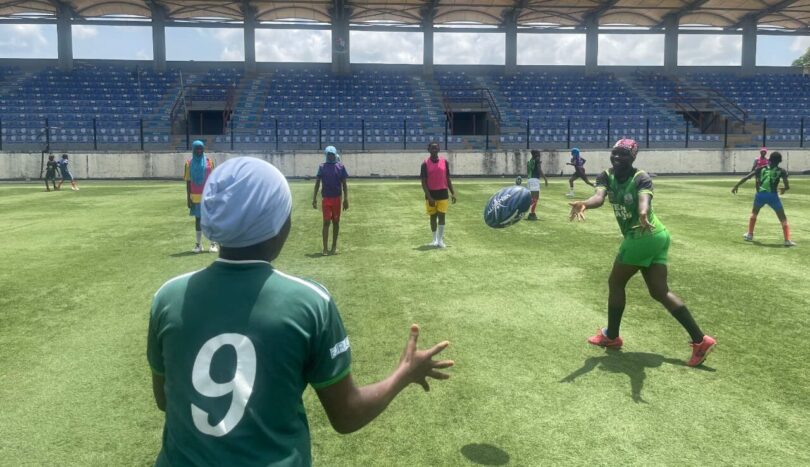
Participants were taken through practical sessions aimed at improving their understanding of the game, while sporting equipment, including rugby balls, boots and jerseys,was distributed to encourage
More than 100 students from schools across Lagos were introduced to advanced rugby techniques and career pathways on Friday as the Nigeria Rugby League Association, NRLA, in partnership with the Australian High Commission, staged a developmental clinic at the Mobolaji Johnson Arena.
Participants were taken through practical sessions to improve their understanding of the game, while sporting equipment, including rugby balls, boots, and jerseys, was distributed to encourage continued engagement. Organisers also used the platform to emphasise the importance of balancing sports with education.
Speaking at the event, Ade Adebisi, Vice Chairman of Nigeria Rugby League Association and Chairman of the Lagos State Rugby Association, described the initiative as a strategic step in expanding the sport’s reach within school systems.
“This is a collaboration between the Australian High Commission, Lagos State Sports Commission, Nigeria Rugby League and Lagos State Rugby Association. It’s more for school development,” he said.
He noted that rugby league is already gaining traction in several schools across Lagos, and that the latest partnership is designed to elevate existing structures.
“The children have been playing… we’re already in school systems in Lagos. This partnership is just to take it to the next level,” Adebisi added.
He further highlighted the significance of international support, which has enabled the introduction of elite-level expertise to the programme.
“They’ve been able to bring a professional player from Australia… and we also have a high-performance coach from Australia to develop the kids,” he said.
Mr Adebisi also underscored the importance of inclusivity, revealing that female participation remains a key focus of development efforts.
“Our females are ranked number 10 in the world. As you can see, it’s 50-50 here. We go to all-girls schools and all-boys schools because we need to develop the next generation,” he explained.
The clinic forms part of a series of activities leading to an international fixture involving Nigeria’s national team, the Green Falcons, scheduled to take place in Lagos, featuring teams from Uganda, Kenya, Côte d’Ivoire and Ghana.
Samoan international rugby league player Lindsay Tui, who participated in the clinic, expressed optimism about the potential of the young athletes.
“I’m here to develop the game… Rugby League, for women especially, has grown so much. We’re here in hopes to develop Nigeria Rugby League as well,” she said.
Reflecting on her interaction with the students, Tui praised their enthusiasm and willingness to learn.
“These kids look like lovely kids, very bright and friendly. You can tell that they’re very keen to learn and just be a part of rugby league,” she noted.
She also advised the participants on the discipline required to succeed in the sport.
“I think you just have to have the right mentality, positive attitudes towards wanting to be a professional athlete. The most important thing is fueling your body, taking care of your body and coming prepared for training,” she said.
From a diplomatic perspective, the Australian High Commission described the partnership as part of a broader strategy to strengthen cultural and sporting ties between the two countries.
Bede Thompson, Second Secretary at the mission, said rugby league presents a unique opportunity to build people-to-people connections.
“Rugby league is absolutely massive in Australia… we want to be able to share that with the world. We’re passionate about expanding the game,” he said.
He added that Nigeria’s recent performances, particularly in women’s competitions, demonstrate the country’s rising status in the sport.
“You look here, you see a lot of talent and a lot of passion. With the work being done and the athleticism that’s already here, I can see a very bright future for Nigeria Rugby League,” Thompson stated.
Also lending his expertise at the clinic was Luke Sherman, Nigeria Rugby League’s Head of International Competitions and High Performance, who stressed the importance of early exposure.
“Getting these kids out and playing the game from a young age means that in five to ten years’ time they’re going to be competing for positions in our national team,” he said.
Mr Sherman pointed to the physical attributes of Nigerian athletes as a major advantage.
“The power and strength that Nigerian people have is not matched anywhere in the world. There’s huge potential here,” he added.
On the role of government, Lagos State Director-General of the Sports Commission, Lekan Fatodu, said the initiative aligns with efforts to promote mass participation beyond traditional sports.
“Our fixation is not going to be on football alone… we want to create opportunities for all sports and identify talents across communities,” he said.
Mr Fatodu also highlighted sports as a tool for diplomacy and international engagement.