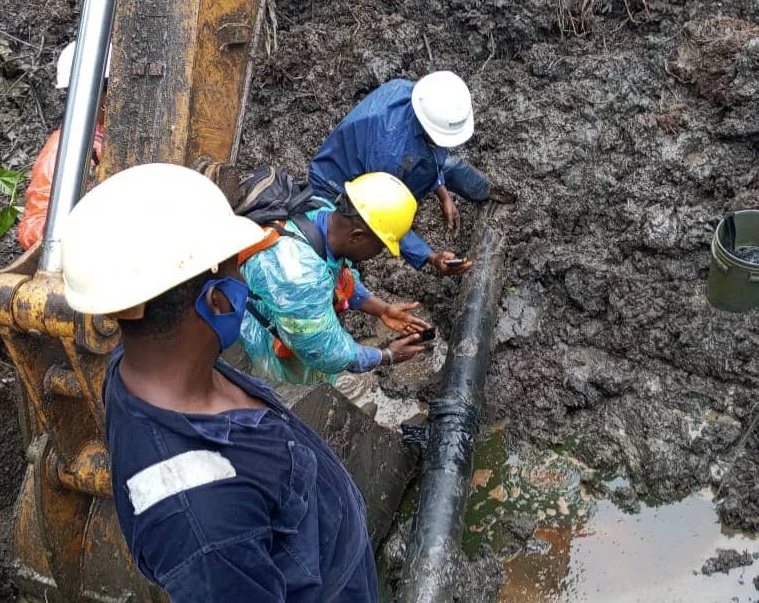
The joint investigation result on an oil spill at Azuzuama Community, Bayelsa has triggered disagreement between Oando, regulators and representatives of the community.
The spill occurred on June 25 along Oando’s six-inch Azuzuama-Tebidaba flow line in Southern Ijaw Local Government Area.
According to a field report by the Environmental Conservation Agriculture and Rural Development, ECARD, the spill which discharged large volumes of crude into the community was caused by ‘induced corrosion’ linked to sabotage.
Reuben Enai, the Director, Petroleum and Pollution, Bayelsa Ministry of Environment, who participated in the joint investigation also reported that the rupture resulted from induced corrosion.
Enai stated that visual examination of the crude delivery pipeline showed marks that suggested deliberate use of acid to cause corrosion at the top section of the pipe.
He argued that natural corrosion could not have caused damage at the ’12 o’clock’ position of the pipeline.
Meanwhile the host community had insisted that the spill resulted from equipment failure and corrosion.
Angasei Perediseghebofa, the Chairman, Azuzuama Community Development Committee, said on Monday in Yenagoa that the outcome of the Joint Investigation Visit (JIV) was faulty.
He said that the visible rust on the exposed pipeline indicated corrosion and not sabotage as claimed by ECARD and the company.
According to him, the testing devices introduced by Oando malfunctioned during the inspection, and prevented a credible determination of the cause of the spill.
Also speaking, Uyabara Boneghen, the committee’s Vice Chairman, questioned the reliability of the testing equipment used by Oando during the JIV.
Boneghen referred to a second leak beneath a platform, saying that the bubbling gas raised another uninvestigated environmental concern in the community.
It would be recalled that JIV is a statutory exercise to probe the cause, estimated spill volume and impacted area in a spill.
Experts say that the divergent views by the regulators, operator and representatives of the host community have rendered the JIV inconclusive.
They urged Oando to immediately contain the spill, clean up contaminated areas, and repair the underwater leak to prevent further environmental damage.
According to them, a separate investigation into the underwater leak will avert prolonged hydrocarbon discharge which can further pollute sources of livelihood in the community.
NAN