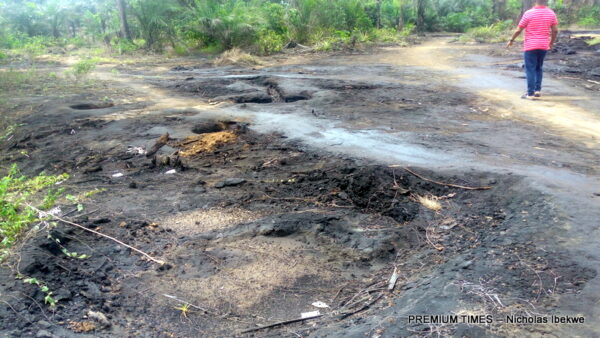
The groups say the federal government should prioritise environmental restoration over reopening oil wells in the polluted Niger Delta.
Fifty-one civil society organisations have opposed plans to resume oil production in Ogoniland, calling on the federal government to abandon the move and instead focus on cleaning up decades of environmental pollution in the area.
The statement followed reports that Dutchford Exploration and Production Company Limited emerged as the successful bidder for the Yorla South oil field in Khana Local Government Area of Rivers State.
The 51 organisations include Oilwatch International, the Health of Mother Earth Foundation, Environmental Rights Action/Friends of the Earth Nigeria, Policy Alert, We The People, Corporate Accountability and Public Participation Africa, Peace Point Development Foundation and Amazon Watch.
“We are unequivocal: Do not reopen the wells. Decommission them. Clean them up. Restore the land. Protect the people. Ogoniland has suffered enough,” the organisations said.
The groups argued that Ogoniland continues to bear the environmental consequences of decades of oil exploration, with contaminated land, polluted water bodies and damaged livelihoods yet to be fully restored despite years of remediation efforts.
They said approving fresh oil production before addressing the environmental liabilities identified by the United Nations Environment Programme (UNEP) would amount to repeating “another cycle of extraction.”
“How can the government contemplate new oil production in Ogoni when the environmental wounds of previous production remain unhealed? This is not development. It is a dangerous attempt to turn an unresolved disaster into a new oil frontier,” the statement said.
The organisations cited the 2025 oil spill in the Kpean community, which hosts 14 Yorla oil wells, as evidence that ageing oil infrastructure continues to pose significant environmental risks.
According to them, crude oil escaped from a dormant wellhead in August 2025, contaminating farmlands, streams and sources of drinking water, while a subsequent spill months later caused additional damage.
They alleged that affected residents were yet to receive meaningful remediation, compensation or healthcare support.
The groups warned that restarting production at the Yorla South field before cleaning up the affected community would expose residents to further environmental hazards.
They said ageing wellheads should be decommissioned rather than returned to operation.
The organisations called for an immediate moratorium on any attempt to resume production at Yorla South pending the completion of environmental assessments and remediation.
Among their demands are an independent assessment of the environmental condition of the oil field, full clean-up of the Kpean spill, public disclosure of the licence and ownership structure, environmental and social impact assessments, meaningful consultation with host communities and a legally enforceable framework assigning responsibility for historical environmental damage.
They also insisted that existing infrastructure should undergo independent integrity assessments and that abandoned facilities should be decommissioned where necessary.
“Community consultation must not be a ceremonial exercise conducted after decisions have already been made,” the statement added.
The opposition comes months after renewed efforts by the federal government to facilitate the return of oil production to Ogoniland, which has been absent for more than three decades.
As previously reported by PREMIUM TIMES, the federal government has repeatedly indicated its intention to resume oil exploration in Ogoniland, arguing that extensive consultations with traditional rulers, community leaders and other stakeholders were underway.
Government officials have maintained that any resumption of production would occur only with the consent of Ogoni communities and alongside the continued implementation of the UNEP-recommended clean-up programme.
Oil production in Ogoniland was halted in 1993 following widespread protests led by the Movement for the Survival of the Ogoni People, which accused oil companies and the Nigerian government of environmental degradation and marginalisation.
The execution of environmental activist Ken Saro-Wiwa and eight other Ogoni leaders in 1995 further drew international attention to the environmental and human rights situation in the area.
In 2011, UNEP published a landmark assessment documenting serious hydrocarbon contamination across Ogoniland and recommended what it described as one of the world’s most ambitious environmental remediation programmes.
Implementation of the clean-up commenced in 2016 under the Hydrocarbon Pollution Remediation Project. However, environmental groups have repeatedly criticised the pace of remediation and questioned whether affected communities have seen significant improvements.
The latest coalition warned that allowing fresh oil extraction before completing environmental restoration would reverse decades of advocacy for environmental justice.