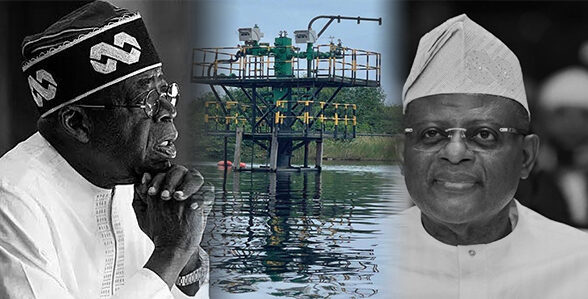
Cross River has lost trillions of naira, and its economy has been negatively impacted, amid several stalled infrastructure projects and reported job losses since it lost the disputed oil wells to Akwa Ibom.
The Inter-Agency Technical Committee (IATC) set up by the Revenue Mobilisation Allocation and Fiscal Commission (RMAFC) verified that Cross River State has 119 crude oil and gas wells and that the state therefore deserves a 13 per cent derivation revenue from those wells.
“The 119 crude oil and gas wells attributed to Cross River State prior to the exercise were benefited by Akwa Ibom State, as such Akwa Ibom State should refund to Cross River State the 13% enjoyed from the 119 oil and gas wells in form of arrears,” the committee stated.
These and other related findings are detailed in the IATC report submitted to the RMAFC in February 2026 for review and subsequent transmission to President Bola Tinubu for consideration.
Apparently strengthened by the IATC report, which has refuted the long-held belief that Cross River lost its littoral status after Nigeria ceded the Bakassi Peninsula to Cameroon on 14 August 2008, Governor Bassey Otu of Cross River has been calling for a restoration of Cross River’s economic rights.
Mr Otu, in February this year in Calabar, told a group of journalists that Cross River accepted to “sacrifice” Bakassi and its oil and gas assets for Nigeria to achieve peace, but that his state and the people have continued to suffer immensely for it.
The journalists, including a PREMIUM TIMES reporter, were in Calabar for a fact-finding tour regarding the dispute between Cross River and Akwa Ibom over the oil wells.
“Today, we bear the scars, which we believe it is time to change it,” Mr Otu said to the journalists before they embarked on a boat ride to the sea to have a view of the oil platforms and the coastal communities.
“To say the least, we are not even asking for more; we are just asking for our own rights. It is Cross River State today; it can be any other state tomorrow,” the governor added.
PREMIUM TIMES learnt that some powerful figures within the Nigerian government have been fighting hard to suppress the IATC report to prevent Cross River from regaining the oil and gas wells.
However, Mohammed Shehu, chairman of RMAFC, said in a February statement that what the commission received from the IATC was a “draft copy” and that media reports suggesting a proposal to transfer oil wells to Cross River were misleading and premature.
“Consistent with established protocol, the draft document has been transmitted to relevant technical and statutory stakeholders, namely the Nigerian Upstream Petroleum Regulatory Commission (NUPRC), the National Boundary Commission (NBC), and the Office of the Surveyor General of the Federation (OSGoF), for detailed review, observations, and technical input,” Mr Shehu said.
He said a final report would be transmitted to President Tinubu after RMAFC’s tripartite committees, comprising the committees on crude oil, gas, and investment, and legal matters, had scrutinised the observations and recommendations from the NUPRC, NBC, and OSGoF.
Two sources close to the presidency have informed PREMIUM TIMES that the governors of Cross River and Akwa Ibom have already held two meetings on resolving the oil well dispute, on President Tinubu’s directive.
The Senate President, Godswill Akpabio, reportedly mediated in one of the meetings.
The two states have gone further to set up a technical committee, which has been meeting on the matter, one of the sources added.
Mr Akpabio’s media aide, Anietie Ekong, confirmed via a Facebook post that the Senate president mediated a meeting on 25 February in Abuja between Governor Otu and Governor Umo Eno of Akwa Ibom State. He posted a photo on the social media site of Mr Akpabio flanked by Messrs Otu and Eno.
President Tinubu is said to be disposed to resolving the dispute between the two states mutually, without going through a prolonged bureaucratic or legal process.
Cross River and Akwa Ibom are APC-controlled states. The resurfaced oil-well dispute between the two has the potential to cause political damage ahead of crucial elections in 2027, besides the concerns over national security.
Cross River has lost trillions of naira, and its economy has been negatively impacted, amid several stalled infrastructure projects and reported job losses since it lost the disputed oil wells to Akwa Ibom. The people of the state, especially the youth, have been apprehensive lately over the renewed dispute.
Khadija Kumo, the director of the Crude Oil Department at RMAFC, chaired the 13-member IATC, inaugurated on 18 June 2025 by the RMAFC Secretary, Joseph Nwaze.
Other members of the IATC were Peter Inyabri (RMAFC), vice chairman; Aderinwale Folorunso (RMAFC), secretary and coordinator; Bulus Emmanuel (NBC); Semiu Ayinde (OSGoF); Jenifer Ekhekide (NUPRC); Azubuike Chinweikpe (OSGoF); Ahmed Hamza (RMAFC); Mukailu Mohammed (NBC); and Aisha Musa (NUPRC).
Umar Kulo, Badamasi Muhammad, and Stayford Eyineje ran the committee secretariat.
The surveyor-general of all the states that were parties to the disputed wells were observers in the conduct of the IATC activities, according to the report.
“The Nigerian Army, Nigerian Navy and other security operatives provided security coverage on land and waters (for the committee),” the report stated.
The IATC was set up mainly to verify the coordinates of disputed oil and gas fields and wells, and of newly drilled oil and gas wells in Nigeria’s Niger Delta region from 2017 to December 2025.
In the simplest terms, coordinates, in this context, are locations from which oil is drawn. A coordinate is to oil production as a beacon stone is to a land survey.
The RMAFC chairman, Mohammed Shehu, while declaring open the coordinates verification exercise on 22 September 2025 in Asaba, Delta State, assured stakeholders of fairness and transparency. He described the exercise as a proactive step toward ensuring the equitable allocation of national resources.
The report explained the methodology deployed by the IATC and stated that the exercise took place in two separate phases.
“The first phase involved the verification of coordinates submitted by the NUPRC. Physical verification of these coordinates was considered essential, as the committee observed that NUPRC was not the primary source of the data submitted to RMAFC and, therefore, the information could not be relied upon entirely. Any variation in coordinates could significantly affect plotting outcomes. Consequently, the exercise emphasised empirical data collection to ensure accuracy and to minimise agitations upon completion of the exercise.