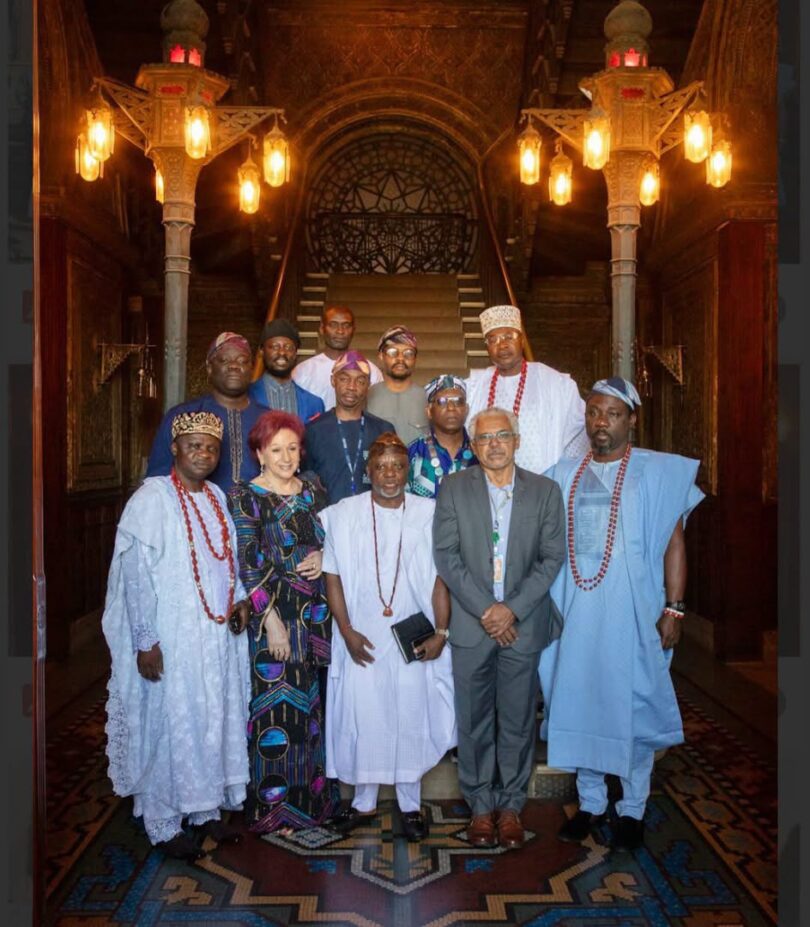
The representatives of the Ooni of Ife, Arole Oodua Olofin Adimula and Natural Head of the Oduduwa race worldwide, Ooni Adeyeye Enitan Ogunwusi, CFR, Ojaja II, were on the delegation of the Federal Republic of Nigeria who were currently in Brazil to discuss the efficacy of Yoruba traditional medicine with the government of Brazil represented by Fiocruz a South America leading Medical research institute. The delegation therein called for global recognition and scientific validation of African traditional medicine, advocating a strategic partnership between Nigeria and Brazil that will combine indigenous knowledge with scientific research to improve healthcare and sustainable development.
The delegation made the call during the Brazil–Nigeria High-Level Bilateral Meeting on Traditional Medicine and Scientific Cooperation held at the Oswaldo Cruz Foundation (Fiocruz), Rio de Janeiro, Brazil, yesterday.
A statement issued on Sunday by the Senior Media Officer to the Ooni, Sodiq Lawal, said the meeting ended with the adoption of a comprehensive implementation roadmap that will guide cooperation between the two countries on traditional medicine, medicinal plant research, technology transfer, academic exchange and public health innovation.
Representing the Ooni at the summit were the Director of Media and Public Affairs, Ooni’s Palace, Otunba Moses Olafare, and the President of Oduduwa Heritage Home in Brazil and International Consultant to the World Orisa Congress (WOOCON), Ajoyemi Olabisi Osunleye.
The meeting brought together representatives of Fiocruz, the Federal Government of Nigeria, the Royal Palace of the Ooni of Ife, Afe Babalola University (ABUAD), Harvard University, Brazil’s Ministry of Racial Equality and the African Pride delegation to deepen South-South cooperation in traditional medicine, medicinal plant research, human milk banking and academic training.
The meeting reaffirmed the mutual commitment of both countries to scientifically validate traditional medicine practices and integrate evidence-based indigenous healthcare into formal health systems.
Participants also reviewed the ongoing Harvard–Brazil–Nigeria metabolomics research involving 68 medicinal plants used in the treatment of diabetes, with discussions on expanding the study to other therapeutic products of medical value.
The summit further recognised a collection of about 500 medicinal plants already studied and scientifically validated in Brazil as a solid foundation for future collaborative research between Nigerian and Brazilian institutions.
Another major outcome of the meeting was the agreement to support the establishment of a Human Milk Bank in Nigeria, leveraging the technical expertise of the Pan American Health Organisation/World Health Organisation Collaborating Centre and Fiocruz’s experience in the field.
The participants also linked the Brazil–Nigeria partnership to global climate initiatives through the International Savanna Forum and COP31 scheduled for September in Goiânia, Brazil, identifying biodiversity conservation, health innovation and social technology as critical areas of future collaboration.
The meeting equally acknowledged Brazil’s ongoing efforts to secure institutional recognition for the healthcare practices of traditional terreiro communities, while noting that Nigeria’s experience in preserving indigenous medicine offers valuable lessons for international policy development.
Speaking during the opening session, the Director of Media and Public Affairs, Ooni’s Palace, Otunba Moses Olafare, said the proposed partnership must be built on three inseparable pillars—indigenous wisdom, traditional medicinal plants and scientific research.
According to him, Africa’s traditional knowledge should not merely be preserved but scientifically validated, refined and responsibly deployed for the benefit of humanity.
“The foundation of this partnership should rest on three inseparable pillars: indigenous wisdom, traditional medicinal plants and scientific research.
“Our purpose is not merely to preserve traditional knowledge, but to combine the wisdom safeguarded by our communities over generations with rigorous scientific research capable of validating, improving and responsibly applying that knowledge for the benefit of humanity.
“Through this approach, we can transform our shared biodiversity and ancestral knowledge into safe, effective and evidence-based health innovations that contribute to public health, scientific advancement and sustainable development.
“These principles should form the cornerstone of the Memorandum of Understanding and all future cooperative initiatives arising from this historic meeting.”
Presenting the Ooni’s position, the Ooni’s delegation explained that African traditional medicine transcends the physical use of herbs, roots and medicinal plants.
He maintained that indigenous healthcare embodies generations of ancestral wisdom, oral traditions, spirituality and sacred knowledge that have been preserved across centuries.
He stressed that within Yoruba civilisation, prayers, incantations and other intangible cultural practices remain integral components of healing and should be recognised alongside scientific validation in any global framework for traditional medicine.
Representing the Federal Government of Nigeria, and leader of the delegation, the Executive Director of the National Institute for Cultural Orientation (NICO), Otunba Biodun Ajiboye, reaffirmed Nigeria’s commitment to preserving indigenous knowledge systems through research, documentation and international collaboration, describing the partnership as a major step towards repositioning Africa’s cultural and scientific heritage on the global stage.
Also speaking, the Vice-Chancellor of Afe Babalola University (ABUAD), Prof. Smaranda Olarinde who led the University team highlighted the institution’s research capacity in traditional medicine, noting that the university had advanced beyond laboratory investigations, with several medicinal products already developed and manufactured.
According to her, the achievement demonstrates ABUAD’s ability to translate scientific research into practical healthcare solutions capable of benefiting society.
The meeting also adopted a detailed implementation calendar to ensure that the resolutions are translated into concrete actions.
Under the roadmap, participating institutions will immediately validate the meeting resolutions and formalise the existing Letter of Intent before constituting a Joint Working Group in August 2026 to coordinate all aspects of the partnership.