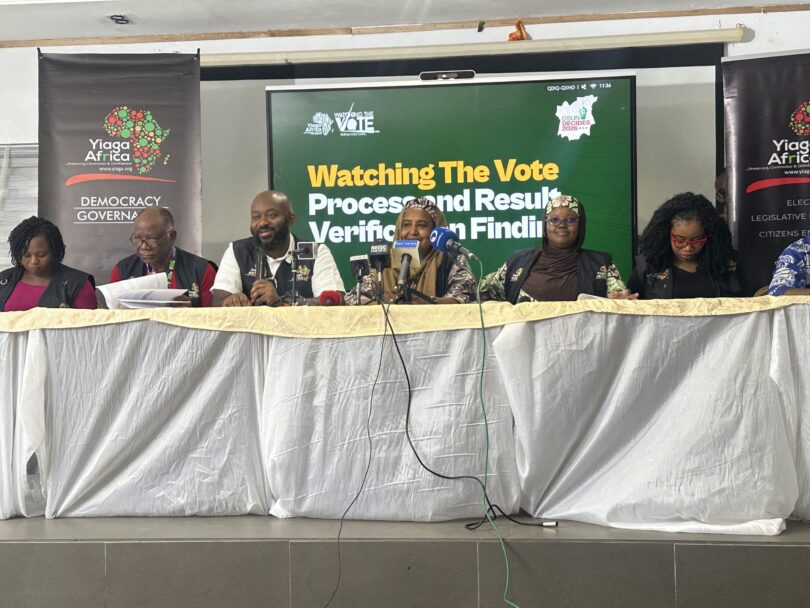
Yiaga Africa, however, said the consistency of the results should not be interpreted as an endorsement of the entire electoral process, particularly amid reports of vote buying and voter inducement.
Election observer organisation, Yiaga Africa, has said the official results of the 2026 Osun State governorship election accurately reflected the ballots counted at polling units. However, widespread reports of vote buying and voter inducement raised concerns about the integrity of voters’ choices.
Adeleke polled 511,067 votes to defeat his closest challenger, Bola Oyebamiji of the All Progressives Congress (APC), who scored 444,815 votes. The result gave Adeleke a margin of 66,252 votes.
The governor won in 19 of the state’s 30 Local Government Areas (LGAs), while Oyebamiji won 11.
The result gave Adeleke 51.9 per cent of the votes, compared with 45.2 per cent for the APC, while Najeem Salam of the African Democratic Congress (ADC) polled 1.7 per cent.
Speaking on behalf of the organisation, the Chairperson of the Osun Election Observation Mission of Yiaga Africa, Asmau Maikudi, said the findings were based on reports from 289 of the 300 sampled polling units, representing 96 per cent of the sample.
She said Yiaga Africa’s Process and Results Verification for Transparency (PRVT) statistical analysis showed that the Accord Party should receive between 50.3 per cent and 54 per cent of the vote, the ADC between 1.4 per cent and 2.1 per cent, and the APC between 43 per cent and 46.8 per cent.
The official results announced by INEC fell within all three estimated ranges.
“Accord’s official result was 51.9 per cent, which is a match in comparison to Yiaga Africa WTV PRVT estimates,” Maikudi said.
“ADC official result was 1.7 per cent, while APC official result was 45.2 per cent, which is a match in comparison to Yiaga Africa WTV PRVT estimates.”
She added that no other political party secured more than 1.2 per cent of the vote.
According to Yiaga Africa, the consistency between its statistical estimates and INEC’s final figures indicates that the electoral commission’s announced results reflected the ballots counted at polling units.
“Had the results been significantly altered at the ward, LGA, or state collation centres, the official figures would have fallen outside Yiaga Africa’s WTV estimated ranges,” the organisation said.
It, however, cautioned that the finding should not be interpreted as an endorsement of every aspect of the election.
“The consistency of the results, therefore, speaks specifically to the accuracy of the tabulation of polling-unit results,” it said, while raising concerns over reports of vote buying and voter inducement.
Yiaga Africa said it deployed 300 stationary observers and 32 mobile observers across all 30 LGAs, alongside 30 LGA results collation observers, to monitor the election-day process and independently verify the results.
Its PRVT methodology uses a representative sample of polling units to assess election conduct and independently estimate the results. The organisation also used its Election Result Analysis Dashboard (ERAD) to track, aggregate and verify polling-unit results published on INEC’s Result Viewing Portal (IReV).
Yiaga Africa has previously used the methodology to independently assess whether official election results correspond with ballots counted at polling units. The organisation says PRVT is designed to provide data-driven verification of official results and strengthen public confidence in electoral outcomes.
For the Osun election, Yiaga Africa said its analysis was based on the number of registered voters, rather than the number of Permanent Voter Cards (PVCs) collected.
The organisation said INEC and the security agencies largely passed the test of election-day preparedness, despite concerns that preceded the poll.
Yiaga Africa said the election was particularly important because it was the last major governorship election before the 2027 general election and one of the first major tests of the Electoral Act 2026 and the new regulatory framework governing election administration and results management.
It said INEC largely succeeded in deploying personnel and materials on time despite the disruption caused by a last-minute court order requiring the inclusion of the Social Democratic Party (SDP), which meant the commission had to reprint ballot papers and result sheets only days before the election.
According to the observer group, accreditation and voting had commenced in 48 per cent of sampled polling units by 8:30 a.m., rising to 96 per cent by 9:30 a.m.
Yiaga Africa said the performance compared favourably with the 2022 Osun governorship election, when accreditation and voting had commenced in 41 per cent of sampled polling units by 8:30 a.m. and 96 per cent by 9:30 a.m.
The organisation said the Bimodal Voter Accreditation System (BVAS) was deployed to all polling units it observed.
The technology functioned properly in 80 per cent of polling units and malfunctioned in 20 per cent. Yiaga Africa said the devices were eventually fixed in the affected locations.
It said the scale of the failures did not reach a level sufficient to undermine the election. However, there were cases in which the system failed to verify the biometric and facial details of elderly voters.
The organisation said 11 per cent of polling units recorded instances where voters whose PVCs had been successfully verified were denied accreditation because the BVAS could not authenticate their fingerprints or facial biometrics.
Yiaga Africa said the experience underscored the need for INEC to examine the causes of biometric authentication failures ahead of the 2027 elections.
The election also provided one of the first major tests of the use of downloadable PVCs following its introduction under the Electoral Act 2026.