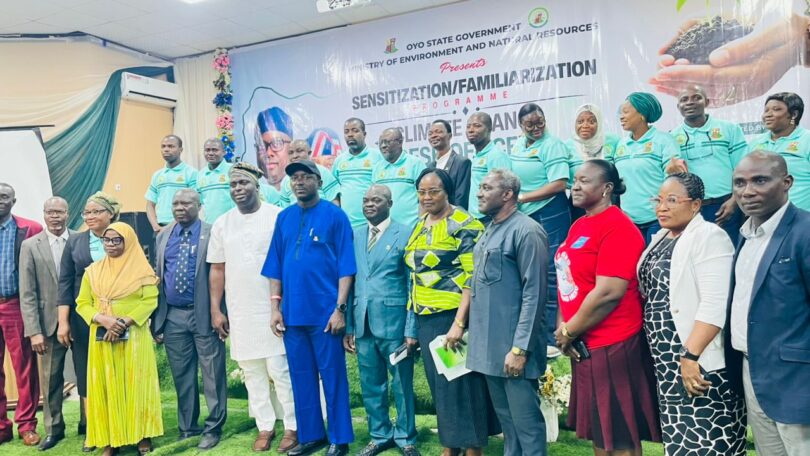
The Oyo State Government has reaffirmed its commitment to strengthening climate governance and expanding climate action to the grassroots, as part of efforts to position the state as a national leader in environmental sustainability and climate resilience.
The achievement was revealed during a Sensitization and Familiarization Programme for Climate Change Desk Officers across Ministries, Departments and Agencies (MDAs), Local Government Areas (LGAs) and Local Council Development Authorities (LCDAs) in the state, themed: “Empowering Local Action for a Cleaner and Climate-Resilient Oyo State.”
Declaring the programme open, the Secretary to the State Government, Prof. Musibau Babatunde who was represented by the Permanent Secretary, Cabinet and Special Services Department, Mr. Ojelabi Olusola, described the ranking improvement as evidence of deliberate and measurable climate actions by Governor Makinde administration.
He said the state government remained committed to extending climate governance initiatives to local governments, Community Development Associations (CDAs) and MDAs to ensure sustainability.
He also called for effective monitoring mechanisms and periodic reporting to track climate action progress across the state.
In his remarks, the Commissioner for Environment and Natural Resources, Hon. Ademola Aderinto, described the development as a reflection of the state government’s growing commitment to climate resilience and environmental sustainability under the leadership of Governor Seyi Makinde.
According to him, climate change has become a visible reality affecting livelihoods through flooding, irregular rainfall, rising temperatures, land degradation, food insecurity and biodiversity loss.
He noted that the government was decentralising climate action by extending environmental initiatives to local governments, communities and institutions across the state.
The commissioner explained that the newly inaugurated climate desk officers would serve as coordinators for environmental reporting, awareness creation, policy implementation and climate risk communication within their respective jurisdictions.
He stressed the importance of regular reporting and monitoring of climate-related activities to enable the state aggregate its carbon reduction efforts and further improve its climate governance profile.
Aderinto highlighted several climate initiatives already undertaken by the state government, including the procurement of over 1,600 electric motorcycles for political office holders across local governments to reduce carbon emissions.
He also disclosed that the state government is constructing a 12-megawatt alternative energy power plant within the state secretariat and installing solar-powered streetlights in different parts of Ibadan as part of efforts to promote renewable energy.
Chairman of the House Committee on Environment, Hon. Olorunpoto Abdulrahman, commended the Ministry of Environment for broadening environmental discussions beyond waste management to include climate resilience and sustainability.
He urged the climate desk officers to become active environmental response coordinators capable of addressing grassroots environmental challenges such as flooding, blocked drainage systems and indiscriminate waste disposal.
Highlighting the state’s previous activities and efforts on climate change, the Permanent Secretary of the Ministry of Environment and Natural Resources, Dr. Sunday Ojelabi, outlined several climate-related achievements recorded by the state government over the years.