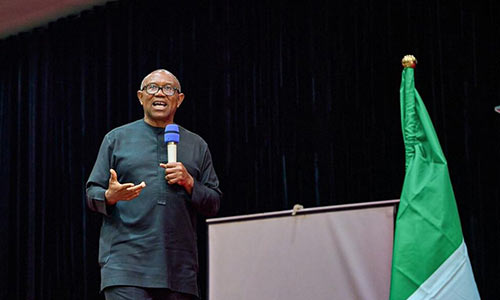
The presidential candidate of the Nigeria Democratic Congress (NDC) and former Governor of Anambra State, Peter Obi, has raised concerns over what he described as Nigeria’s growing preference for politics over entrepreneurship, warning that a country where people in government do better than entrepreneurs is “a failed country” and that Nigeria’s high interest rate regime is systematically killing small businesses and discouraging the productive investment that should be the foundation of national prosperity.
Speaking on Saturday, June 14, 2026, at the This Generation Conference 2026, the annual conference of Summit Bible Church in Abuja, under the theme “Thriving in the Marketplace,” Obi addressed young innovators and entrepreneurs with a message that combined economic analysis, personal reflection, and a sharp critique of a national culture he said has placed political patronage at the centre of economic life at the expense of innovation, hard work, and wealth creation.
Obi framed the core problem in stark terms: “Any society where people prosper more in politics than in business is a failed society. Any society you see people in government doing better than entrepreneurs, then it is a failed country. That’s why our country is not working.”
The statement encapsulates a criticism that goes beyond partisan politics to address a structural distortion in Nigeria’s economy. In a healthy economic system, the wealthiest and most influential individuals drive value through technology, manufacturing, services, and innovation, while the government serves as a regulator and enabler creating a stable framework for enterprise. In Nigeria, Obi argued, this relationship has been inverted: political office has become the primary vehicle for wealth accumulation, attracting talent away from productive enterprise and into a system of patronage, rent-seeking, and resource extraction.
The consequence, he argued, is that the country’s most capable individuals pursue political positions for personal enrichment rather than channelling their energy into building businesses that create jobs, generate tax revenue, and lift communities out of poverty.
Obi identified Nigeria’s high interest rate environment as one of the most immediate threats to entrepreneurship and small business survival.
“Small businesses die in Nigeria because of high interest rates. No business will survive on 35 per cent interest rate,” Obi stated.
He argued that entrepreneurs and manufacturers are increasingly unable to access the affordable credit needed to expand operations and create jobs. Instead, financial institutions find it more attractive to lend to the government, which offers guaranteed returns through treasury bills and bonds at rates that make private sector lending comparatively unappealing.
The result, Obi argued, is a lending environment that starves the productive economy of capital while channelling available resources into government borrowing, a cycle that sustains public sector expansion while the private sector, which should be the engine of employment and growth, withers.
Drawing comparisons with countries such as Japan and Singapore, where governments provide entrepreneurs with affordable access to credit as a deliberate policy to stimulate innovation and economic diversification, Obi argued that Nigeria must fundamentally rethink its lending policies if it hopes to reduce unemployment, drive economic growth, and build a productive economy.
“Empowering businesses through favourable financing conditions would yield greater national benefits than an economy dominated by political patronage,” Obi stated.
Obi drew on his personal entrepreneurial journey to illustrate how dramatically the economic environment has changed. He recalled a period early in his career when he purchased vehicles for as little as N2,700 and N7,359, and when a trip to the United Kingdom cost N100.
While the comparison reflects decades of currency depreciation and inflation rather than a direct policy critique, Obi used it to underscore the contrast between an era when aspiring entrepreneurs could enter business with modest capital and the present reality where soaring borrowing costs, regulatory barriers, and limited institutional support have made it increasingly difficult for young Nigerians to start and sustain enterprises.
The personal anecdote also served a motivational purpose: demonstrating that one of Nigeria’s most prominent business figures built his career from humble commercial beginnings rather than through political connections, reinforcing his argument that the country’s future prosperity depends on empowering entrepreneurs rather than expanding the political class.
Obi warned specifically against a cultural trend in which young Nigerians see entering political office as a faster route to wealth than the discipline, patience, and risk involved in building businesses.
He argued that when the incentive structure of a society rewards political alignment more than market innovation, the consequences are predictable: talented individuals pursue political offices for wealth rather than starting businesses that create jobs; national resources are spent on government upkeep and political patronage rather than on infrastructure, education, and public services; genuine entrepreneurs are stifled by corruption, high regulatory barriers, and poor infrastructure; and local and foreign investors move their capital to environments where markets are fair and property rights are secure.
Obi tasked the innovators and entrepreneurs in his audience to develop what he called “an entrepreneurial mindset capable of transforming ideas into sustainable ventures,” stressing that “consistency, resilience, and discipline remain critical ingredients for long-term business success.”
The This Generation Conference 2026 was convened by the Senior Pastor of Summit Bible Church, Dr Andy Osakwe, who in his welcome address described the event as “a broad ecosystem that extends beyond commerce to encompass careers and every sphere of human endeavour that involves interaction and service to others.”
Dr Osakwe stressed the importance of adopting what he called a “trans-generational mindset,” urging participants to pursue goals that create lasting value for society rather than focusing solely on personal advancement and material success.
“True fulfilment lies in building legacies that positively influence future generations and contribute meaningfully to national development,” Osakwe stated.
He emphasised that becoming productive and industrious requires a combination of spiritual dependence and practical preparation, encouraging participants to seek divine guidance while also committing to acquiring the knowledge, competencies, and professional skills needed to excel.
“Faith and excellence should go hand in hand. Individuals who aspire to make a difference in the marketplace must be intentional about personal growth, innovation and continuous learning,” Osakwe stated, adding that “integrity, diligence and a service-oriented mindset remain essential attributes for anyone seeking sustainable success and societal relevance.”
The event featured panel and interactive sessions, keynote addresses, song ministration, and prayer for Nigeria. Speakers who shared business insights with participants included Collins Nwaya, co-owner of Nordic Hotels; Funke Adeoye, Executive Director of Hope Behind Bars Africa; Adebola Adefila, CEO of IreDire; Andrew Ogbeh, founder of SewPro; Ndubuisi Chidomere, CEO of Pamtech Group; Sam Odia, CEO of Millard Fuller Foundation; and Tricia Olufemi-Olumide, CEO of TriciaBiz and founder of Ziba Beach Resort.