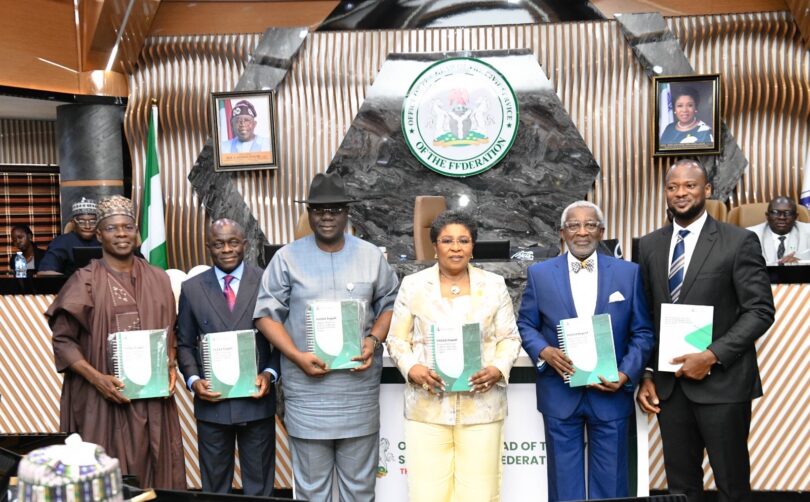
Presentation of the report marks the official closeout of the landmark exercise designed to provide an evidence-based foundation for strengthening the capacity, effectiveness and future-readiness of Nigeria’s Federal Civil Service
Phillips Consulting (pcl.), the Lead Consultant for the Personnel Audit and Skills Gap Analysis (PASGA) project, formally presented the PASGA Report, marking the official closeout of the landmark exercise designed to provide an evidence-based foundation for strengthening the capacity, effectiveness and future-readiness of Nigeria’s Federal Civil Service.
Beyond establishing a clearer picture of the Civil Service workforce, PASGA provides actionable insights to support the next phase of public sector transformation, helping government understand where its workforce stands today, where critical capability gaps exist, and what must be done to build the skills and institutions required for tomorrow.
As Lead Consultant, Phillips Consulting worked alongside 15 cluster consultants, namely Workforce Group, StransformLimited, Pivotage Consulting, MacTay Consulting, TWPC Tech, Knewrow Performance Engineering, Zimedy Services Ltd., Evo & Hogg Limited, GEORGID Consulting, Greenfields Consultancy and Allied Services Ltd., QriosityInternational Limited, 1StepAhead Consulting, Premium-Gold Resources Consulting, Time-Line Consult Limited and Saddat Unique Services Ltd., to deliver the nationwide exercise, bringing together expertise, technology, workforce analytics and project management capabilities to support the successful execution of the assignment across Ministries, Departments and Agencies (MDAs).
A key value of the PASGA Report is its ability to move the conversation beyond personnel numbers to workforce intelligence and capability development.
The report presents key findings from the exercise, including outcomes from the personnel verification process and insights from the skills gap analysis conducted across the Federal Civil Service.
Among other areas, the report provides:
Key findings from the PASGA exercise highlight significant insights emerging from the nationwide assessment.
Verification outcomes, providing an evidence-based view of personnel records across participating MDAs.
Skills gap analysis outcomes, identifying the areas in which capability gaps exist and the skills that require greater attention across the Federal Civil Service.
Capability development priorities, highlighting areas where targeted learning, reskilling, upskilling, and workforce development interventions can have the greatest impact.
Personnel profiles for individual MDAs, providing a more granular view of workforce composition and capabilities across Ministries, Departments and Agencies.
Strategic recommendations to support workforce optimisation, capability development, and institutional effectiveness.
A Reform Implementation Roadmap, outlining priorities and actions across the short, medium and long term to support the progressive transformation of the Federal Civil Service.
Together, these insights provide the government with a stronger basis for making workforce decisions, from identifying capability priorities and designing targeted development interventions to strengthening workforce planning and aligning people capabilities with institutional mandates.
At the heart of PASGA is the recognition that identifying a skills gap is not an endpoint; it is the starting point for transformation.
The skills assessment component provides an opportunity better to understand the competencies available within the Civil Service, identify areas requiring development, and support more targeted approaches to building workforce capability.
For civil servants, the value extends to gaining greater visibility into the skills required to perform effectively in an increasingly volatile public sector environment. For MDAs, the insights provide a basis for more strategic workforce planning, targeted capability development, and improved deployment of talent.
At the system level, the findings create an opportunity to move from broad-based training interventions towards evidence-led capability development, where actual workforce needs and institutional requirements inform development priorities.
This shift is particularly important as the nature of public service continues to evolve, with digitalisation, emerging technologies, changing citizen expectations and increasingly complex policy and service-delivery demands requiring new and enhanced capabilities.
The PASGA Report is therefore positioned not simply as a record of an audit but as an actionable instrument for transformation.
Its Reform Implementation Roadmap provides a structured direction for translating the findings into action, with recommendations spanning immediate priorities, medium-term interventions, and longer-term reforms.
The roadmap is intended to support stakeholders in progressively strengthening workforce capability, institutional effectiveness, and the overall performance of the Federal Civil Service.
By establishing a common evidence base, PASGA creates an opportunity for government and MDAs to make more informed decisions about people, skills, structures and capability investments.
The successful completion and presentation of the PASGA Report further demonstrate Phillips Consulting’s role in supporting complex, large-scale transformation programmesacross Nigeria.
As Lead Consultant, pcl. brought together its experience in workforce transformation, organisational capability, project management, data-driven decision-making and institutional reform to support an exercise with implications that extend beyond individual MDAs to the broader effectiveness of the Federal Civil Service.
For Phillips Consulting, PASGA reflects its broader commitment to serving as a driver and enabler of transformation for public and private institutions, helping organisations understand their current realities, identify opportunities for improvement, and translate insights into practical pathways for sustainable performance.
The Chairman of Phillips Consulting, Foluso Phillips, stated, “PASGA represents the kind of transformation work that goes beyond a single project or a single report. It is about creating the evidence, insights and direction required to strengthen one of the most important institutions in our national development ecosystem – the Federal Civil Service. As Lead Consultant, Phillips Consulting is proud to have contributed our expertise to an exercise of this scale and significance. The completion of PASGA reinforces our belief that sustainable transformation begins with understanding people, capabilities and institutions, and using that understanding to make better decisions.”
Olawanle Moronkeji, COO, Phillips Consulting, emphasised “The completion of PASGA demonstrates what is possible when workforce data, technology, structured assessment and transformation expertise come together around a clear national objective. The value of the exercise lies not only in what we have established about the workforce today, but in how these insights can inform what happens next. The skills gap analysis gives government a stronger basis for prioritising capability development and building a Civil Service that is increasingly agile, skilled and equipped to respond to the demands of the future.”
Mrs Didi Esther Walson-Jack, OON, mni, Immediate Past Head of the Civil Service of the Federation, noted, “The PASGA Report provides an important evidence base for strengthening the Federal Civil Service. Understanding our personnel profile, capabilities and areas requiring development is essential to building a more effective, responsive and future-ready public service. The findings and recommendations provide valuable direction for the next phase of workforce and institutional reforms, and we appreciate the commitment of Phillips Consulting and the wider consulting team in delivering this important national assignment.”