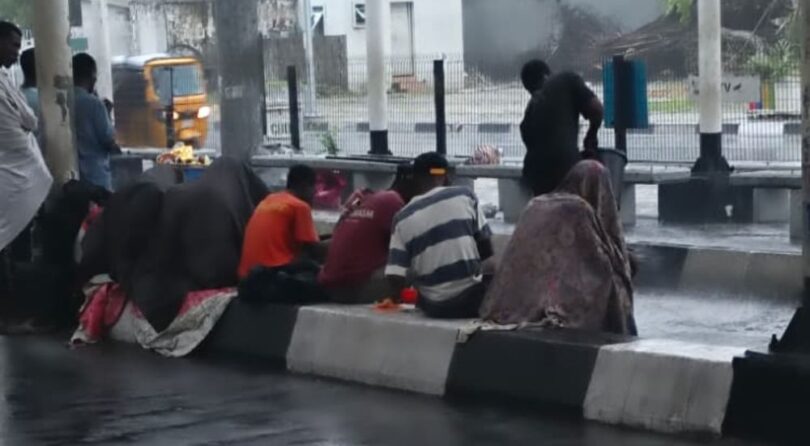
There is a growing trend of teenagers sleeping in public spaces across Lagos. This has raised concerns about homelessness, child welfare, poverty, and urban neglect in Nigeria’s commercial capital.
The teenagers, many of whom appear to have recently completed secondary school, are frequently seen around pedestrian bridges, bus terminals, markets, and major roads across the state.
In April, NewsNGR correspondent visited Ojodu-Berger and observed at least seven teenagers sleeping beneath and around the pedestrian bridge in the area. Some of them had work tools beside them, suggesting they were shoemakers or artisans trying to survive in the city.
With nothing to sleep on, the teenagers lay directly on the bare pavement in the early hours of the morning. The scene was observed around 6:30 a.m., as commuters moved through the area to begin their day.
At Oshodi, similar scenes have become common. Teenagers are often seen sleeping around pedestrian bridges and bus stops in the early hours of the day, while in Oyingbo Market, some young boys sleep beside their wheelbarrows before beginning daily labour activities.
At the Bus Rapid Transit (BRT) terminal in Tafawa Balewa Square (TBS), NewsNGR also observed teenagers alongside older homeless adults sleeping on waiting seats within the terminal. While some carried bags and personal belongings, others had nothing with them except duvet covers and pieces of clothing.
Observers say some of the teenagers appear to have no identifiable means of livelihood or vocational skills, leaving them exposed to crime, exploitation, drug abuse, and other social dangers.
Along Ozumba Mbadiwe Avenue in Victoria Island, several bus stops have gradually turned into makeshift sleeping areas for homeless youths and adults. Some are seen there not only in the early mornings but also during the afternoon, indicating that the spaces may have become semi-permanent shelters.
The situation has sparked growing public concern, particularly on social media.
In February, an X user, YL_IN_LAGOS (@yL_IN_LAGOS), shared photographs of teenagers he claimed were not more than 15 years old sleeping on road pavements in Victoria Island.
The images quickly went viral and triggered widespread reactions from Nigerians who expressed concern over the increasing number of vulnerable children and teenagers living on the streets.
“Was passing through VI this morning, then I saw (sic) this young young Kids sleeping outside beside the express,” the user wrote.
“(Sic) Non of them is up too 15 years old….I’m really sort of words.”
Reacting to the incident, the Lagos State Commissioner for Environment and Water Resources, Tokunbo Wahab, described the trend as troubling and blamed peer influence for some of the cases involving runaway teenagers.
“It is deeply troubling to see teenagers who should be under the care and protection of their parents roaming the streets and sleeping in public spaces across Lagos,” Wahab said.
“Many of the cases we have encountered show that some of these young people are influenced by peers and end up running away from home.”
The commissioner explained that the state government usually transfers such teenagers to the Ministry of Youth and Social Development whenever they are picked up during enforcement operations.
“As a government, whenever such children are apprehended during our operations, they are not abandoned. They are handed over to the appropriate authorities under the Ministry of Youth and Social Development, where they are properly profiled, counselled and kept in safe custody while efforts are made to trace and reunite them with their parents or guardians,” he added.
The issue later took an emotional turn after the mother of one of the teenagers seen in the viral photographs reportedly contacted the X user, saying her 14-year-old son was among those sleeping on the streets.
According to her, the boy had been missing since November 2025. The woman, who said she was unfamiliar with Lagos, pleaded with the public to assist her in locating her son.
Responding to the development, Wahab urged parents and guardians of missing children to report such cases to the authorities immediately.
“If a parent has reached out indicating that a child is missing, I encourage them to formally report at the nearest police station and also contact the Ministry of Youth and Social Development so proper verification can be carried out immediately,” he said.
The increasing presence of teenagers sleeping in public places is becoming a visible social challenge across Lagos. From Abule-Egba on the mainland to Victoria Island on the island, similar scenes are emerging daily, reflecting worsening economic hardship, family instability, migration pressures, and the growing number of vulnerable youths struggling to survive in the city.
Child rights advocates and social welfare experts have warned that if urgent interventions are not implemented, more teenagers could become exposed to criminal networks, substance abuse, trafficking, and long-term homelessness.
A legal practitioner and Principal Counsel of the Basic Rights Council Initiative, James Ibor, described the trend as evidence of deep systemic failures in governance, education, and social protection.
Ibor argued that Nigeria exhibits several characteristics of a failing state, with citizens left to merely survive amid economic hardship and institutional decay.
“Nigeria is a state of particular concern because all the indices of a failed state has manifested,” he told NewsNGR.
“Social services are nonexistent. I cannot say it is weak. It is non-existent.”
According to him, the failure of the education system has contributed to rising youth vulnerability, with many children attending school only to obtain certificates rather than acquire meaningful skills.
Ibor warned that the growing number of children heading households, some forced to beg or engage in informal labour to support sick or elderly relatives, signals a broader breakdown in social protection systems.
“We have to deliberately rebuild the nation. Unfortunately, not with the set of leaders we have today.
“And my fear is that we don’t even have young people who have been prepared to take over. So we have to declare a state of emergency in rebuilding our nation,” he added.
In January, the mass arrest of street children along the Lekki-Epe Expressway sparked widespread debate, with social advocates, celebrities and the Lagos State Government expressing differing views on how the issue should be addressed.
Nigerian chess player and coach Tunde Onakoya condemned the arrests as inhumane and ineffective.
He argued that repeated crackdowns fail to resolve the deep-rooted causes of child homelessness.