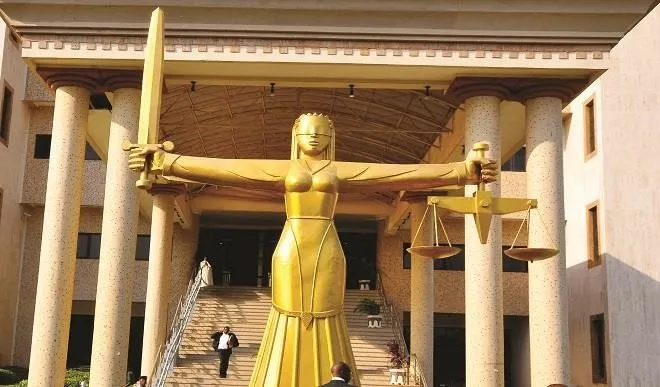
)The Federal High Court has issued (Pre-Election) Practice Directions, 2026, for a fair, impartial and expeditious determination of pre-election cases across the country.
The new practice direction was issued by the Chief Judge (CJ), Justice John Tsoho on Tuesday.
This, the CJ said is in exercise of the powers conferred on him by virtue of Sections 254, 285 (9), (10) and (14) of the 1999 Constitution (as amended), Sections 29 (5) and 88 (2) of the Electoral Act, 2026 and all other powers enabling him to that regard.
The FHC’s Director of Information, Dr. Catherine-Oby Christopher, made this known in a statement on Tuesday in Abuja.
The court said the practice directions is also aimed at ensuring that in all election matters, the parties focus on matters which are genuinely in issue.
The CJ said it would minimise the time spent in dealing with interlocutory matters; ensure that the possibility of amicable settlement is explored before the parties go into hearing and minimise undue adjournments and delays in the conduct of matters.
He also said that it was in line with the constitution, the Electoral Act, 2026, and other applicable laws.
“The Federal High Court of Nigeria hereby notifies members of the Bar, political parties, litigants and the general public that the Honourable the Chief Judge of the Federal High Court, Hon. Justice John Terhemba Tsoho, OFR, has issued the Federal High Court (Pre-Election) Practice Directions, 2026.
“It is instructive that the current Practice Directions has repealed the 2022 version,” the CJ said.
According to a copy of the (Pre-Election) Practice Directions, 2026 attached to the statement, the provisions of the Federal High Court (Civil Procedure) Rules, 2019 shall apply to any issue not provided for in this Practice Directions.
“The court, in every pre-election matter before it, shall pay particular attention to the provisions of Sections 29 (5) (6) (7), 83 (5) & (6), 88 (1 4) of the Electoral Act, 2026 and Section 285 (14) (C) of the 1999 Constitution (as amended)
“A party challenging the conduct or outcome of a primary election shall join as respondents in the suit, all the relevant parties to enable the court to effectively determine the dispute,” it said.