The presidency said it was unable to understand which land borders Atiku intended to reopen, insisting that Nigeria’s borders with neighbouring countries are already open.
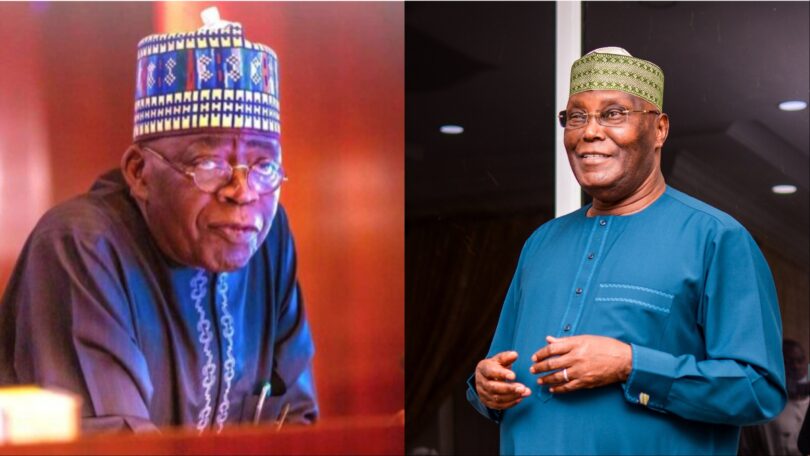
The Presidency has faulted a proposal by Atiku Abubakar, the presidential candidate of the African Democratic Congress (ADC), to reopen Nigeria’s land borders that are still shut if elected president in 2027.
Mr Dare said the Tinubu administration directed the reopening of most of the country’s land borders on 14 March 2024 and that the directive had not been reversed.
He stated this in a statement on Friday in response to Atiku’s pledge to reopen Nigeria’s land borders that remain closed and introduce policies to ease the importation and movement of goods if elected president in 2027.
“The facts are straightforward: Nigeria’s land borders are already open. The Federal Government announced the reopening of most of the country’s land borders on 14 March 2024, and it has not reversed that position.
“It is therefore difficult to understand which borders the former Vice President intends to ‘open’ when the borders are already open. On February 14, 2026, President Tinubu opened the Kamba border in Kebbi State, with attendant economic and diplomatic gains,” he said.
PREMIUM TIMES earlier reported that Atiku pledged to reopen land borders that remain shut and develop seaports in the southern part of the country to create a more balanced system for the importation and transportation of goods.
Atiku, a former vice president who has sought to become Nigeria’s president in six election cycles since 1993, said the closure of land borders had forced many businesses to shut down and contributed to worsening insecurity in the country.
The former vice president said during his campaign for the 2023 presidential election, which he lost, that he held discussions with shippers and ship-development companies in Europe to seek their support for the development of ports in the South-south and South-east.
Nigeria’s busiest seaports are concentrated in Lagos, creating what many consider an imbalance in the country’s import and export infrastructure, despite the fact that other southern states, including Akwa Ibom and Bayelsa, have coastlines and access to the Atlantic Ocean.
Mr Dare asked Mr Atiku to clarify his proposal, particularly whether he intended to relax existing border controls.
He said Mr Atiku should explain which controls he intended to remove and the safeguards his administration would put in place to prevent terrorism, arms trafficking, smuggling, human trafficking and other forms of transnational organised crime.
“If he means he would relax existing border controls, then Nigerians deserve to know precisely which controls he intends to remove, why he considers their removal necessary, and what safeguards his administration would deploy against terrorism, arms trafficking, smuggling, human trafficking, and other forms of transnational organised crime,” he said.
Mr Dare also described Atiku as “unhinged”, accusing him of making statements aimed at attracting and deceiving his supporters.
“This distinction is fundamental. But of course, Atiku is unhinged now, and he would say or announce anything to attract and deceive the politically gullible,” he said.
He argued that borders should be managed through modern border-management systems rather than being left uncontrolled.
“An open border is not an uncontrolled border. Modern border management is designed to facilitate legitimate movement, trade and economic interaction while preventing criminals and terrorist organisations from exploiting the same channels.
“Effective border governance therefore requires a combination of immigration control, customs administration, intelligence-sharing, surveillance, technology and coordinated security operations.
“This is particularly important for Nigeria because our northern security environment cannot be divorced from developments across the Sahel and the Lake Chad Basin,” he said.
The presidential spokesperson maintained that, although Nigeria’s land borders are open, the government must continue to prioritise security and prevent terrorists and criminal networks from exploiting porous borders.
“As Atiku rightly acknowledged, Nigeria shares borders with Niger, Chad, and Cameroon. While the region continues to confront terrorism, violent extremism and transnational organised crime have proven to be domestic disturbances that have found border porosity as a channel for their export to other countries,” he said.
Mr Dare referenced the Global Terrorism Index 2026, which he said indicated that approximately 41 per cent of terrorist attacks occur within 50 kilometres of an international border, while about 64 per cent occur within 100 kilometres.
“Borderlands are particularly vulnerable where difficult terrain, limited state presence and weak coordination create opportunities for terrorist organisations to operate.
“The implications for Nigeria are obvious. As domestic insurgencies evolve into increasingly networked and transnational terrorist threats, effective border management becomes an indispensable component of national security.
“Terrorists and criminal networks exploit sovereign boundaries precisely because security forces cannot simply pursue them across international borders without appropriate cooperation and legal frameworks,” he said.
Mr Dare clarified that the presence of security agencies in border communities does not mean that the government has closed the country’s land borders.
“Consequently, Nigeria’s focus on the Northeast and Northwest corridors, including the coordinated deployment of the Armed Forces and other security institutions, should not be misconstrued as evidence of closed borders. It reflects responsible border security.
“The former Vice President, as an experienced politician who has previously occupied the second-highest office in the country, should know this distinction,” he said.
The presidential spokesperson said politicians’ comments on national security and the economy should be based on facts and accompanied by a clear alternative policy agenda.
He said Nigerians should expect Atiku to explain how his proposed administration would improve border surveillance, strengthen intelligence-sharing with neighbouring countries, modernise customs and immigration operations, deploy technology, protect border communities and deepen regional cooperation against terrorism and organised crime.