The committee’s issued the threat following the DG’s repeated failure to appear before it for allegedly refusing to resign in adherence to President Bola Tinubu directive requiring political appointees seeking elective offices in the 2027 general elections to do so by 31 March.
The House of Representatives Committee on Legislative Library, Research and Documentation has threatened to recommend sanctions against the Director-General of the National Institute for Legislative and Democratic Studies (NILDS), Abubakar Sulaiman, over his alleged participation in the 2026 All Progressives Congress (APC) governorship primary election in Kwara State while still occupying his public office.
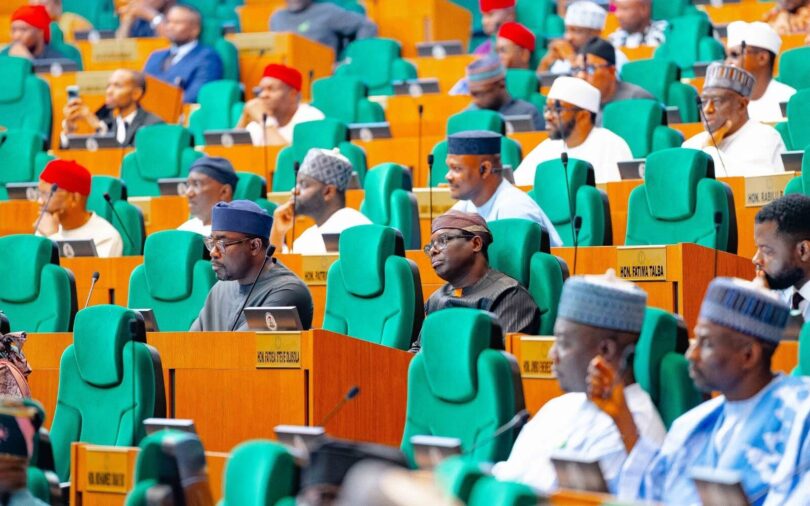
The committee chairman, Yusuf Galambi, stated this on Tuesday during an investigative hearing on the need to preserve the political neutrality of public institutions and ensure compliance with constitutional, administrative and other rules governing the participation of public office holders in electoral contests.
Mr Galambi said the NILDS DG was invited to appear before the committee on 18 June, 24 July and 4 August but failed to attend any of the hearings.
He contrasted Mr Sulaiman’s absence with the conduct of the petitioners, who, according to him, had consistently appeared before the committee to substantiate their allegations.
“We invited the DG of NILDS to appear before this honourable committee on the 18th of June; he refused to come. We gave him a second chance on the 24th of July; he did not honour the invitation, and today, 4th of August, he did not show up.
“Meanwhile, the petitioners are always here, waiting to prove the allegations against him,” he said.
The chairman said the committee had provided the NILDS Director-General with sufficient opportunity to respond to the allegations but had resolved to proceed with the matter following his repeated absence.
“Our committee believes that if allegations are levelled against someone and he is given an opportunity to defend himself, and he refuses, it means he has something to hide.
“So, in our resolution today, following his refusal to appear before the committee, the committee has resolved that the allegations against him stand. We are going to write our recommendations to the House, and the allegations stand,” Mr Galambi said.
He said the committee could conclude its investigation and submit its report and recommendations to the House without further waiting for Mr Sulaiman.
However, the committee chairman said the NILDS director-general would still be given an opportunity to respond if he appeared before the report was finalised.
“If he decides to come and defend himself before we write our report and recommendations, we will allow him,” he said.
Mr Galambi cited the Code of Conduct for Public Officers, the Public Service Rules and the Electoral Act as part of the legal and administrative framework governing political activities by public office holders.
He referred to the Fifth Schedule, Section 7(1) of the Code of Conduct for Public Officers, which prohibits public officers from placing themselves in a position where their personal interests conflict with their public duties.
He also cited Rule 030422 of the Public Service Rules and Section 88(1) of the Electoral Act 2026, which he said restrict political appointees from being voting delegates or contestants at party conventions, congresses and primaries for the purpose of nominating candidates for elections.
The chairman further referred to Section 84(12), which he said provides requirements relating to the resignation or disengagement of public officers seeking elective positions.
According to him, the provisions are intended to protect the neutrality of public institutions, prevent conflicts of interest and stop public resources from being deployed for partisan political activities.
The investigation followed a petition considered by the House on 4 June concerning the alleged participation of Mr Sulaiman in the APC governorship primary in Kwara State while serving as NILDS DG.
According to Mr Galambi, the petition contains allegations bordering on the alleged use of government facilities, vehicles and personnel for partisan political activities.
It also raises concerns over the alleged failure of public office holders to resign or take the required leave before engaging in political campaigns or seeking elective office.
The committee chairman said the investigation was intended to determine the extent to which public officers seeking elective positions complied with constitutional, administrative and other applicable requirements.
He said the committee was also mandated to examine measures adopted by ministries, departments and agencies and the Head of the Civil Service of the Federation to preserve political neutrality in public institutions.
The panel, he added, would recommend legislative, administrative and prosecutorial measures where necessary to deter future violations and protect the integrity of public institutions.
Mr Galambi stressed that the National Assembly did not oppose the political ambitions of public officers but insisted that such ambitions must be pursued within the law.
“Let me state this clearly. The National Assembly does not begrudge any public officer their constitutional right to aspire. Section 40 of the 1999 Constitution of the Federal Republic of Nigeria, as amended, guarantees that right. But that right must be exercised within the law.
“You cannot serve two masters. You cannot be a regulator in the morning and a campaigner in the afternoon using state resources,” he said.
The committee’s position comes against the backdrop of a directive by President Bola Tinubu requiring political appointees seeking elective offices in the 2027 general elections to resign their appointments by 31 March.
The directive, announced by the Office of the Secretary to the Government of the Federation in March, applied to ministers, presidential advisers and assistants, as well as Directors-General and chief executive officers of federal government parastatals, agencies, commissions and government-owned companies.
According to the directive, affected officials were required to submit their resignation letters through the Office of the Secretary to the Government of the Federation no later than 31 March.