At the time the debate commenced, 87 senators were in attendance, exceeding the constitutionally required two-thirds majority needed to pass such an amendment. Two-thirds of the Nigerian 109-senate is 73.
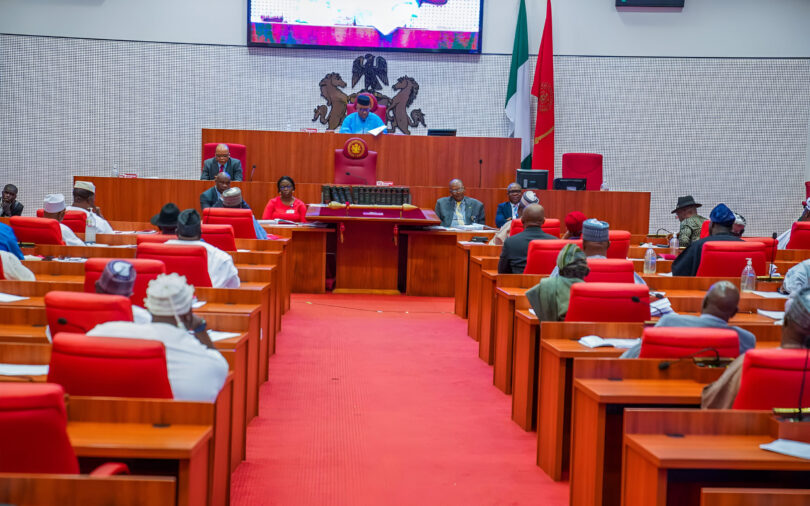
Nigerian senators have commenced the final debate on a constitutional amendment bill seeking to establish state police.
The Senate Leader, Opeyemi Bamidele, led the debate on the consideration of the bill.
At the time the debate commenced, 87 senators were in attendance, exceeding the two-thirds majority required to pass such an amendment. Two-thirds of the Nigerian 109-senate is 73.
The lawmakers will use a manual voting process to determine whether the bill secures the required two-thirds majority. Under this procedure, each senator will stand up, introduce themselves and publicly declare whether they support or oppose the bill.
The Senate President, Godswill Akpabio, said the manual voting process is necessary to enable Nigerians to know the position of each lawmaker on the proposed state police system.
Mr Bamidele, while leading the debate on the bill, said its provisions reflected the views expressed by stakeholders during the regional public hearings and in memoranda submitted to the National Assembly.
Mr Bamidele said the bill does not abolish the federal policing structure but rather seeks to strengthen Nigeria’s policing system. According to him, state police would be responsible for crime prevention and monitoring, as well as the recruitment and training of personnel.
He added that establishing state police commissions would strengthen oversight mechanisms and reduce the likelihood of arbitrary police control.
Ogun State Governor, Dapo Abiodun, and his counterparts from Ondo and Kaduna states, Lucky Aiyedatiwa and Uba Sani, respectively, are present in the chamber to observe the debate.
The Chief of Staff to the President, Femi Gbajabiamila, the Director-General of the Nigeria Governors’ Forum (NGF), Lateef Shittu, and attorneys-general of some states are also in attendance.
The House of Representatives passed the state police bill on 11 June. On the same day, the bill passed second reading in the Senate and was subsequently referred to the Senate Committee on Constitutional Review for further legislative consideration.
On Tuesday, when senators convened for an emergency plenary, Mr Akpabio read a letter from President Bola Tinubu requesting the lawmakers to consider and pass the constitutional amendment bill seeking the establishment of state police.
Mr Tinubu transmitted a draft of the bill, along with its various clauses, to the upper chamber, though it remains unclear whether those clauses differ from the version that passed second reading in the Senate two weeks ago.
What is certain, however, is that the draft contains additional provisions not included in the version passed by the House of Representatives. The president acknowledged this in his letter.
“The bill builds on the significant work already done in this regard by the House of Representatives and the Senate, and incorporates additional safeguards to ensure that the creation of a dual policing structure to address our nation’s evolving national security challenges will be achieved quickly and effectively to the benefit of all Nigerians,” the letter read.
The president’s disclosure suggests that some provisions contained in the version earlier passed by the House may be amended or replaced during the legislative process.
Political interests are also expected to shape the debate, with governors likely to push for provisions favourable to state governments, while lawmakers may seek to include clauses that align with their own interests.
As it stands, senators have only begun debating the bill at the committee of the whole stage. Any version eventually approved by the Senate will be harmonised with the House version through a conference committee before the final bill is transmitted to the president for assent.
The call for a state police is still a contentious issue among Nigerian political figures. Some argued that without proper arrangements, state police could be exploited by governors to harass political opponents, suppress dissent, and stifle press freedom. Supporters, however, maintained that the best way to tackle insecurity in the country is through state policing.
So far, only Kebbi South Senator, Garba Maidoki, has publicly opposed the bill, arguing that the timing is inappropriate and that lawmakers were not given sufficient time to review the 146-page draft.
Mr Maidoki, a member of the African Democratic Congress (ADC), expressed his opposition during an appearance on Channels Television’s Politics Today on Tuesday.
The senator said he and other like-minded lawmakers would oppose the bill when it comes up for final passage.
Mr Maidoki’s concerns appear valid, particularly given that the Senate began debating the bill less than 24 hours after the president transmitted it to the National Assembly. The short timeframe may not allow lawmakers to adequately scrutinise the document before making a final decision.
Nevertheless, there are indications that the bill will secure the required support and pass the Senate today.