The bill seeks to devolve policing powers to subnational governments to strengthen Nigeria’s internal security architecture.
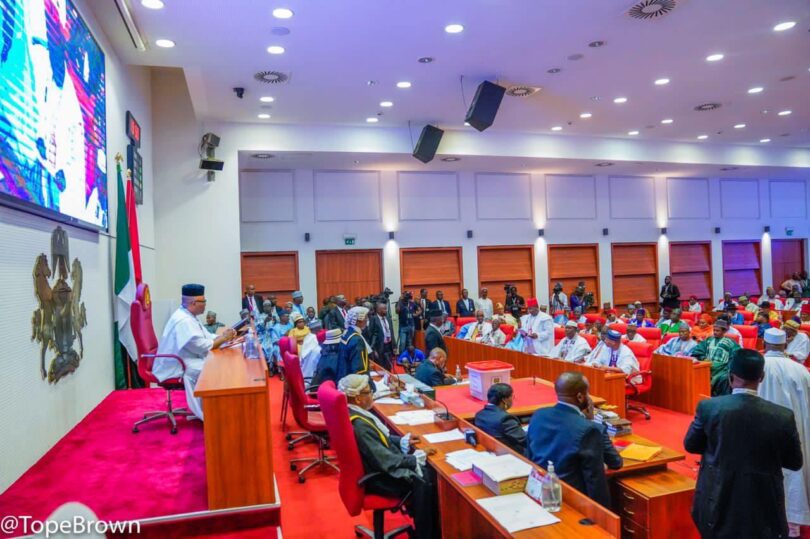
A bill seeking to establish state police passed the second reading in the Senate on Wednesday.
After the passage, the bill was referred to the Senate Committee on Constitution Review, chaired by the Deputy Senate President, Barau Jibrin, for further legislative scrutiny, including the conduct of public hearings to gauge public opinion on the proposed state police system.
The bill, sponsored by the Senate Leader, Opeyemi Bamidele, seeks to devolve policing powers to subnational governments to strengthen Nigeria’s internal security architecture.
The proposed legislation also seeks to modernise the country’s policing framework by establishing State Police Service Commissions to regulate recruitment, training, and oversight of personnel.
In addition, it proposes moving policing from the Exclusive Legislative List to the Concurrent Legislative List, thereby allowing both federal and state governments to exercise policing powers.
Mr Bamidele, while leading the debate on the bill, said the introduction of state police was not intended to weaken the Nigeria Police Force, but to strengthen security operations at all levels of government.
Addressing concerns that governors could abuse state police, the Senate leader said the bill establishes State Police Commissions, which would be responsible for recruitment, training, and coordination of state policing activities, thereby serving as an institutional safeguard against political interference.
He said state policing would improve intelligence gathering and strengthen the nation’s security architecture.
“It will improve intelligence gathering: Local police officers are better equipped to obtain actionable intelligence from communities because they understand local languages, customs and social structures.
“Modern policing relies heavily on intelligence rather than force. State Police will significantly strengthen Nigeria’s intelligence architecture,” the senate leader, who made a strong case for the establishment of a state police system, added.
Mr Bamidele further said state police would reduce the burden on the federal police and promote community-based policing.
“It will also relieve pressure on the Federal Police: The Federal Police currently bears responsibility for policing the entire nation. Establishing State Police will allow the Federal Police to focus on interstate crimes; terrorism; organised criminal networks; border security; cybercrime; protection of federal assets and national security operations,” he added.
He added that the proposal would strengthen Nigeria’s federal system by ensuring a more equitable distribution of powers and responsibilities among different tiers of government.
“It will strengthen Nigeria’s federal structure. Nigeria operates a federal system of government. Under a true federation, powers and responsibilities should be appropriately shared among different levels of government. Most mature federations maintain sub-national police institutions alongside federal law enforcement agencies,” he said.
Over the years, there have been calls from some state governments and civil society organisations for localised policing as incidents of armed robbery, communal clashes and other security challenges increased.
A National Conference was convened during the administration of former President Goodluck Jonathan, where the participants recommended the creation of state police as a strategy to reduce insecurity.
The insurgency of banditry, kidnapping, and other terrorist activities has increased pressure from governors and political leaders for the creation of state police.
In the absence of a formal state policing structure, some regions have established informal security outfits such as Amotekun in the South-west, Ebube Agu in the South-east, and Hisbah in the North-west.
Despite the security challenges, the call for a state police is still a contentious issue among political figures. Some argued that without proper arrangements, state police could be exploited by governors to harass political opponents, suppress dissent, and stifle press freedom. Others said the best way to reduce insecurity is through state policing.
Recently, the Senate President said the proposed state police framework would establish a National State Police Commission to regulate the operations of state police formations, including the recruitment, training, promotion, discipline, and conduct of officers.
During the debate, most senators expressed support for the proposal, saying state police could provide a lasting solution to the country’s growing security challenges.
The Chief Whip, Tahir Monguno, said the creation of state police would strengthen grassroots security and enhance efforts to combat insecurity nationwide.
He noted that involving local communities in security operations would improve effectiveness, deepen public trust and strengthen intelligence gathering.
However, Adamu Aliero (Kebbi Central) cautioned that any reform must comply with constitutional requirements.
Mr Aliero argued that Nigeria’s security challenges may not be solely structural. He noted that, with fewer than 400,000 police officers serving a population of over 200 million, the country may require a significant increase in workforce in addition to institutional reforms.
The House of Representatives had earlier in the day passed a bill to establish state police.
If there are differences between the versions passed by both chambers at the third reading stage, each chamber will establish a committee to harmonise those differences before transmitting them to the president for assent.