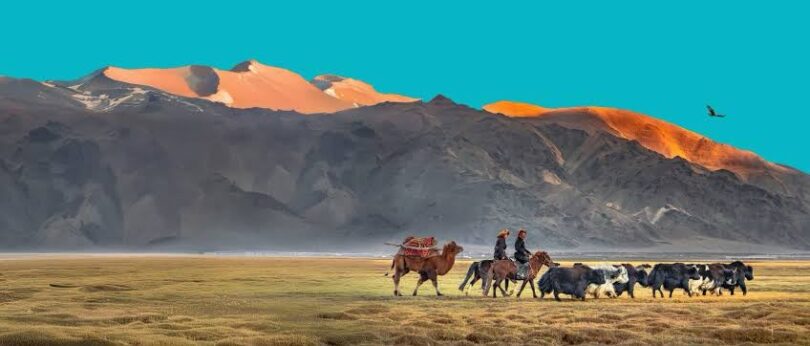
As Nigeria prepares to participate in the 17th session of the UNCCD (COP17) in Mongolia, the country’s rangelands and grazing routes are facing mounting pressure from desertification, drought, land degradation and competing land-use demands.
On a Monday in early August, when a herd of cattle led by pastoralists strayed into a soybean farm in the Pampo community, Kataeregi District, Katcha Local Government Area, Niger State, North-central Nigeria, an argument broke out between the farmers and the herders.
The incident is the latest in a long-running pattern of farmer-herder clashes that has affected agrarian communities across Nigeria. Repeated confrontations and reprisal attacks have devastated communities, caused deaths and disrupted agricultural activities and livelihoods.
Over the past decade, farmer-herder conflicts in Nigeria have resulted in thousands of deaths, widespread displacement and significant economic losses, particularly across the Middle Belt and North-central regions.
Documentation by organisations, including Amnesty International and the Nigerian Security Tracker, has recorded thousands of deaths linked to the conflicts. Previous reports have also documented intense periods of violence, including more than 3,600 deaths during one multi-year spike and an estimated 3,000 deaths across North-central states during a subsequent five-year period.
At the heart of the conflict is increasing competition over shrinking land and natural resources. Data show that Nigeria has about 417 grazing reserves covering a land area of about 4.5 million hectares, spread across the Northern region and parts of the South West (Oyo and Ogun states). Of this figure, 273 have been officially gazetted. However, over the decades, the physical network of routes and rangelands has become increasingly dysfunctional due to anthropogenic pressures driven by population growth, urbanisation, and the Land Use Act of 1978.
Meanwhile, extreme weather events such as rapid desertification, recurrent droughts, and pasture degradation have reduced the availability of grazing land in northern Nigeria and other parts of the Sahel. As pastoralists move in search of water and pasture, they increasingly come into contact with sedentary farmers whose livelihoods depend on cultivated land.
The proliferation of small arms and light weapons has also transformed what might otherwise have been localised disputes over crops, livestock and access to land into deadly confrontations.
In some areas, experts say, criminal groups and armed gangs have exploited existing communal tensions, further worsening insecurity. However, they have also hinted that the crisis cannot be addressed solely as a security problem. The deteriorating condition of Nigeria’s rangelands and grazing routes is also central to the problem.
As global attention turns to COP17, Nigeria’s rangelands are coming under increasing pressure from desertification, climate change and competing land-use demands. The degradation is disrupting pastoral livelihoods, increasing pressure on agricultural land and threatening biodiversity across northern Nigeria and the wider Sahel.

In an interview with PREMIUM TIMES, Naziru Zakari, a Bauchi-based wildlife conservation expert, said rangelands are critical not only to pastoralism but also to biodiversity conservation.
“I am going to speak from the perspective of wildlife conservation and management as a conservation biologist. Firstly, rangelands are extremely important for biodiversity conservation because they are where many wildlife species find refuge and survive,” he said.
Mr Zakari said rangelands also provide habitat for rare and endangered species that may not necessarily be found within protected areas.
“This brings home the importance of efficient management of rangelands, as it affects biodiversity conservation,” he said.
According to him, human activities, including grazing, farming and infrastructure development, have contributed significantly to the degradation and encroachment of rangelands and grazing routes in Nigeria.
He criticised the management of grazing routes and rangelands by government institutions, saying ineffective management has contributed to their deterioration.
“This has led to the degradation of the grazing routes and rangelands, leaving the nomadic herders with no option but to encroach into government wildlife protected areas and private lands to graze their animals, and sometimes even settling for some period of time if they notice the place is rich for feeding their livestock,” he said.
Mr Zakari said the resulting competition for land and pasture has helped sustain farmer-herder clashes.
“Hence, the clash between farmers and herders continues to erupt as a result of this,” he said.
He called for improved management of grazing routes and government-owned grazing reserves, arguing that simply eliminating grazing routes without providing alternative infrastructure would not resolve the problem.
“In my candid opinion, the government’s improvement of rangeland management and grazing routes will go a long way in solving the farmer-herder clashes,” he said.
“This can be done because there are already land-use practices and government policies regarding the use of land. The government can ensure strict compliance with the law.”
Mr Zakari added that the government should invest in infrastructure within grazing reserves and strengthen law enforcement to encourage pastoralists to use designated areas.

In the face of this problem, the federal government has increasingly promoted ranching as part of its response to the long-running farmer-herder crisis.
This prompted the government to initiate the National Ranching Policy framework that began taking shape following the establishment of the Federal Ministry of Livestock Development in July 2024.
The rollout has occurred in stages.
In September last year, the government launched the broader operational framework, the five-year National Livestock Master Plan,