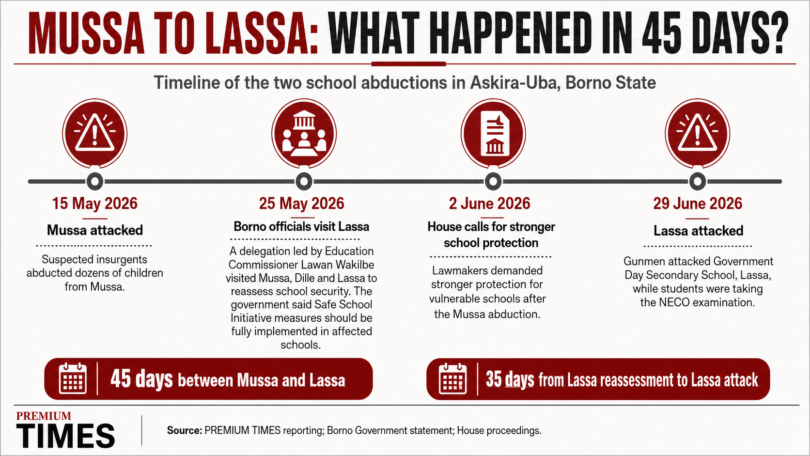
Ten days after the abduction of schoolchildren in Mussa, Borno State, Government officials visited Lassa to reassess school security and ordered the implementation of Safe Schools measures in the affected schools. Thirty-five days later, gunmen attacked Government Day Secondary School, Lassa.
Ten days after suspected insurgents abducted dozens of children in Mussa, Borno State officials visited neighbouring Lassa to reassess the security situation and evaluate the safety of its public schools.
After the assessment, the government said Mr Wakilbe directed that “all Safe School Initiative measures be fully implemented in the affected schools pending further government directives.”
Fasuma Askira, education secretary of Askira-Uba Local Government Area, was among the officials listed as members of the delegation.
The government also said the temporary closure and relocation of Government Day Secondary School, Mussa, was an immediate safety measure under the Safe Schools Initiative.
Thirty-five days later, Lassa was attacked.
On 29 June, suspected insurgents attacked Government Day Secondary School, Lassa, while students were taking the National Examinations Council examination.
Some abductees were recovered shortly after the attack, but subsequent verification by PREMIUM TIMES established that 36 students and a teacher remained in captivity.
The Lassa attack came 45 days after Mussa.
The government had, however, announced Safe Schools measures between the two attacks.
Interviews with parents, community leaders and the local education authority, together with parliamentary and government records reviewed by PREMIUM TIMES, did not establish what measures were implemented at Government Day Secondary School, Lassa, following the May assessment.
Mrs Askira, who was reportedly part of the government delegation that visited Lassa, told PREMIUM TIMES in an interview on 19 August that the Safe Schools programme was not operating in schools in the affected area.
The federal body coordinating the country’s Safe Schools response also did not clarify, despite repeated enquiries, whether Mussa or Lassa had been registered, verified or formally assessed under the national programme, what intervention reached the area, or how the Borno government’s announced measures related to the federal Safe Schools structure.
The effects of the insecurity have also spread throughout the local education system.
Mrs Askira confirmed that only 56 of Askira-Uba’s 113 primary schools were functioning following security-related closures, compared with 76 before the Mussa crisis.
Security concerns around Mussa and Lassa did not begin with the May attack.
More than a year before the Mussa abduction, concerns over the security situation in the communities had reached the House of Representatives.
On 20 February 2024, Midala Balami, who represents Askira-Uba/Hawul Federal Constituency, sponsored a motion titled “Need to Prevent Killings and Deploy Urgent Security Measures in Saban Gari, Kelle, Dille, Lassa and Mussa Towns in Askira-Uba and Hawul Local Government Areas in Borno State.”
The House noted that attacks, killings and destruction in the communities had become recurrent and said there was an urgent need for “robust and efficient security measures” to prevent further attacks.
It urged the Nigerian Army and other security agencies to deploy, strengthen and intensify security measures in Mussa, Lassa, Dille and the surrounding axis.
Eight months later, the House again discussed security in the same communities, this time in relation to education.
On 15 October 2024, Mr Balami sponsored another motion regarding the difficulties faced by students taking JAMB, WAEC, and SSCE examinations in Mussa, Dille, and Lassa.
The House noted that insecurity was affecting students in the communities and called on the Federal Ministry of Education to collaborate with security agencies to ensure the safety of students, teachers and examination materials.
It also mandated relevant committees to monitor compliance.
The records show that security concerns in Mussa and Lassa had been formally brought before the National Assembly more than a year before the two school abductions.
On 15 May 2026, suspected insurgents attacked Mussa.
PREMIUM TIMES subsequently obtained a register from Mussa Ward councillor Peter Wabba identifying 40 missing children by name, age and family background.
Further checks in the community at the time suggested the number could be higher, with families and local officials producing varying counts.
Mr Wabba later told PREMIUM TIMES that little reliable information about the children’s whereabouts had reached grassroots community leaders.
“At our level, there is no information apart from hearsay,” he said.