The renewed interest highlights the enduring relevance of the artist’s exploration of everyday life and overlooked childhood realities.
Months after its release, The Hills That Raised Us, a 2025 photographic series by Nigerian visual artist Chukwudi Nwachukwu, is drawing renewed attention online.
While the series was not initially launched with widespread publicity, its recent traction has sparked conversations around childhood, labour and the environments that shape young lives.
Speaking with Premium Times, the soft-spoken artist said the renewed interest in the work has been both unexpected and reflective.
“I didn’t set out for it to trend. But I think the images are relatable. People have seen these scenes before, so when they come across them again in a different way, it stays with them,’’ he said.
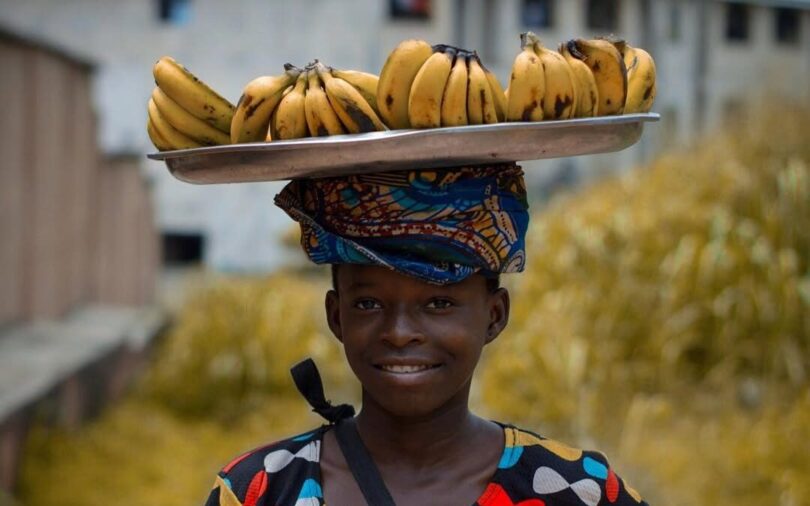
Shot in Uturu, Abia State, the series focuses on children who sell groundnuts along busy roadside markets, balancing trays on their heads as they move between vehicles and travellers. At first glance, the scenes are ordinary. But Mr Nwachukwu says the intention was always to look deeper.
“The work looks beyond what they are doing to who they are becoming,” he said.
During the series’ production, the project took on a more personal dimension when the photographer met one of the children who shared his name.
The boy explained that he was hawking during his school break to support himself and his family while waiting for the next term.
 “That moment felt personal. I could relate to that sense of responsibility at a young age.”
He linked the experience to his upbringing in Aba, Abia State, a city widely known for its industrious culture.
“Growing up in Aba, you observe the rhythm of work early. It shapes how you see effort and survival,” he added.
Across the series, Uturu’s red hills appear quietly in the background of each frame. They are constant but understated.
For the artist, meaning extends beyond geography.
“The hills are not just scenery. They represent the environment that raises people, not just where they live. The idea that the environment shapes identity lies at the heart of the project.’’ he explained.
Born in 1999, Mr Nwachukwu studied Mass Communication at Abia State University, Uturu, where his interest in storytelling deepened.
Now based in Port Harcourt, his work spans photography and film, combining documentary and observational approaches to explore everyday life.
 His projects often focus on communities, urban spaces, and what he describes as the “quiet rhythms of labour” that define daily survival.
“I’ve always been curious about how people live and what they carry within them,” he said.
That curiosity, he explained, was shaped by his upbringing in a religious household, where his father served as a clergyman.
“People came with different struggles and expectations. You begin to understand, over time, how much people carry, even when they don’t say it,” he noted.
Mr Nwachukwu’s style is deliberately restrained. He relies on natural light and simple composition, allowing his subjects and their environments to speak without exaggeration.
Through both photography and film, he aims to preserve everyday experiences that are often ignored.
“I want to document real moments and preserve stories that might not always be seen as important,” he said.
The Hills That Raised Us also opens up broader conversations about childhood and labour in many Nigerian communities, where responsibility often begins early.
Rather than dramatise these realities, the series presents them with dignity and honesty.
“It’s about paying attention to what we already see and understanding it better,’’ he said.
Months after its release, the renewed attention suggests that the images are finding new meaning with audiences, not because they are unfamiliar, but because they reflect a reality many recognise.