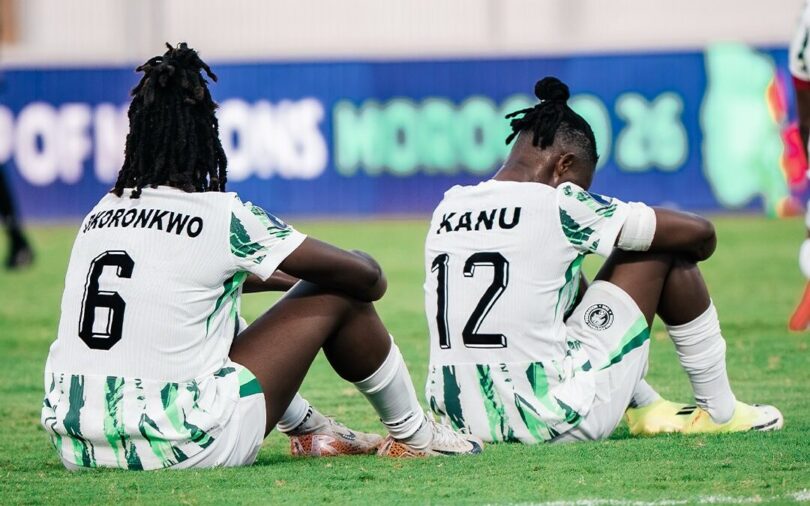
The signs were there that the Falcons had fallen off their perch, but that is not the most hurtful thing: the fact that the players have been let down by the football federation, which clearly showed no iota of strategy or plan to help the team succeed.
The signs have been there since last year, when the collective strength of the players, not any masterplan from the Nigeria Football Federation (NFF), dragged the team to a 10th WAFCON title in Rabat.
Like the biblical Samson, who did not know his strength had left him, the Falcons arrived in Morocco believing that ten stars on the badge and a rich history would be enough to waltz through. It wasn’t. Nigeria stumbled through the group stage. They lost to WAFCON debutants Malawi, scraped past Zambia 1-0, and needed a fortuitous 6-2 rout of Egypt to survive on goal difference.
In Nigerian parlance, they wobbled and fumbled their way into the quarter-finals, where Cameroon shut them out entirely. Only the four WAFCON semi-finalists earn automatic World Cup places. Under Gusau’s NFF, both of Nigeria’s flagship national teams, the Super Eagles and the Super Falcons, have now failed to qualify for their respective World Cups through the front door. That is not misfortune. That is the cumulative cost of two decades of drift.
Twenty years ago, Nigeria’s advantage in African women’s football was so overwhelming that a serious, funded, long-term plan could realistically have produced a World Cup semi-finalist by now. Three things were needed, and none were sustained.
A real domestic league, treated as infrastructure rather than charity. The Nigeria Women’s Football League has survived on the goodwill of state governments and sporadic sponsorship rather than a coherent commercial and broadcast strategy. Compare that to Morocco, which five years ago launched a deliberate national women’s football strategy, based on youth academies, a professionalised league, coaching pipelines, and is now reaping continental finals and automatic World Cup qualification as a direct result. Nigeria had a decade’s head start in talent and squandered it in administration.
A structured pathway from Flamingos and Falconets to the senior team. Nigeria’s women’s youth sides have consistently reached the latter stages of global finals, proving that raw talent has never been the problem. What has been missing is a federation-run bridge, a clear coaching philosophy, sports science, and fitness benchmarks that translate youth promise into senior-team readiness, rather than leaving each generation to rediscover form from scratch under a new coach.
Nigeria’s biggest asset is the number of Falcons playing in Europe and the United States. But scouting, integration, and camp welfare have too often been reactive. Players called up close to tournaments, bonus disputes resurfacing at the worst possible moments, and preparation windows compressed instead of planned years in advance. A federation serious about semi-finals and beyond would have built year-round data on every eligible player abroad and resolved welfare issues long before they became distractions at major tournaments.
None of this required extraordinary money. It required continuity of leadership and a plan that outlived any single NFF administration, something Nigerian football has rarely had.
The damage is not irreversible, but it will not be undone by the rhetoric of the kind Amaju Pinnick’s era was known for or by another four years of ad hoc tournament preparation.
First, whoever wins September’s NFF election must present, before the vote, a costed and time-bound women’s football strategy, not a manifesto line but a document with named milestones, the way Morocco’s federation did.
Second, the domestic league needs a broadcast and sponsorship overhaul that makes playing in Nigeria financially viable again, so talent isn’t lost to obscurity before it can be scouted. Third, a full-time technical department should track every Nigerian-eligible player abroad from the youth level, so squad-building for major tournaments starts years, not months, in advance.
Fourth, welfare and bonus structures need to be settled in contract terms and made permanent, removing the recurring off-field distractions that have dogged the team at major tournaments.
Let me be clear. For the Super Falcons, the playoff route to Brazil isn’t just a path; it’s the only door left standing. Miss it, and this generation watches the World Cup from home for the first time. That alone should be unthinkable.
But here’s the painful truth: even qualification won’t erase two decades of stagnation. It will only delay the reckoning. Yet if the Falcons fail to make it to Brazil entirely? That missing presence would make the case for reform in September undeniable, not by choice, but by the sheer weight of humiliation.
And perhaps, heartbreakingly, that might be the only silver lining left: a crisis so loud that even the deaf finally hear the call for change. Also, much more painful is that instead of resigning their posts, the administrators, collectively, are seeking another team in office—for what?
Nigeria has never lacked players capable of reaching a World Cup semi-final. What it has lacked, for two decades, is a federation willing to build the system around them. September’s election is the clearest chance in years to change that.