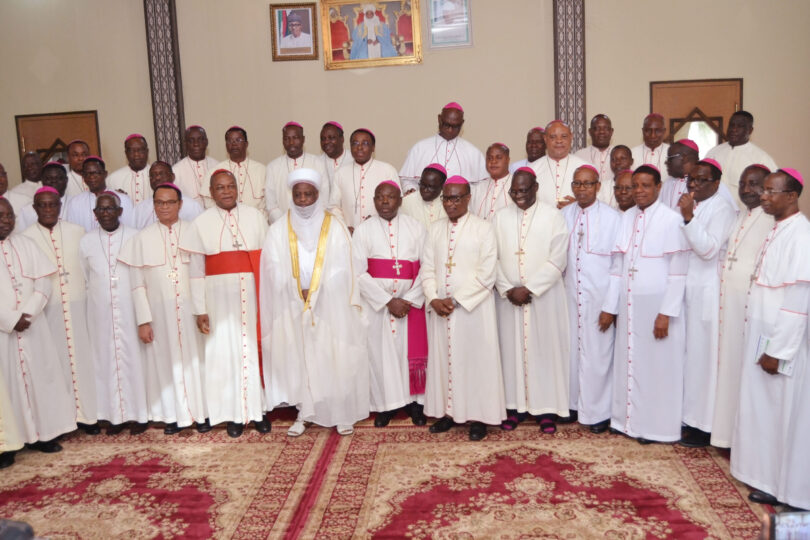
The Sultan of Sokoto and President-General of Jama’atu Nasril Islam (JNI), Muhammad Sa’ad Abubakar, and the Catholic Bishops Conference of Nigeria (CBCN) made the calls in separate statements
Nigeria’s top Muslim and Catholic leaders have expressed deep concern over the country’s security situation, jointly urging the federal government to take urgent steps to curb persistent killings, kidnappings and other violent crimes.
Their interventions come amid attacks by bandits, insurgents and other armed groups, including recent incidents that left dozens dead and hundreds displaced in the northern regions.
The concerns also follow a series of high-profile security incidents in recent weeks, including deadly attacks on communities in Sokoto and the abduction and subsequent death in captivity of retired Major General Rabe Abubakar in Katsina State, underscoring the continuing threat posed by armed groups despite ongoing security operations.
In a message marking the commencement of the Islamic New Year (Muharram 1448 AH), the Sultan urged Nigerians to combine spiritual efforts with practical support for security agencies in tackling the country’s security challenges.
According to a statement issued by the Secretary-General of JNI, Khalid Abubakar Aliyu, the Sultan said the nation’s security situation demands collective responsibility from citizens, religious leaders and government institutions.
“The time has come for us to look inward and rededicate ourselves to Allah while working together with relevant security agencies to stabilise the nation,” the statement quoted him as saying.
As part of efforts to seek divine intervention, the Sultan directed imams leading daily congregational prayers across the country to observe Qunootun-Nawazil—special prayers traditionally offered during periods of calamity, conflict or distress.
He also appealed to Muslims to dedicate the first Friday congregational prayer of the new Islamic year, scheduled for 19 June, to prayers for peace, security and national stability.
The Archbishop of Lagos and Vice-President of the Catholic Bishops Conference of Nigeria (CBCN), Alfred Martins, said Nigerians were increasingly frustrated by the persistent killings, kidnappings and displacement across the country.
Mr Martins spoke during a thanksgiving Mass at Holy Cross Cathedral in Lagos to celebrate the 90th birthday, 60 years of priestly ministry and 55 years of episcopal service of Anthony Okogie.
He urged President Bola Tinubu and other elected leaders to intensify efforts to restore peace and security nationwide.
“Every day we hear of people being kidnapped, soldiers being ambushed and killed, communities displaced and traditional rulers fleeing their domains. It is becoming increasingly difficult to understand what is happening in our country,” he said.
The cleric added that the greatest gift political leaders could offer Nigerians—and Mr Okogie in particular—would be a country where citizens can live, travel and sleep without fear.
Mr Martins called for improved welfare, motivation and equipment for security personnel, arguing that the current security challenges require a stronger and more effective response.
While acknowledging measures taken by the government to address insecurity, he said many Nigerians believed the situation had continued to deteriorate despite official assurances and ongoing security operations.
“As CBCN, we have consistently drawn attention to these challenges and suggested ways forward. While the government has explained steps being taken, the problems persist and, in many cases, are getting worse,” he said.
The remarks by the Sultan and the Catholic bishops reflect deepening anxiety among religious leaders over the human and economic costs of insecurity, which continues to disrupt livelihoods, force displacement and undermine public confidence in state institutions.
Their interventions also highlight a significant convergence between Nigeria’s foremost Muslim and Catholic leadership on the urgent need for stronger measures to protect lives, secure communities and restore confidence in the country’s security architecture.