According to the body, illicit trade exposes weaknesses in regulation, enforcement, border control and market surveillance while Nigeria’s porous borders continue to fuel smuggling, allowing untaxed and unverified products to enter the market.
Across Nigeria, wines and spirits are familiar features of everyday social life, present at weddings, birthdays, naming ceremonies, business engagements, and weekend gatherings, and play a vital role in moments of connection, celebration, and shared experiences. This important role that spirits and wines play in our everyday social life is however threatened by increasing illicit trade in the sector.
Made up of notable organisations including Bacardi, Brian Munro Limited, Diageo, Guinness Nigeria, Moët Hennessy, Nigerian Bottling Company, Nigerian Breweries, Pernod Ricard Nigeria and William Grants & Sons, SWAN believes that fragmented enforcement cannot defeat organised criminal networks, especially with the coordination of counterfeit syndicates observed over time. That is why the association organised the workshop, to bring all the key stakeholders around the table to explore ways to better tackle the menace.
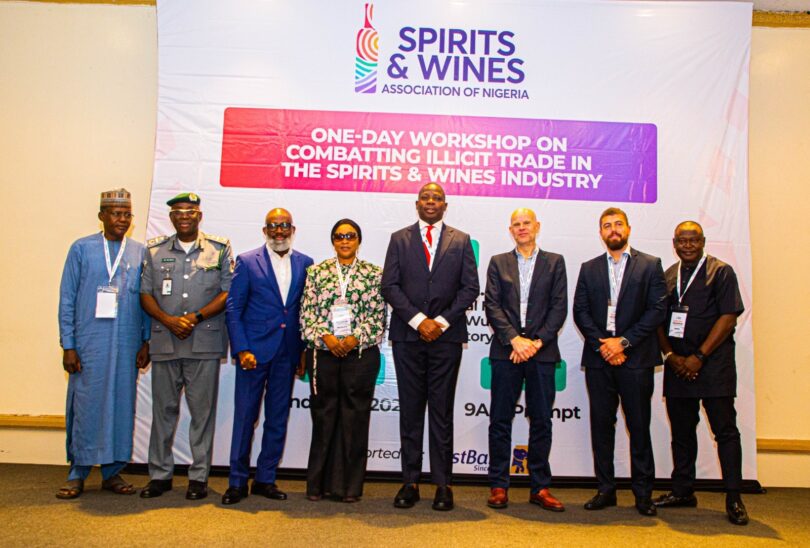
Held on 22 April 2026 at Abuja Continental Hotel, Abuja, the high-level workshop brought together key players across the value chain, all united by the shared objective of combatting fake and adulterated alcoholic products threatening lives and livelihoods. Apart from regulatory agencies, law enforcement bodies, manufacturers, distributors, legislators, senior media practitioners, the diplomatic community and international organisations, including Interpol and the Alliance Against Counterfeit Spirits (AACS), were also represented.
According to the body, illicit trade exposes weaknesses in regulation, enforcement, border control and market surveillance while Nigeria’s porous borders continue to fuel smuggling, allowing untaxed and unverified products to enter the market. The conclusion at the workshop indicates that the Standards Organisation of Nigeria, the Nigeria Customs Service, the National Agency for Food and Drug Administration and Control, and the Federal Competition and Consumer Protection Commission and other stakeholders have critical roles in combating illicit trade.
In his opening remarks, the Managing Director of Pernod Ricard and President of SWAN, Michael Ehindero, described illicit trade as a direct threat not only to business integrity but to human life.
“Illicit trade, defined as the production, importation, or sale of goods outside regulatory frameworks, continues to pose risks to consumer protection, government revenue, and legitimate businesses.
“This includes counterfeiting, smuggling, illegal production, tax evasion, and the diversion of legitimate products into unauthorised channels. It is a global challenge that cuts across multiple sectors in the consumer goods industry, food and beverages, pharmaceuticals, tobacco, cosmetics, and alcohol, with significant consequences for public health, government revenues, and economic development.
According to him, counterfeiters are increasingly replicating trusted brands, producing and distributing illicit products outside regulated systems while smuggling and parallel imports continue to bypass safety checks and taxes.
“Beyond the human cost, illicit trade has a devastating impact on our economy. Governments lose billions in tax revenue, funds that should be supporting education, healthcare, infrastructure, and public safety.
Legitimate businesses that invest in compliance, quality, and employment are unfairly undercut. Jobs are lost. Investor confidence is shaken. This is not a victimless crime, it weakens entire value chains and slows national development,” he added.
Speaking at the event, Tony Okwoju, SWAN Director-General, called for stronger stakeholder-led enforcement against illicit trade due to its impact on lives, legitimate business and government revenue.
Providing a global perspective, David Francis, Managing Director of the Alliance Against Counterfeit Spirits (AACS), highlighted the increasing sophistication of counterfeit operations, noting that fake packaging materials are often mass-produced abroad and shipped into local markets.
“They’re becoming organised into gangs, well-organisednetworks and becoming really sophisticated. The quality of the things we are seeing coming from China into this market are making it increasingly challenging for consumers to spot fake goods, whether they’re bad or good, or whatever the fundamentals are.

“So, you’ll see the labels, you’ll see the cartons, you’ll see the bottles, and you’ll see the caps. This is a do-it-yourself counterfeiting kit coming into the domestic market. All you need to find is the liquid. And we all know that the liquid is relatively easy to source in any domestic market around the world. So again, I just want to highlight how important it is that we stop these things getting into the market,” he said.
Also speaking, Kingsley Uranta, a media expert, called for stronger investigative journalism to expose the networks behind illicit trade, stressing that the problem is both widespread and deeply entrenched.
At the regulatory level, agencies acknowledged the growing threat of illicit trade while outlining ongoing interventions. The Federal Competition and Consumer Protection Commission (FCCPC) described the situation as a serious public health and economic challenge. In his keynote address, Tunji Bello, Executive Vice Chairman of FCCPC, warned that illicit alcohol trade is a “multi-dimensional crisis” affecting consumer safety, market integrity, and public revenue.
“It is not merely an industry problem,” Bello said, stressing that the issue touches on “consumer protection, health protection, public revenue, public safety, and indeed the overall integrity of our market.
Kolapo Oladeji, an Assistant-Comptroller of Customs, who represented the service, pointed at ongoing efforts to combat smuggling and strengthen border controls while also calling for improved policy frameworks. According to him, the agency plays a critical role in the wines and spirits industry through licensing local manufacturers and collecting excise duties, while also enforcing fiscal policies for the Federal Government.
“Today, we are faced with smuggling activities, we are faced with tax evasion, we are faced with counterfeiting, and products smuggling, competing with the local manufacturers, who are paying their taxes regularly,” Oladeji asserted while stressing the need for stronger regulatory and legal frameworks, improved tax policies, and enhanced border control and enforcement to curb illicit trade.
Other governmental bodies, including the Standards Organisation of Nigeria (SON) and the Nigeria Customs Service (NCS), reaffirmed their commitment to enforcement but stressed that a unified, multi-stakeholder approach is essential to combat the menace.
“SON, in line with its mandate, remains firmly committed to setting and promoting standards that ensure the quality and safety of alcohol and drinks in the Nigerian market.
“However, tackling illicit trade requires a coordinated, multi-stakeholder approach. No single institution can address these challenges alone. Effective enforcement, intelligence, determination, industry compliance and consumer awareness and transparency mechanisms must work together if we are to achieve lasting results,” Ishaku Mohammed, said on behalf of the agency.
Deliberations at the workshop produced a range of recommendations, including the creation of a formal multi-stakeholder coordination platform, intelligence-led enforcement strategies, increased investigative journalism and and the strengthening of laws. Participants also emphasized the need for sustained public awareness campaigns, whistleblower mechanisms, and tighter supply chain controls.
With SWAN declaring an all-out offensive against illicit trade and stakeholders pledging sustained collaboration, there is cautious optimism that the Abuja engagement marks a turning point. And the consensus leaves no one in doubt: that only a united front, anchored on enforcement, technology, industry accountability, and public vigilance, can halt the spread of illicit trade and protect both consumers and legitimate businesses.