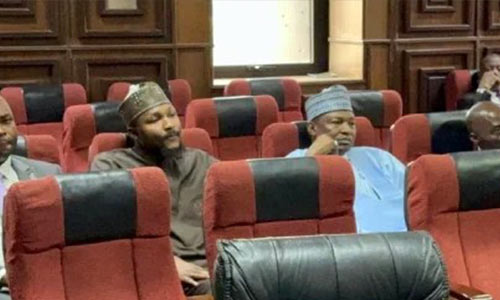
The Federal Government has amended the charges filed against former Attorney-General of the Federation Abubakar Malami and his son Abdulaziz, removing the allegation of terrorism financing that formed the centrepiece of the original prosecution leaving the defendants facing only a charge of illegal possession of firearms in what critics are likely to describe as a dramatic scaling back of a case that was used to justify the former minister’s arrest, prolonged detention, and re-arrest across multiple security agencies.
At the court session on Wednesday, Akinlolu Kehinde, counsel to the Department of State Services, informed the court about the amendment and applied to substitute the former charge with the new one. The amended charge borders solely on illegal possession of firearms, alleging that arms and live cartridges were found in Malami’s residence in Birnin Kebbi, Kebbi State.
Both defendants pleaded not guilty to the amended charge, and the presiding judge, Justice Joyce Abdulmalik, allowed them to continue on the bail terms and conditions granted on February 27, 2026 — N200 million each with two sureties in like sum. The case was adjourned to May 26 and June 15 for trial.
The significance of the amendment lies not in what remains but in what was removed.
When Malami and Abdulaziz were first arraigned by the DSS on February 3, 2026, they faced a five-count charge bordering on alleged terrorism financing and illegal possession of firearms charges that carry some of the most severe penalties under Nigerian law and that were used to justify extraordinary security measures around the former minister.
The terrorism financing component was the most explosive element of the original charge. The DSS had accused Malami of refusing to prosecute terrorism financiers whose case files were reportedly forwarded to the office of the Attorney-General for prosecution during his tenure an allegation that suggested the former AGF had actively shielded individuals linked to terrorism from justice.
That allegation has now been entirely removed from the case, leaving only the firearms possession charge a significant downgrade that transforms the case from one involving national security and terrorism to a relatively straightforward criminal charge about weapons found at a residence.
The amended charge alleges that arms and live cartridges were found in Malami’s residence in Birnin Kebbi. The prosecution did not, in open court, provide details about the quantity or type of arms allegedly recovered, the circumstances of the search, or when the alleged recovery took place.
The charge of illegal possession of firearms, while still a criminal offence under the Firearms Act, carries significantly less severe penalties than terrorism financing under the Terrorism (Prevention and Prohibition) Act and lacks the political and national security dimensions that made the original charge so consequential.
Malami’s counsel, Shuaibu Aruwa SAN, confirmed that his clients had been served with the amended charge and agreed that the fresh charge be read to the defendants a procedural step that suggests the defence did not oppose the substitution.
For the defendants, the amendment represents a partial victory. The terrorism financing allegation which carried the most severe potential penalties and the greatest reputational damage has been removed. The remaining firearms charge, while still serious, is a more limited and defensible accusation.
The plea of not guilty to the amended charge sets the stage for a trial that will focus solely on whether the arms and cartridges were found at Malami’s residence and whether their possession was unlawful a narrower factual inquiry than the sprawling terrorism financing case that the original charges contemplated.
Justice Abdulmalik’s decision to allow the defendants to continue on the existing bail terms N200 million each with two sureties in like sum, as granted on February 27 means Malami and his son will not need to apply for fresh bail or satisfy new conditions. The bail terms granted under the original, more serious charges remain in force for the amended, less serious charge.
The removal of the terrorism financing charge raises several critical questions.
Why was the allegation dropped? If the DSS had evidence that Malami refused to prosecute terrorism financiers an allegation that, if proven, would have had enormous implications for national security what happened to that evidence? Has the intelligence been re-evaluated and found wanting, or has a decision been made at a higher level to narrow the prosecution?
Was the terrorism charge justified in the first place? The original charge was used to justify Malami’s arrest by the DSS, his detention, and the extraordinary security measures surrounding his case. If the charge has now been dropped, questions arise about whether it was ever supported by sufficient evidence or whether it was used primarily as a tool to justify detention.
Does the amendment affect the other charges? Malami is also facing prosecution by the EFCC on money laundering charges involving N8.7 billion, alongside his wife and son. The EFCC is also pursuing civil forfeiture of 57 properties. And the ICPC has filed charges at both the Federal High Court and Kaduna State High Court. The DSS charge amendment does not affect these separate proceedings.
What does this signal about the government’s case? The scaling back from five counts including terrorism financing to a single firearms charge could be interpreted in several ways — as the prosecution strengthening its case by focusing on what it can prove, as a concession that the terrorism financing allegation was unsupportable, or as a strategic decision influenced by factors beyond the evidence.
Malami’s prosecution has been one of the most politically charged cases in Nigeria, involving multiple agencies the EFCC, DSS, and ICPC each pursuing separate charges across different courts.
The former AGF has consistently maintained his innocence across all proceedings, describing his prosecution as political persecution linked to his July 2025 defection from the APC to the African Democratic Congress and his association with opposition figures including former Vice President Atiku Abubakar.
The timing of the EFCC’s property marking and seizure of his Maitama residence which came hours after Atiku visited and the involvement of three different security and anti-corruption agencies in his prosecution have fuelled the political persecution narrative.
The dropping of the terrorism financing charge the single most politically explosive allegation against Malami is likely to strengthen this narrative among his supporters, who will argue that the charge was manufactured to justify his detention and has been quietly abandoned now that it has served its purpose.
The trial on the amended firearms possession charge is fixed for May 26 and June 15, 2026. The prosecution will need to prove that the arms and cartridges were found at Malami’s residence and that their possession was unlawful.
Malami’s defence is expected to challenge the circumstances of the search, the chain of custody of the alleged weapons, and whether proper procedures were followed in the recovery arguments the former AGF has foreshadowed in earlier public statements where he accused security agencies of searching his properties without proper notice or his presence.
The separate EFCC money laundering case, the ICPC corruption charges in Kaduna, and the civil forfeiture proceedings for 57 properties all continue independently, meaning Malami remains entangled in multiple legal battles even with the terrorism financing charge dropped.
For the former Attorney-General, Wednesday’s development reduces the legal jeopardy on one front but the war across multiple courts and agencies continues.