By Kabir Abdulsalam —
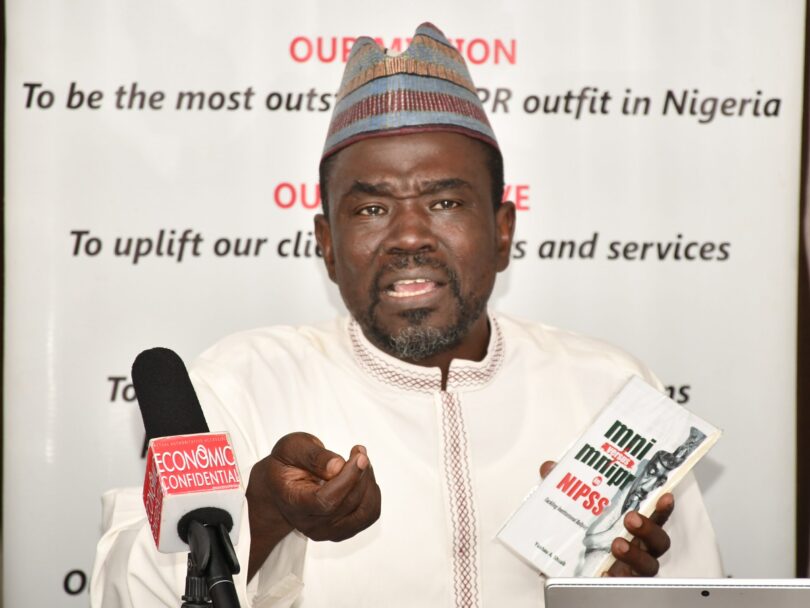
When I received copies of MNI versus MNIPR in NIPSS: Tackling Institutional Bullying and AI in Crisis Communication in Nigeria: Challenges and Prospects, both authored by Yushau A. Shuaib, Managing Director and Chief Executive Officer of Image Merchants Promotion Limited (IMPR), I expected two very different books. One appeared to be a memoir of institutional conflict; the other, an academic work on emerging technology and crisis communication.
Having read both, I discovered they are, in many respects, companion volumes. Together, they tell the story of how personal adversity can become intellectual opportunity, and how an interrupted academic journey can ultimately produce work of lasting national and international significance.
As Associate Editor of Spokespersons Digest—the publication behind the National Spokespersons Awards—I was naturally drawn to Chapter Eight of the memoir, “The NIPR Betrayal,” spanning pages 139 to 161. Having covered the activities of the Nigerian Institute of Public Relations (NIPR) for several years, I approached the chapter with professional curiosity. What I found was an emotionally compelling account that raises broader questions about institutional relationships, professional loyalty and the delicate balance between organisational discipline and support for members.
According to the memoir, shortly after his withdrawal from the Senior Executive Course (SEC) 47 at the National Institute for Policy and Strategic Studies (NIPSS), Kuru, Shuaib was invited to appear before the Ethics Panel of the NIPR Council over actions arising from the dispute.
For someone whose professional life had been closely intertwined with the Institute for more than three decades, the experience was understandably painful.
Shuaib traces his relationship with the NIPR back to his undergraduate days at Bayero University, Kano, where he specialised in public relations and, in 1992, became the first recipient of the NIPR President’s Prize for the Best Graduating Public Relations Student. Three years later, he was honoured as the Kano/Jigawa Chapter’s Public Relations Person of the Year.
His career subsequently expanded beyond Nigeria through advanced studies, including a Master’s degree in Public Relations from the University of Westminster, London, professional research in online public relations, and affiliations with international organisations such as the Chartered Institute of Public Relations (CIPR), the Public Relations Society of America (PRSA), and the International Public Relations Association (IPRA). Under his leadership, IMPR also earned multiple international recognitions, including SABRE Awards Africa and IPRA Golden World Awards.
Against this backdrop, one seemingly minor incident in the memoir becomes symbolically significant. The invitation from NIPR reportedly addressed him as “ANIPR” rather than “MNIPR,” the professional designation he had used for many years and which, according to him, had previously appeared in official correspondence from the Institute.
At first glance, it appears trivial. Yet anyone familiar with public relations understands that titles, professional designations and institutional language often carry symbolic meaning. They communicate recognition, identity and belonging.
Shuaib writes that after drawing the Registrar’s attention to the issue, another invitation was issued, this time omitting any professional designation altogether.
Whether intentional or not, the incident deepened his perception that his decades of contribution were no longer receiving institutional acknowledgement.
Equally striking is the memoir’s account of the National Spokespersons Awards.
The book explains that the initiative was conceived in 2019 during the tenure of Mallam Mukhtar Sirajo as President of the NIPR. Its inaugural edition was independently organised by IMPR in 2021 with the Institute’s endorsement before both organisations entered into a formal partnership through a Memorandum of Understanding in 2023.
The awards have since grown into one of Nigeria’s foremost platforms for recognising excellence in strategic communication, honouring spokespersons, public information managers, corporate affairs practitioners, military communicators and crisis communication professionals.
According to the memoir, however, the partnership was terminated before the expiration of the agreement by Dr. Ike Neliaku led NIPR.
What surprised me further was when the institute, following the termination, introduced another awards platform under a different name.
Reflecting on the episode, Shuaib writes: “Organisations can withdraw endorsements. Partnerships can be terminated. Titles can be withheld. But one’s name—carefully built over decades—must remain answerable first to conscience, history and truth.”
That statement captures the emotional centre of Chapter Eight.
If that chapter represents the wound, Chapter Nine—”A Blessed Disappointment”—represents the healing. In my view, it is the memoir’s most inspiring chapter.