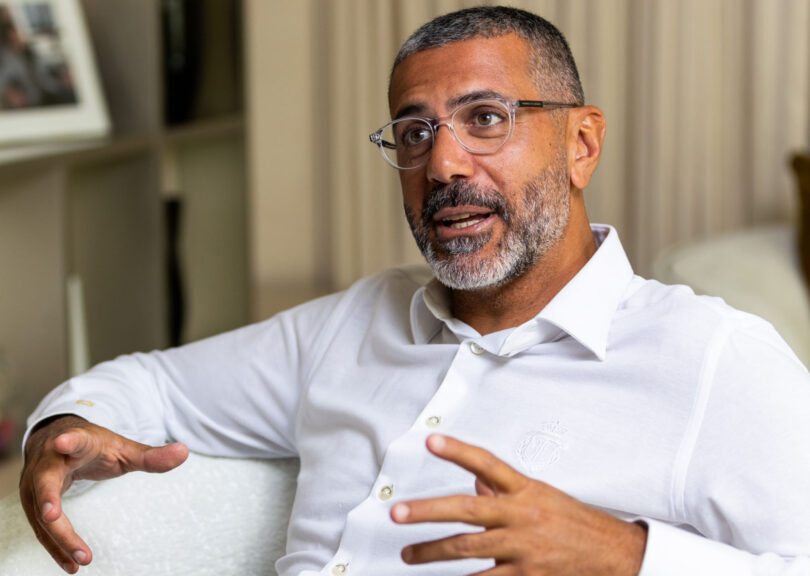
Here is what Bassim Haidar needs you not to talk about.
When he took Optasia to the Johannesburg Stock Exchange in late 2025, investors came in on a specific promise that the company had a near-monopoly position in Nigeria’s airtime and data lending market.
Being Africa’s largest consumer market, Optasia was embedded so deeply in the infrastructure of MTN and Airtel that no competitor could touch it. Thirty-two million transactions a day. ₦5.6 trillion in lending value over five years.
It was the ideal machine that printed money and showed no signs of stopping. On that basis, Haidar raised hundreds of millions of rands from investors who believed they were buying into something close to a sure thing.
What those investors were apparently not told is that Nigeria had a problem with the arrangement. The FCCPC’s Digital Lending Regulations, the framework that Haidar has since gone to extraordinary lengths to destroy, did not materialise from thin air after the IPO.
The regulatory direction was visible. The intent to open the airtime lending market to Nigerian-owned competitors, to require credit bureau data sharing, to restrict exclusivity arrangements, did not come as surprises dropped on an unsuspecting industry.
They were the product of a regulatory process that anyone running a dominant lending operation in Nigeria was watching closely. Haidar was watching it more closely than anyone.
The question that his investors are now asking, and it is the right question, is why none of that found its way into the prospectus as material risk. You see, the difference between “we operate in Nigeria with near-monopoly infrastructure” and “we operate in Nigeria with near-monopoly infrastructure that is currently under regulatory threat” is not a footnote. It is the entire investment thesis. It is the difference between a growth story and a company fighting for survival.
That is why Bassim Haidar is running amok. The court injunction in April 2026 restraining MTN and Airtel was obtained with unusually urgent speed. This cannot be the move of a company calmly confident in the merits of its legal position.
It was a desperate attempt to freeze the regulatory clock before the market could fully process what was happening. Every week that the FCCPC’s framework is held at bay by litigation is another week that Optasia’s share price does not fully reflect the ground shifting beneath it.Haidar retains a fraction of the shares he once held.
The investors who came in at listing are holding the rest. When this unravels, and the trajectory suggests it will, those investors will want to know exactly what he knew, when he knew it, and why they were not told.
Those are not questions that dissolve under pressure.
They are the kind that follow a man out of boardrooms and into courtrooms of a very different kind than the Federal High Court in Abuja.
Nigeria did not create this problem for Bassim Haidar. He created it for himself by building a business model dependent on regulatory capture, by taking that model to public markets without full transparency, and by betting that muscle and litigation could hold back a tide that was already coming in when he was still counting his IPO proceeds.
Surely, the end is nigh. However, Nigeria’s FCCPC’s lending bill is not his enemy. The truth of his IPO prospectus is.