While Peter Obi urged Nigerians to vote against politicians who breach the peace agreement, Omoyele Sowore dismissed the accord as a “ritual” and called for sanctions against violators.
Presidential candidates and national chairpersons of political parties participating in the 2027 general elections on Tuesday signed a national peace accord in Abuja, committing themselves to peaceful and issue-based campaigns ahead of the commencement of electioneering on Wednesday.
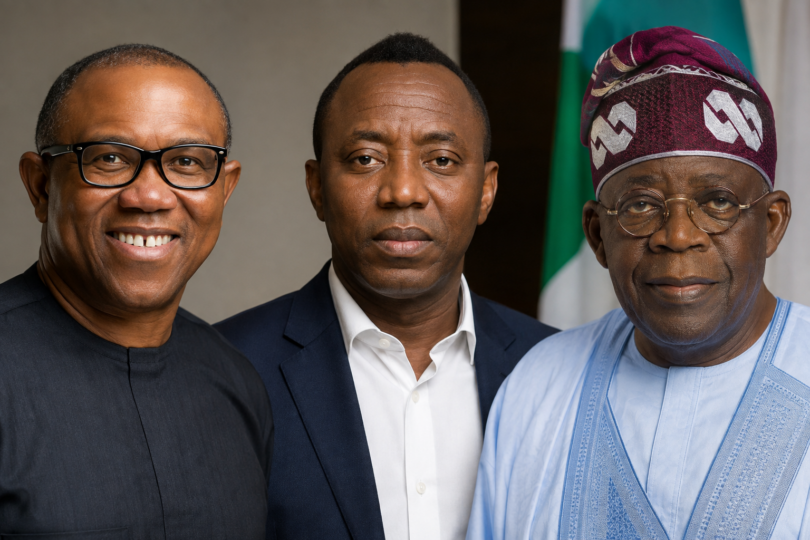
The ceremony, held at the International Conference Centre, brought together representatives of several political parties and presidential candidates, including the presidential candidate of the Nigeria Democratic Congress (NDC), Peter Obi; the African Action Congress (AAC) candidate, Omoyele Sowore; and the Social Democratic Party (SDP) candidate, Adewole Adebayo.
The Independent National Electoral Commission’s (INEC) timetable for the 2027 general elections sets Wednesday, 19 August 2026, as the commencement date for campaigns for the presidential and National Assembly elections, making Tuesday’s signing the final major peace-building activity before formal electioneering begins.
President Bola Tinubu, the presidential candidate of the All Progressives Congress (APC), was absent and was represented by the Secretary to the Government of the Federation, George Akume. The APC National Chairman, Nentawe Yilwatda, also signed the accord.
The presidential candidate of the African Democratic Congress (ADC), Atiku Abubakar, was also not present at the event.
Other political parties represented at the ceremony included the Labour Party, Democratic Leadership Alliance, National Democratic Party, National Rescue Movement, SDP, Youth Party, Young Progressives Party and Zenith Labour Party, among others.
The accord was presented by the organisers as a commitment by political actors to uphold the Constitution, the Electoral Act, guidelines issued by INEC and other laws regulating elections.
The National Peace Committee has facilitated similar agreements during previous election cycles as part of efforts to prevent electoral competition from escalating into violence and other forms of political conflict.
Representing Mr Tinubu, Mr Akume said the peace accord was an opportunity for political parties and candidates to reaffirm their commitment to peaceful and transparent elections.
He commended members of the NPC, particularly Mr Abubakar, the Sultan of Sokoto and Bishop Matthew Kukah, for sustaining the peace initiative since 2014.
Mr Akume said Nigeria’s electoral process had recorded improvements through the use of technology, citing the permanent voter cards and the Bimodal Voter Accreditation System (BVAS) as measures that had strengthened the integrity of elections.
He also pointed to the governorship elections held in Anambra, Ekiti and Osun states between October 2025 and August 2026, saying the different outcomes demonstrated that political parties could win elections through the electoral process.
According to him, transparent elections would reduce disputes and strengthen confidence in democratic institutions.
Mr Akume urged political parties to campaign on policies and avoid exploiting ethnic and religious divisions for electoral advantage.
“Let us campaign on superior ideas. Let us debate issues and promote the best policies to expand opportunities for our people,” he said.
He said the APC rejected violence, hate speech, misinformation, including misinformation generated or amplified through artificial intelligence, and incitement on social media.
“Win or lose, our country, Nigeria, must be the ultimate winner,” he said.
While the agreement was presented as a commitment to peaceful elections, Mr Sowore expressed scepticism about its ability to prevent electoral violence.
Speaking to journalists after the ceremony, he described the signing as a “ritual,” arguing that previous peace agreements had not stopped violence during elections.
Mr Sowore specifically referred to the violence and deaths recorded during the 15 August Osun State governorship election.
“I don’t have faith in it. I’m bringing faith to the system. Those are two different things,” he said.
The AAC candidate argued that signing an agreement without consequences for violations would have little impact.
He called for the introduction of what he described as a “Justice Accord,” under which candidates and political parties that breach the peace agreement would face sanctions.
According to him, previous signatories had gone on to participate in violent activities despite their commitments.
Mr Obi also questioned the need for politicians to sign a peace agreement, saying candidates seeking public office should demonstrate responsible conduct without being compelled to do so.
The former Anambra State governor urged voters to punish politicians who violate their commitments by voting them out of office.
Asked what sanction should apply to a candidate or party that breached the agreement, Mr Obi said: “The punishment is that Nigerians should not vote for them.”
He said politicians seeking executive office should conduct themselves in a manner worthy of the positions they aspire to occupy.
“You can’t answer ‘His Excellency’ without being an excellent person,” he said.